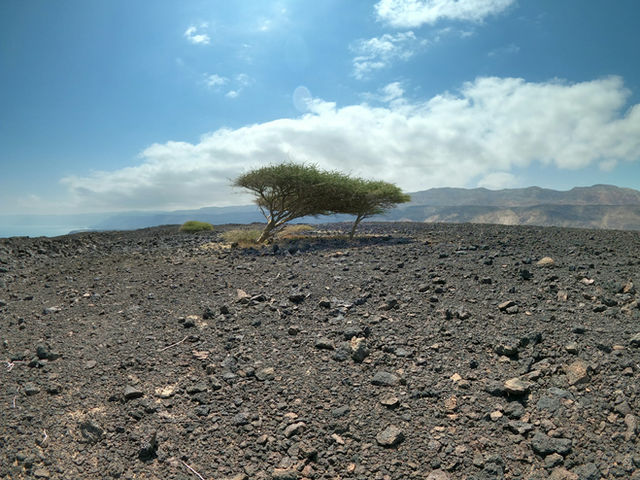
Djibouti — hero
← All destinations Country

Djibouti

Earth's most otherworldly corner. Djibouti serves up alien salt lakes, shark-whale encounters and Red Sea diving — Africa's best-kept adventure secret, hiding in plain sight.

  • Currency Fr Djiboutian Franc (Fr)
  • Language Arabic, French
  • Best time October – February
  • Visa Visa required — e-visa online before travel, or visa on arrival paid in US-dollar cash; onward-travel proof needed
Why visit

Why Djibouti

Earth's most otherworldly corner. Djibouti serves up alien salt lakes, shark-whale encounters and Red Sea diving — Africa's best-kept adventure secret, hiding in plain sight.

  • Lake Assal, Africa's lowest point and a blinding-white salt lake
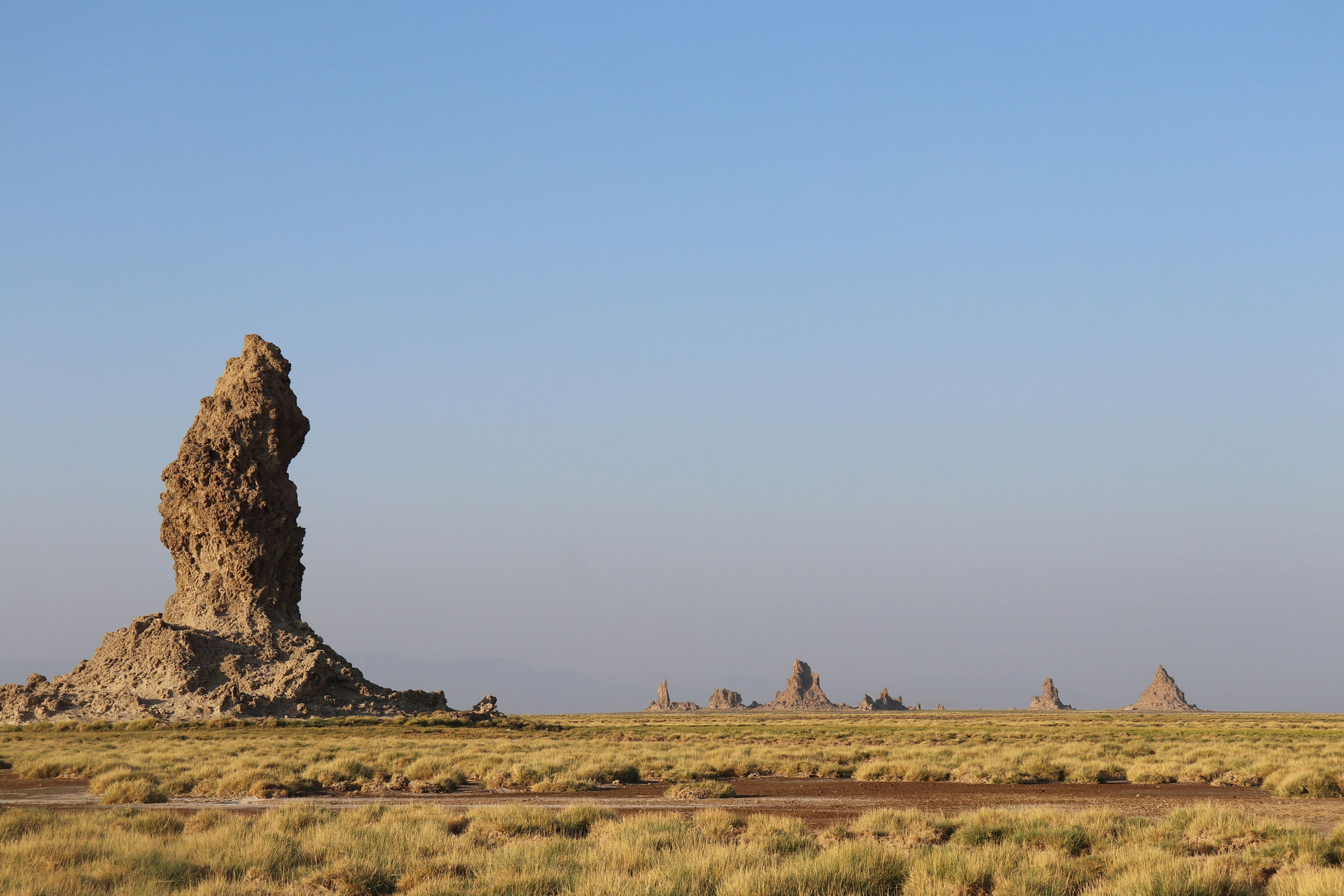
  • The otherworldly limestone chimneys of Lake Abbé at dawn
  • Snorkelling with whale sharks in the Gulf of Tadjoura (Nov–Feb)
  • Diving the Red Sea reefs and the highlands of Day Forest National Park
Read more

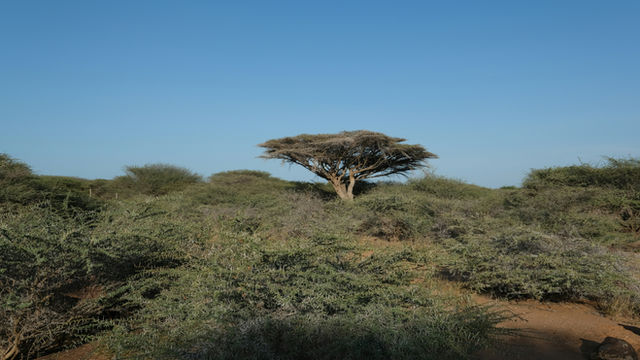
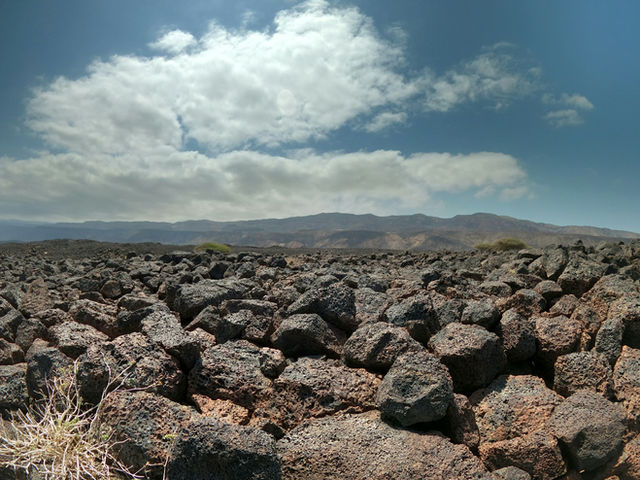
Tiny but extraordinary, Djibouti punches far above its weight for the soft adventure traveller seeking something genuinely uncrowded. Swim alongside whale sharks in the Gulf of Tadjoura, snorkel crystal-clear Red Sea reefs, and hike the volcanic moonscapes surrounding Lake Assal — Africa's lowest point and one of the saltiest bodies of water on Earth.

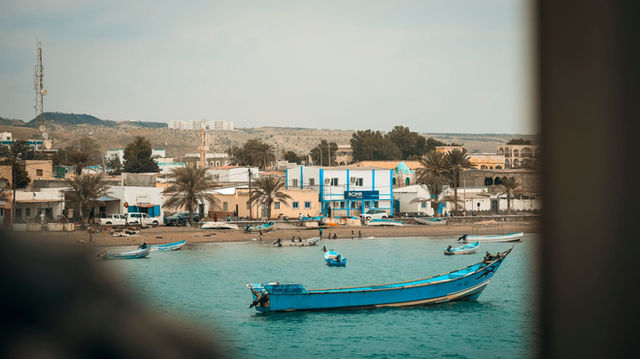
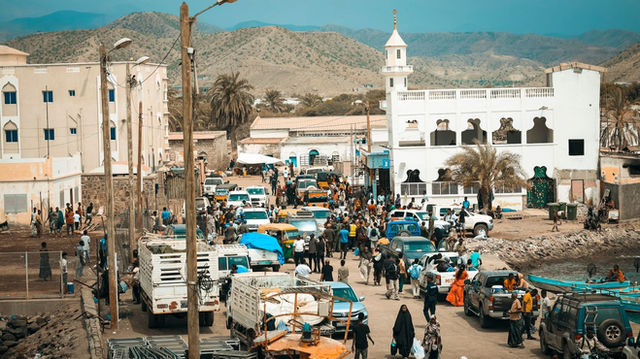
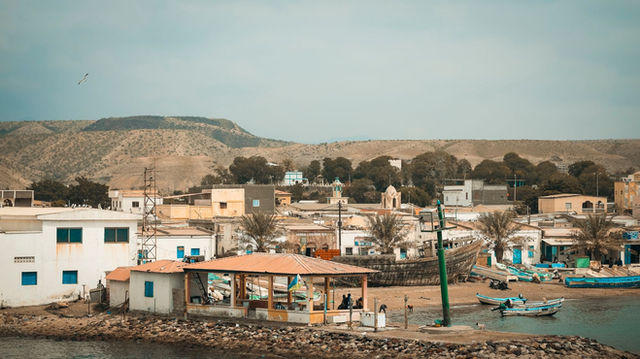
This is a compelling dupe destination for travellers drawn to Ethiopia or Eritrea but craving easier access and smoother logistics. Djibouti City's compact, walkable centre blends French colonial architecture with vibrant Somali and Afar market culture — a rare, community-led cultural immersion well off the tourist trail.

With a stable infrastructure and a surprisingly connected international airport serving Europe directly, Djibouti rewards the curious family or experiential traveller willing to swap the predictable for the planet's most surreal landscapes.

A pillar, not a footnote

Eat your way through Djibouti

The single reason many travellers come back — the food culture worth reshaping a trip around, and the dishes to seek out region by region.

Djibouti

A Somali-Afar-Yemeni crossroads on the Red Sea, where spiced lamb-and-rice stew meets the French baguette.

Djibouti eats at a crossroads. The national dish is skoudehkaris, lamb and rice slow-cooked with cardamom and cinnamon until the spice perfumes the whole pot — Yemeni, Somali and Afar cooking folded into one plate. Beside it comes fah-fah, a fiery goat or camel stew you scoop up with torn pieces of spongy lahoh pancake.

The Red Sea does the rest — grilled fish landed that morning along the coast. And then, unmistakably, France: baguettes and pavement cafés in Djibouti City, a colonial habit that never left. Afternoons slow right down for khat, the mildly narcotic leaf chewed in shaded rooms while the heat passes, glasses of strong spiced shaah tea poured alongside. A small country with a lot of flavours crossing through it.

Dishes to seek out
  • Skoudehkaris (spiced lamb-and-rice stew)
  • Fah-fah (spicy goat or camel stew)
  • Lahoh (spongy fermented flatbread)
  • Sabayad (flaky layered flatbread)
  • Grilled Red Sea fish
  • Sambusa (meat samosa)
  • Shaah (spiced tea)
Things to do

Nature, culture & hidden gems

Editorial content coming soon

We're hand-picking the standout places, hidden gems and can't-miss activities in Djibouti. Meanwhile, the cities above are a great starting point.

Plan your trip

Curated Djibouti itineraries

Browse all Djibouti trips →
When to go

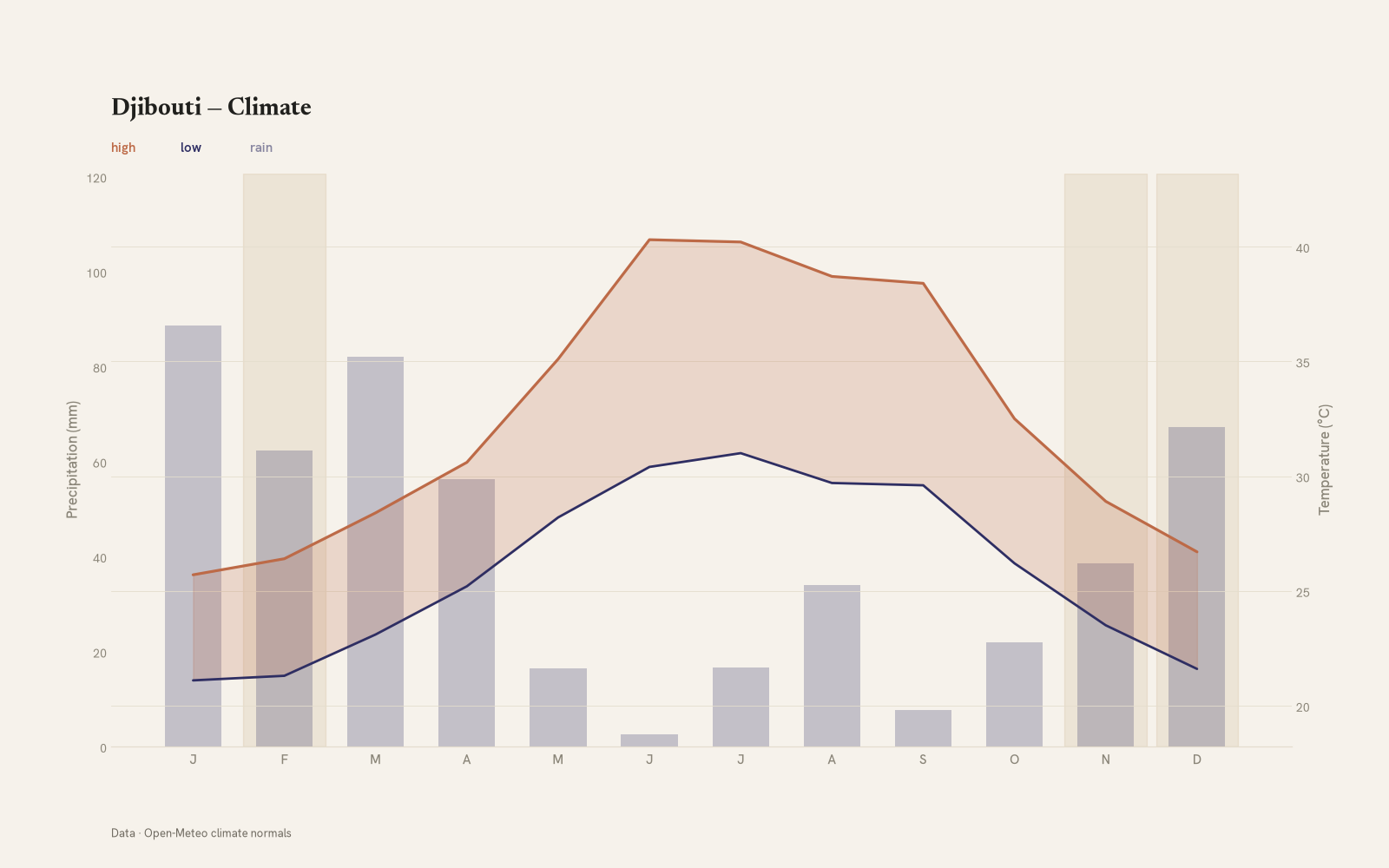
Weather & timing in Djibouti RIGHT NOW 42° clear

Best Feb, Nov–Dec · Shoulder Jan, Apr, Oct

  1. Jan / -4°
  2. Feb / -2°
  3. Mar 12° /
  4. Apr 18° /
  5. May 24° / 14°
  6. Jun 28° / 18°
  7. Jul 30° / 20°
  8. Aug 28° / 18°
  9. Sep 24° / 14°
  10. Oct 18° /
  11. Nov 12° /
  12. Dec / -2°

Best time to visit

October – February

Best for
  • Culture
  • Cuisine
  • Landscape
  • History
At a glance
Sunshine 7 hr/day (est.)
Rain days 8 days/mo (est.)
Wettest December · 60mm
Driest June · 10mm
Part of East Africa →
By season
Spring (Mar–May)

What to expect — Daytime highs average about 18°C with overnight lows near 8°C, and it stays largely dry.

What's best — Apr is comfortable, with thinner crowds.

Summer (Jun–Aug)

What to expect — Daytime highs average about 29°C with overnight lows near 19°C, and it stays largely dry.

What's best — Peak heat and the biggest crowds — many travellers prefer spring or autumn.

Autumn (Sep–Nov)

What to expect — Daytime highs average about 18°C with overnight lows near 8°C.

What's best — Nov is among the best time to visit — good weather with manageable crowds. Oct also works well.

Winter (Dec–Feb)

What to expect — Daytime highs average about 7°C with overnight lows near -3°C.

What's best — Dec and Feb are among the best time to visit — good weather with manageable crowds. Jan also works well.

A little context

A little history

To read what you're looking at — the empires and eras that shaped Djibouti's food, art and streets.

Afar and Somali (Issa) peoples astride ancient Red Sea trade routes, Islamised early through nearby Zeila and Tadjoura — giving a Muslim, Afar-Somali culture and cuisine — held by France as French Somaliland from 1888, later the French Territory of the Afars and the Issas, leaving French official and café culture in the capital — independent on 27 June 1977, the Horn's newest state — and commanding the Bab-el-Mandeb strait, which turned it into a port-and-transit economy hosting foreign military bases, while a stark landscape of salt lakes and rift geology (Lake Assal, Lake Abbe) built a tourism of volcanic scenery rather than green wilderness.
Before you book

Know before you go

The practical back-matter — safety, drones and the essentials, in one place.

Safety

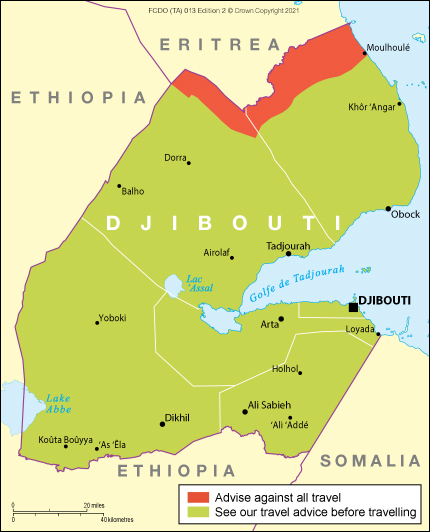
Moderate — check FCDO advice FCDO advice →

Official UK Foreign, Commonwealth & Development Office guidance is the definitive source — check it close to your travel dates.

Drone rules (sub-250g)

  • Djibouti
    Effectively a no for visitors: Djibouti has no drone law, no tourist registration and no sanctioned way to fly, and the country bristles with foreign military bases — flying unauthorised risks seizure or far worse. Treat it as off-limits and ask ACAM first. ⚠ Effectively the whole country is sensitive — the airport, port and the many military installations (Camp Lemonnier, French, Chinese and Japanese bases) are strict no-fly, and the FCDO advise-against-travel Djibouti–Eritrea border zone is off-limits. Rules checked: Jul 2026

National parks, protected sites and religious/heritage venues often have their own rules and permits — always check the specific site before you fly.

The essentials

Plug & voltage Type C/E · 220V
Daily budget Expensive (high prices, little competition)
Region Eastern Africa