Equatorial Guinea — hero
← All destinations Country

Equatorial Guinea

Africa's best-kept secret: volcanic islands, ancient rainforest and Gulf of Guinea beaches with almost no crowds. Equatorial Guinea rewards the genuinely curious.

  • Currency Fr Central African Cfa Franc (Fr)
  • Language French, Portuguese, Spanish
  • Best time November – April
  • Visa Visa required — e-visa online (~72h) or London embassy; historically one of Africa's hardest visas
Why visit

Why Equatorial Guinea

Africa's best-kept secret: volcanic islands, ancient rainforest and Gulf of Guinea beaches with almost no crowds. Equatorial Guinea rewards the genuinely curious.

  • Malabo — Spanish colonial old town and cathedral on volcanic Bioko island
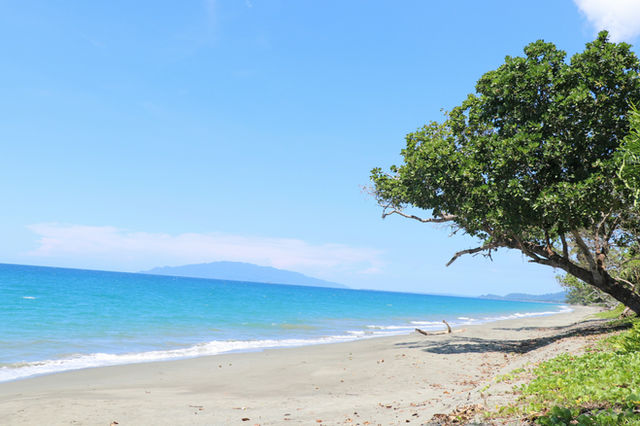
  • Bioko Island — Pico Basilé volcano, turtle-nesting beaches and rare drill monkeys
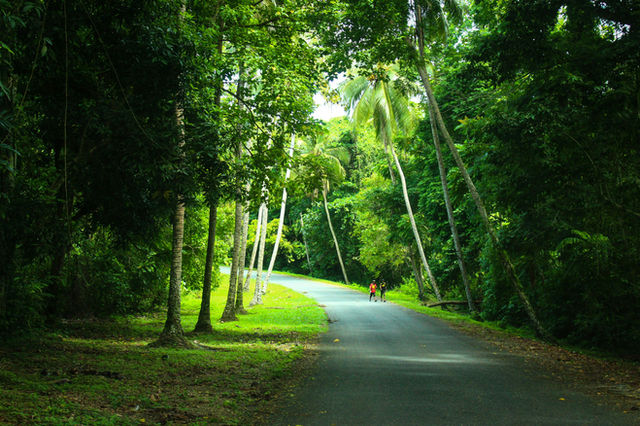
  • Monte Alén National Park — mainland rainforest with gorillas, elephants and chimpanzees
  • Bata — the mainland's coastal city and waterfront promenade
Read more

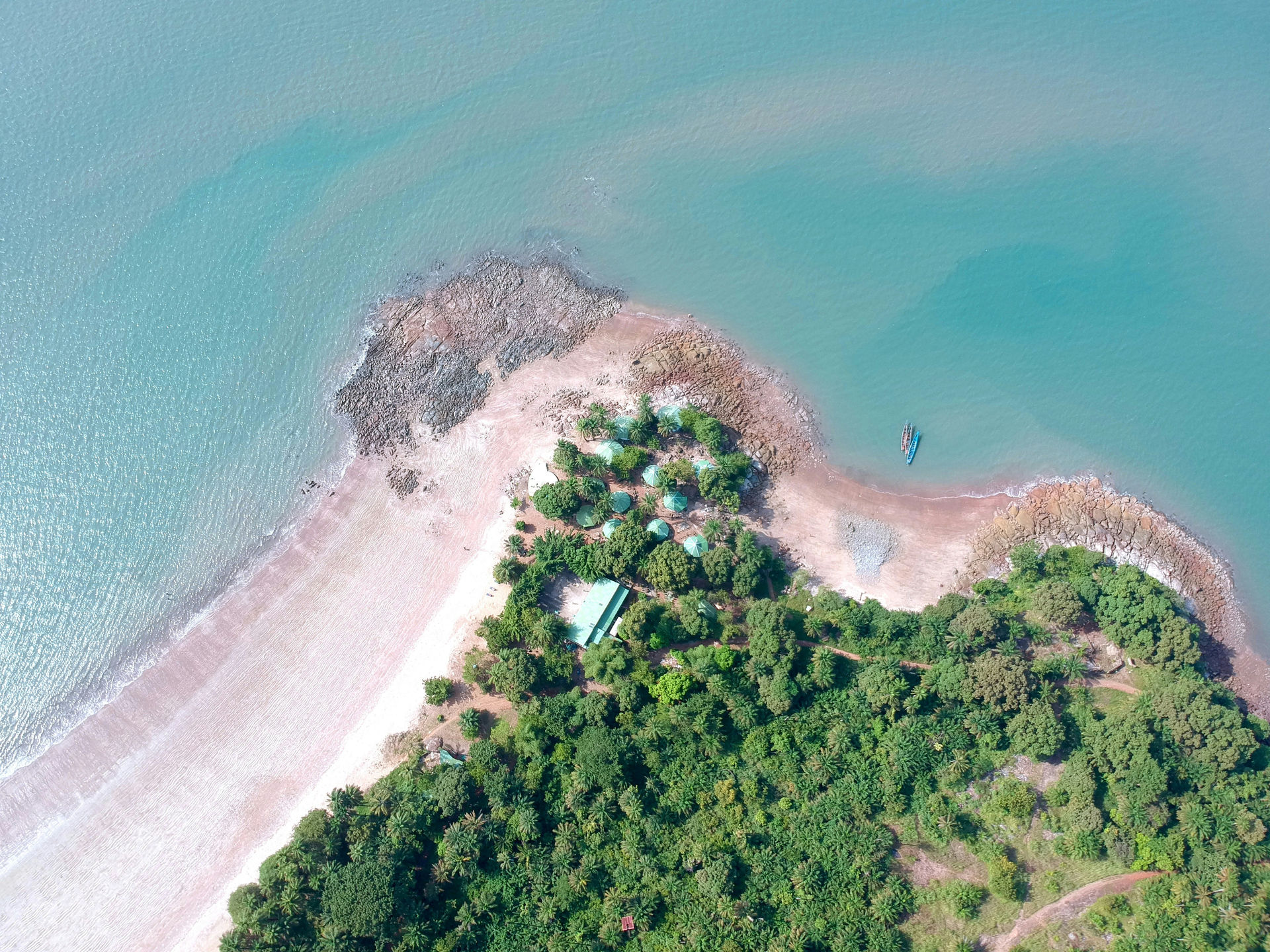
Equatorial Guinea is one of Africa's most overlooked destinations — a compact country split between a lush mainland and the dramatic volcanic island of Bioko, where mist-shrouded peaks plunge straight to black-sand beaches. The sheer absence of tourist infrastructure is, paradoxically, its greatest asset for travellers craving raw authenticity.

Bioko's rainforests harbour rare endemic primates — including drills and several endangered monkey species — making it a quietly extraordinary destination for community-led wildlife conservation experiences. Local research stations welcome engaged visitors, blending soft adventure with genuine purpose.

Malabo, the island capital, carries faded Spanish colonial architecture and a lively waterfront energy, while the mainland enclave of Mbini opens doors to dense Congo Basin rainforest almost entirely untouched by mass tourism. For families and experiential travellers willing to venture off the obvious map, this is the real thing.

A pillar, not a footnote

Eat your way through Equatorial Guinea

The single reason many travellers come back — the food culture worth reshaping a trip around, and the dishes to seek out region by region.

Equatorial Guinea

Central Africa's one Spanish-speaking table: chilli fish pepe-soup and Fang forest stews beside a Guinean paella.

Equatorial Guinea is the only Spanish-speaking country in Africa, and its plate is a genuine one-off: Fang forest cooking meeting Iberian habit. The everyday signature is pepe-soup, a fiery chilli-laced fish broth, eaten with cassava, yam or plantain; the Fang staple is bambucha, cassava leaves stewed down with palm kernel.

The Spanish left more than the language. You'll find paella made with chicken or guinea fowl, and fish served con tres salsas, three sauces at once. Bushmeat and antelope, smoked or grilled, are prized in the forest; the coast off Bioko turns to fresh reef fish. Bake ripe bananas with coconut for pudding, pour a cold Guineana beer, and you've a cuisine that exists nowhere else on the continent.

Dishes to seek out
  • Pepe-soup (spicy chilli fish soup)
  • Bambucha (Fang cassava-leaf palm stew)
  • Pescado con tres salsas (fish with three sauces)
  • Succotash (beans
  • corn and vegetable stew)
  • Grilled bushmeat (smoked forest meat)
  • Paella (Guinean-style
  • with chicken)
  • Guineana (local lager)
Things to do

Nature, culture & hidden gems

Editorial content coming soon

We're hand-picking the standout places, hidden gems and can't-miss activities in Equatorial Guinea. Meanwhile, the cities above are a great starting point.

Plan your trip

Curated Equatorial Guinea itineraries

Browse all Equatorial Guinea trips →
When to go

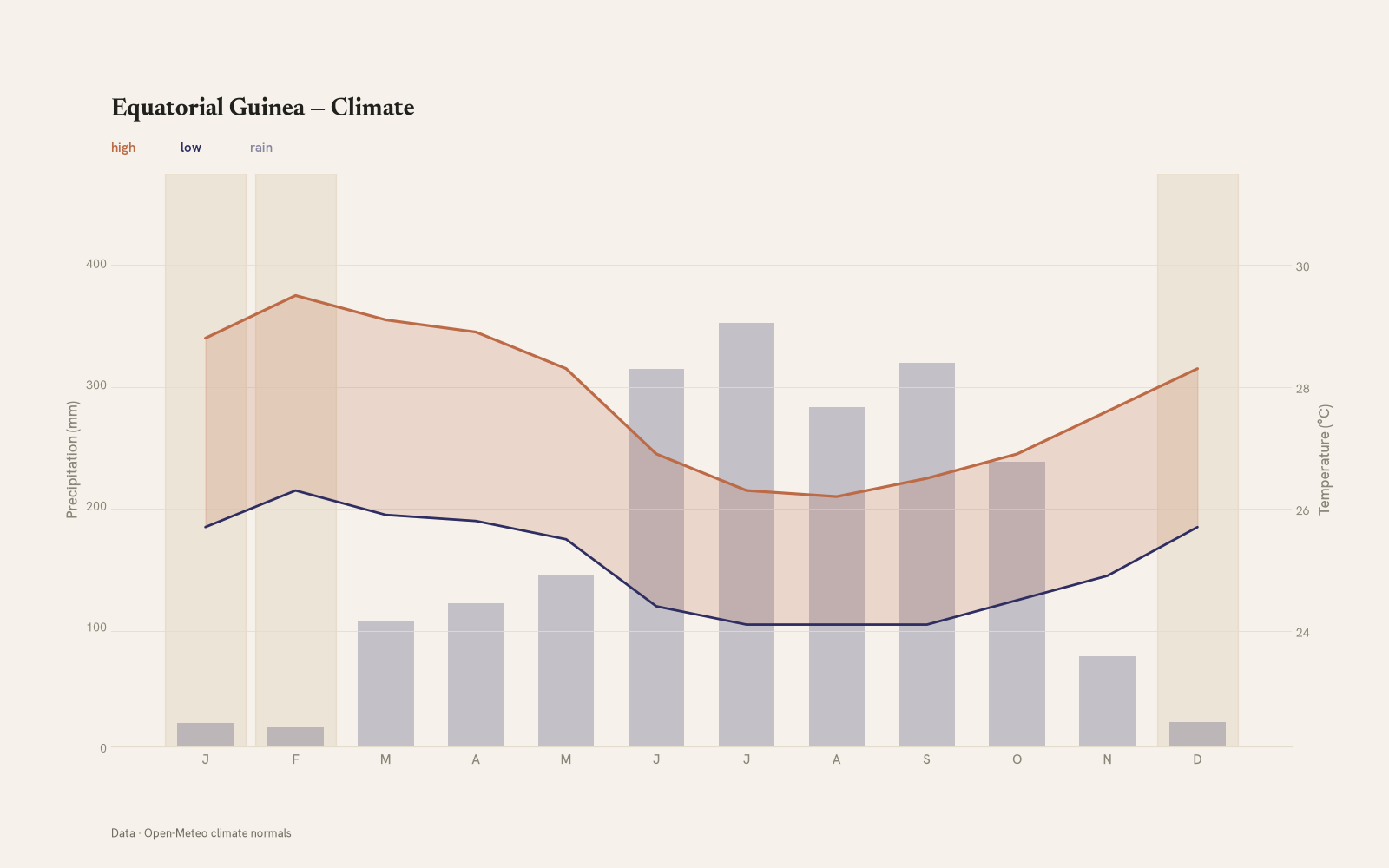
Weather & timing in Equatorial Guinea RIGHT NOW 25° cloudy

Best Dec–Feb · Shoulder Mar–Apr, Nov

  1. Jan / -4°
  2. Feb / -2°
  3. Mar 12° /
  4. Apr 18° /
  5. May 24° / 14°
  6. Jun 28° / 18°
  7. Jul 30° / 20°
  8. Aug 28° / 18°
  9. Sep 24° / 14°
  10. Oct 18° /
  11. Nov 12° /
  12. Dec / -2°

Best time to visit

November – April

Best for
  • Culture
  • Cuisine
  • Landscape
  • History
At a glance
Sunshine 7 hr/day (est.)
Rain days 8 days/mo (est.)
Wettest December · 60mm
Driest June · 10mm
Part of West Africa →
By season
Spring (Mar–May)

What to expect — Daytime highs average about 18°C with overnight lows near 8°C, and it stays largely dry.

What's best — Mar and Apr are comfortable, with thinner crowds.

Summer (Jun–Aug)

What to expect — Daytime highs average about 29°C with overnight lows near 19°C, and it stays largely dry.

What's best — Peak heat and the biggest crowds — many travellers prefer spring or autumn.

Autumn (Sep–Nov)

What to expect — Daytime highs average about 18°C with overnight lows near 8°C.

What's best — Nov is comfortable, with thinner crowds.

Winter (Dec–Feb)

What to expect — Daytime highs average about 7°C with overnight lows near -3°C.

What's best — Dec, Jan and Feb are among the best time to visit — good weather with manageable crowds.

A little context

A little history

To read what you're looking at — the empires and eras that shaped Equatorial Guinea's food, art and streets.

A Fang-populated mainland (Río Muni) and a Bubi-rooted Bioko island — an enduring island/mainland divide — ceded by Portugal to Spain in 1778 and run as 'Spanish Guinea', the only Spanish colony in sub-Saharan Africa, leaving Spanish official and a lasting culinary and architectural legacy — independent on 12 October 1968, after which roughly half the population emigrated to Spain — held through the brutal 1968–79 Macías dictatorship, ended by the 1979 coup that installed Teodoro Obiang, still president and the world's longest-serving head of state — and transformed by mid-1990s offshore oil into a wealthy but tightly controlled, expensive state.
Before you book

Know before you go

The practical back-matter — safety, drones and the essentials, in one place.

Safety

Low risk FCDO advice →

Official UK Foreign, Commonwealth & Development Office guidance is the definitive source — check it close to your travel dates.

Drone rules (sub-250g)

  • Equatorial Guinea
    Do not bring one. Equatorial Guinea has no drone rules and is intensely security-conscious — even photographing an official building is risky — so a foreigner's drone is very likely to be seized at customs, with detention a real possibility. ⚠ Blanket sensitivity around all government, presidential, military, oil, port and airport sites in Malabo and Bata — photography alone is discouraged; the Bioko island parks and any official building are effective no-go zones. Rules checked: Jul 2026

National parks, protected sites and religious/heritage venues often have their own rules and permits — always check the specific site before you fly.

The essentials

Plug & voltage Type C/E · 220V
Daily budget Expensive
Region Middle Africa