Eswatini — hero
← All destinations Country

Eswatini

Africa's hidden kingdom, hiding in plain sight. Eswatini delivers royal culture, big-five wildlife and soft mountain adventure in one compact, crowd-free package.

  • Currency L Swazi Lilangeni (L)
  • Language English, Swazi
  • Best time April – September
  • Visa Visa-free for UK visitors for up to 30 days
Why visit

Why Eswatini

Africa's hidden kingdom, hiding in plain sight. Eswatini delivers royal culture, big-five wildlife and soft mountain adventure in one compact, crowd-free package.

  • The Umhlanga Reed Dance and Incwala royal ceremonies
  • Rhino tracking and big game at Hlane and Mkhaya reserves
  • Mlilwane Wildlife Sanctuary and the Ezulwini 'Valley of Heaven'
  • Swazi craft markets — Ngwenya glass, candles and weaving
Read more

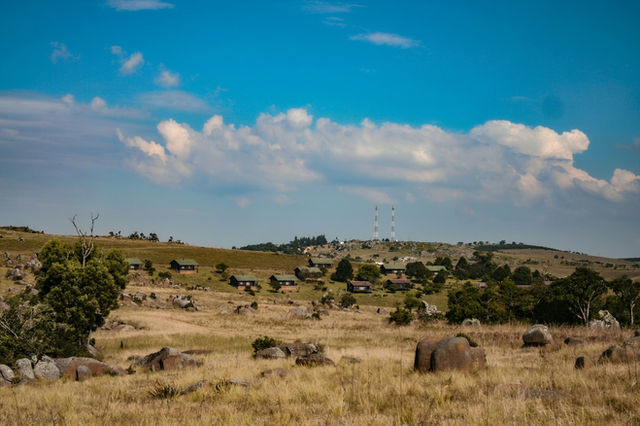
Landlocked between South Africa and Mozambique, Eswatini punches far above its size. Hlane Royal National Park offers genuine big-five encounters without the queues of more famous reserves, making it the definitive dupe destination for families craving authentic safari without the price tag or the crowds.

The kingdom's living culture is its real superpower. The annual Umhlanga Reed Dance and Incwala ceremony are among Africa's most spectacular community-led events — visceral, deeply rooted and genuinely participatory rather than staged for tourists. Craft villages around Malkerns invite travellers to slow down, connect with local artisans and bring home something that actually means something.

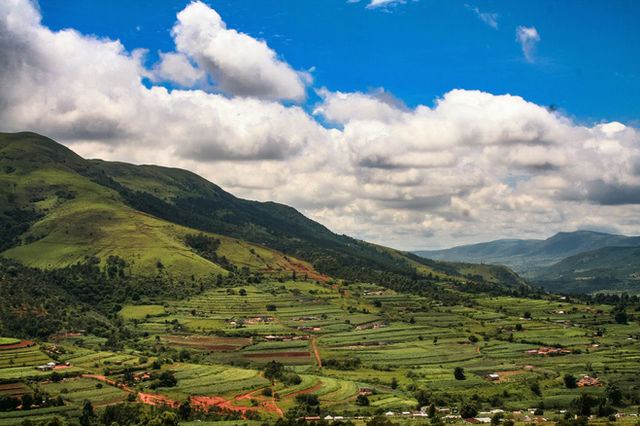
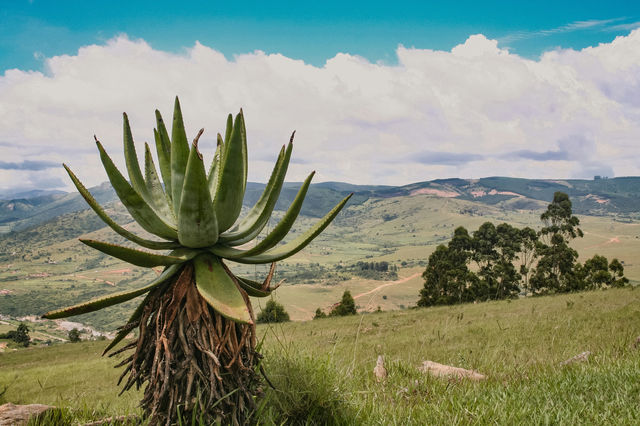
The Malolotja Nature Reserve rewards hikers and mountain-bikers with dramatic highveld scenery and one of Africa's longest zip-lines, while cosy lodges along the Ezulwini Valley make the perfect unhurried base for families stretching a southern Africa circuit into a meaningful, mindful adventure.

A pillar, not a footnote

Eat your way through Eswatini

The single reason many travellers come back — the food culture worth reshaping a trip around, and the dishes to seek out region by region.

Eswatini

Maize, sour milk and roadside 'chicken dust' — and marula fruit brewed into the King's own festival wine.

Eswatini eats close to the land. The everyday plate is maize — sishwala, a thick porridge — eaten with beans, groundnut-stewed pumpkin leaves and a pour of emasi, tart cultured sour milk that is the defining flavour of a Swazi meal. For something quick, follow the smoke to 'chicken dust', chicken grilled at a roadside stall in a haze of charcoal, served with pap and salad.

The real story, though, is marula. Each late summer the tree's small yellow fruit is brewed into buganu, a tangy country wine, and the harvest becomes a royal ceremony in which the women present the first brew to the King. Pair that with the Umhlanga Reed Dance and you see how, in this tiny kingdom, food and ritual are the same thing. The dishes echo Zulu tradition; the ceremonies are pure Swazi.

Dishes to seek out
  • Sishwala / pap (thick maize porridge)
  • Emasi (cultured sour milk)
  • Chicken dust (roadside grilled chicken)
  • Sidvudvu (pumpkin-and-maize porridge)
  • Umbidvo wetintsanga (pumpkin leaves with groundnuts)
  • Umncweba (dried raw meat)
  • Buganu (marula fruit wine)
Things to do

Nature, culture & hidden gems

Editorial content coming soon

We're hand-picking the standout places, hidden gems and can't-miss activities in Eswatini. Meanwhile, the cities above are a great starting point.

Plan your trip

Curated Eswatini itineraries

Browse all Eswatini trips →
When to go

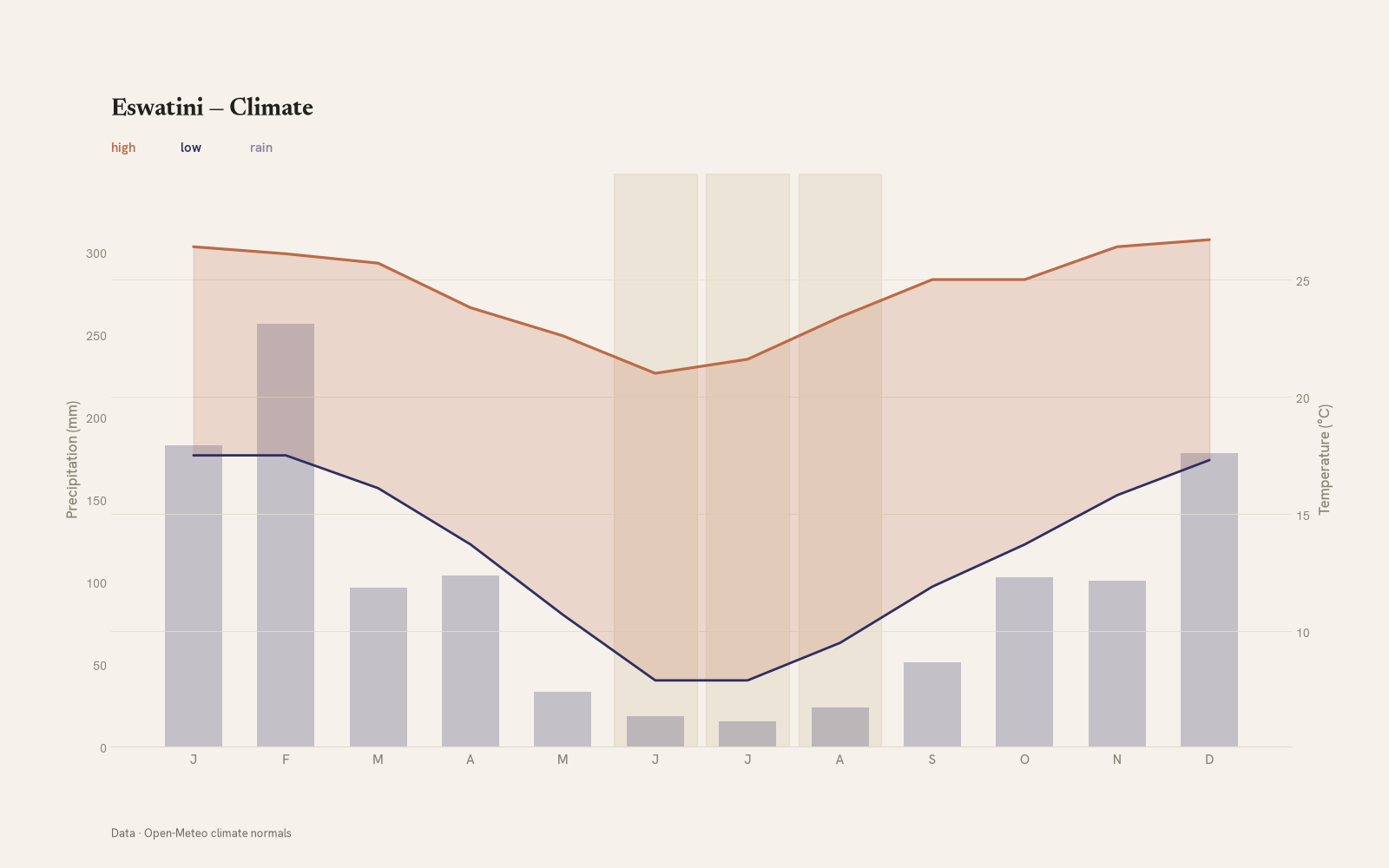
Weather & timing in Eswatini RIGHT NOW 22° clear

Best Jun–Aug · Shoulder Apr–May, Sep

  1. Jan / -4°
  2. Feb / -2°
  3. Mar 12° /
  4. Apr 18° /
  5. May 24° / 14°
  6. Jun 28° / 18°
  7. Jul 30° / 20°
  8. Aug 28° / 18°
  9. Sep 24° / 14°
  10. Oct 18° /
  11. Nov 12° /
  12. Dec / -2°

Best time to visit

April – September

Best for
  • Culture
  • Cuisine
  • Landscape
  • History
At a glance
Sunshine 7 hr/day (est.)
Rain days 8 days/mo (est.)
Wettest December · 60mm
Driest June · 10mm
Part of Southern Africa →
By season
Spring (Mar–May)

What to expect — Daytime highs average about 18°C with overnight lows near 8°C, and it stays largely dry.

What's best — Apr and May are comfortable, with thinner crowds.

Summer (Jun–Aug)

What to expect — Daytime highs average about 29°C with overnight lows near 19°C, and it stays largely dry.

What's best — Jun, Jul and Aug are among the best time to visit — good weather with manageable crowds.

Autumn (Sep–Nov)

What to expect — Daytime highs average about 18°C with overnight lows near 8°C.

What's best — Sep is comfortable, with thinner crowds.

Winter (Dec–Feb)

What to expect — Daytime highs average about 7°C with overnight lows near -3°C.

What's best — Cold and quiet; some mountain roads and sights run reduced hours.

A little context

A little history

To read what you're looking at — the empires and eras that shaped Eswatini's food, art and streets.

The Swazi (Dlamini) nation coalesced in the early 19th century as Nguni clans consolidated under Sobhuza I and Mswati II, whom the nation is named after — forging the strong centralised monarchy that still governs national life — made a British protectorate in 1903, which preserved the crown through indirect rule — independent as the Kingdom of Swaziland on 6 September 1968 — turned absolute in 1973 when Sobhuza II repealed the constitution and banned parties, still Africa's last absolute monarchy — and renamed Eswatini by Mswati III in 2018, reasserting a precolonial identity whose royal festivals, the Umhlanga Reed Dance and Incwala, remain the country's signature draw.
Before you book

Know before you go

The practical back-matter — safety, drones and the essentials, in one place.

Safety

Low risk FCDO advice →

Official UK Foreign, Commonwealth & Development Office guidance is the definitive source — check it close to your travel dates.

Drone rules (sub-250g)

  • Eswatini
    A real barrier even though flying is allowed: you must secure an import licence from SWACAA before you enter the country with a drone, plus a separate letter of approval to fly — turn up without them and it can be seized, with fines or worse. Arrange both well ahead. ⚠ No flying over towns, roads or power sites; keep clear of Matsapha airport and, above all, royal residences and ceremonial grounds, which are strictly off-limits. Hlane, Mkhaya and Mlilwane reserves set their own rules. Rules checked: Jul 2026

National parks, protected sites and religious/heritage venues often have their own rules and permits — always check the specific site before you fly.

The essentials

Plug & voltage Type M · 230V
Daily budget Budget-friendly to mid-range
Region Southern Africa