Kiribati — hero
← All destinations Country

Kiribati

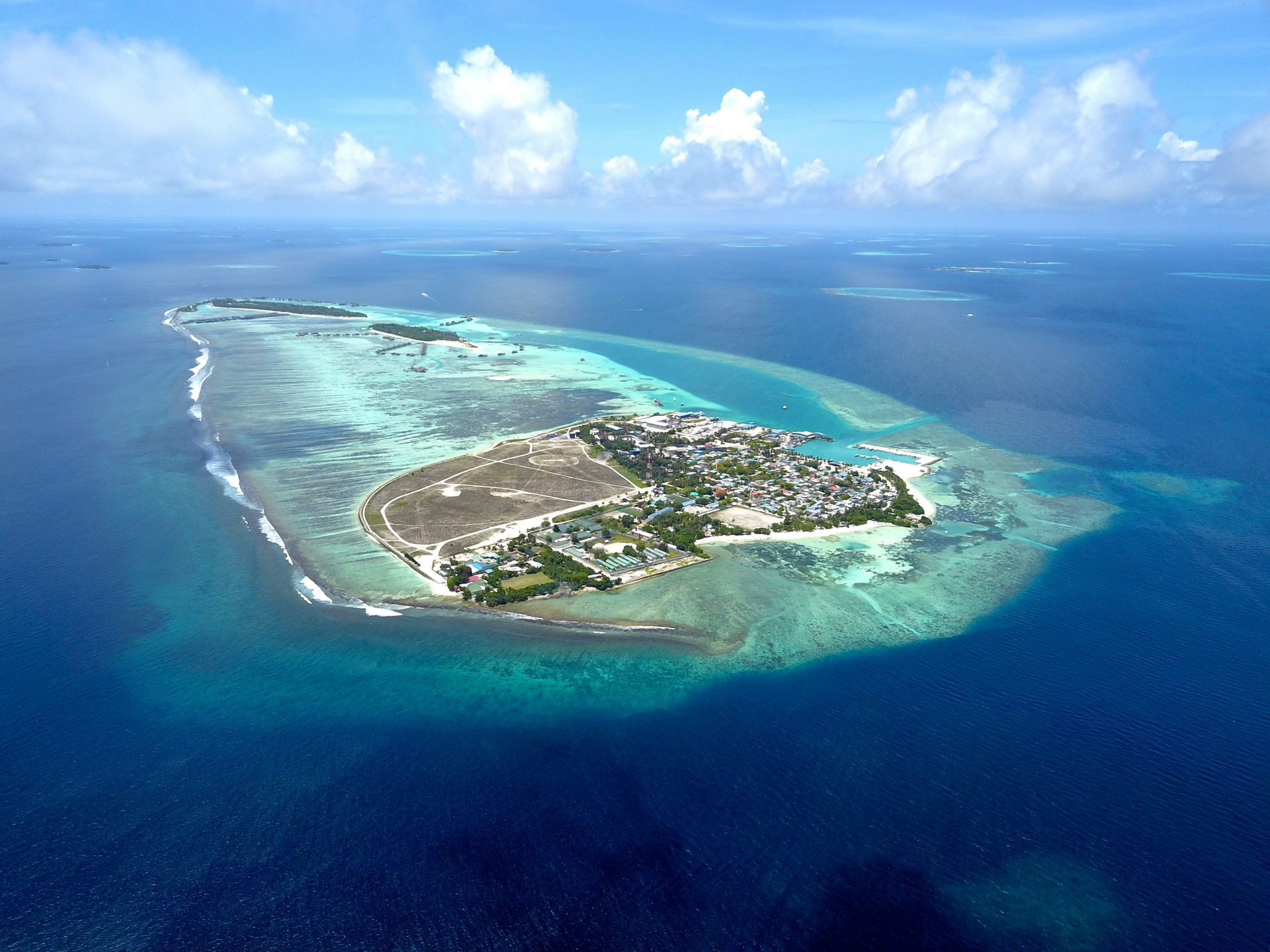
Infinite horizons, zero crowds. Kiribati is the Central Pacific's most purposeful frontier — world-class bonefishing, raw WWII history, and atoll conservation at the edge of the world.

  • Currency $ Australian Dollar ($)
  • Language English, Gilbertese
  • Best time August – November
  • Visa Visa-free (up to 1 month on arrival)
Why visit

Why Kiribati

Infinite horizons, zero crowds. Kiribati is the Central Pacific's most purposeful frontier — world-class bonefishing, raw WWII history, and atoll conservation at the edge of the world.

  • Battle of Tarawa WWII relics on Betio
  • Kiritimati (Christmas Island) bonefishing
  • Kiritimati's vast seabird colonies
  • Remote maneaba atoll life
Read more

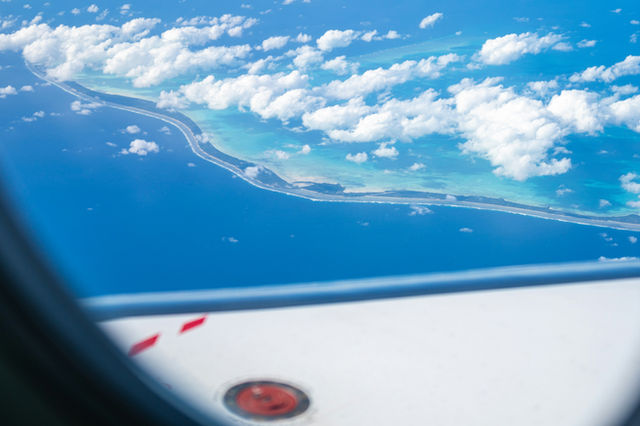
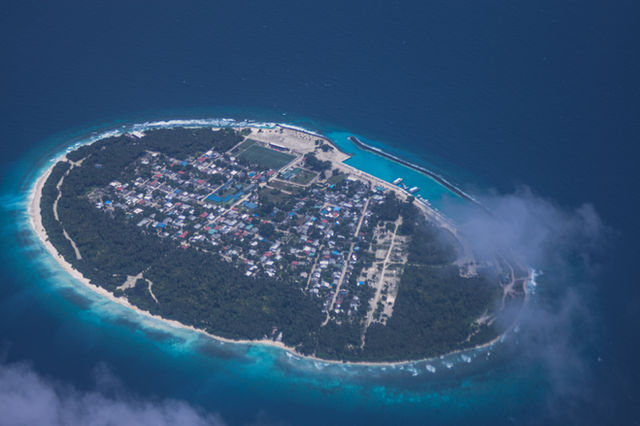
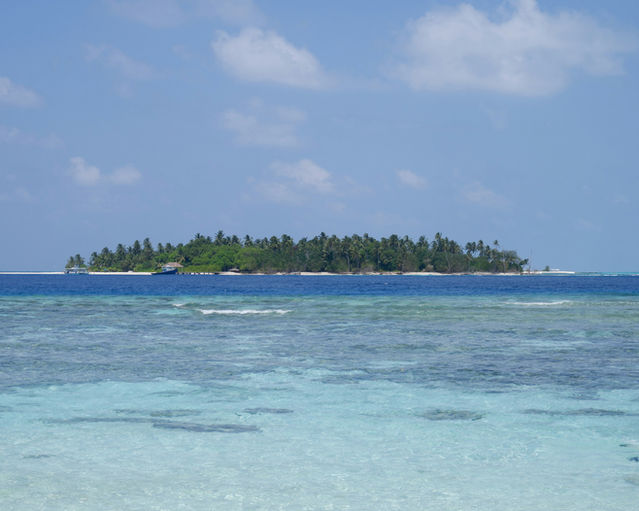
Few destinations demand as much of the traveller — or give back as much in return. Kiribati's scattered atolls span all four hemispheres, from the WWII-scarred lagoons of Tarawa to the bonefish flats of Kiritimati, the world's largest coral atoll. This is the Pacific at its most elemental and unhurried.

With its very existence shaped by climate and sea-level rise, Kiribati has built a regenerative tourism model of rare integrity — visitors join mangrove restoration crews and marine sanctuary monitoring, with every stay directly funding community-led adaptation. Low-volume, high-value access ensures the atolls remain as wild as the horizon.

The Phoenix Islands Protected Area, a vast UNESCO World Heritage marine sanctuary, anchors a growing offer in soft adventure and experiential travel — think deep-water dive sites, traditional seafaring culture, and skies lit by stars undimmed by any city on Earth.

A pillar, not a footnote

Eat your way through Kiribati

The single reason many travellers come back — the food culture worth reshaping a trip around, and the dishes to seek out region by region.

Kiribati

Swamp-taro babai, coconut in everything, and lagoon-fresh sashimi on remote equatorial atolls.

Kiribati is a scatter of low equatorial atolls where salt soil and scarce fresh water make farming brutally hard, so the food comes from the sea and the coconut palm. The prestige crop is babai, giant swamp taro grown for years in hand-dug pits mulched down to the freshwater lens and served at feasts. Around it: reef fish and tuna sashimi minutes out of the lagoon, breadfruit in season, and palusami, taro leaves baked soft in coconut cream in the earth oven — widely called the national dish.

Coconut is the backbone — water to drink, cream in nearly every dish, and sap tapped daily into karewe toddy that's drunk fresh and sweet or aged sour, then boiled into kamaimai syrup poured over rice and babai. Because ships come rarely, imported rice and tinned meat fill the gaps. Eat at a maneaba feast of umu-cooked palusami and reef fish, and you've tasted a genuinely far-flung corner of the world.

Dishes to seek out
  • Palusami (taro leaves in coconut cream)
  • Te babai (giant swamp taro)
  • Ika mata (coconut-cured raw fish)
  • Reef fish and sashimi
  • Te bua toro ni baraki (baked swamp-taro cake)
  • Kamaimai (coconut-toddy syrup)
  • Karewe (coconut toddy)
Things to do

Nature, culture & hidden gems

Editorial content coming soon

We're hand-picking the standout places, hidden gems and can't-miss activities in Kiribati. Meanwhile, the cities above are a great starting point.

Plan your trip

Curated Kiribati itineraries

Browse all Kiribati trips →
When to go

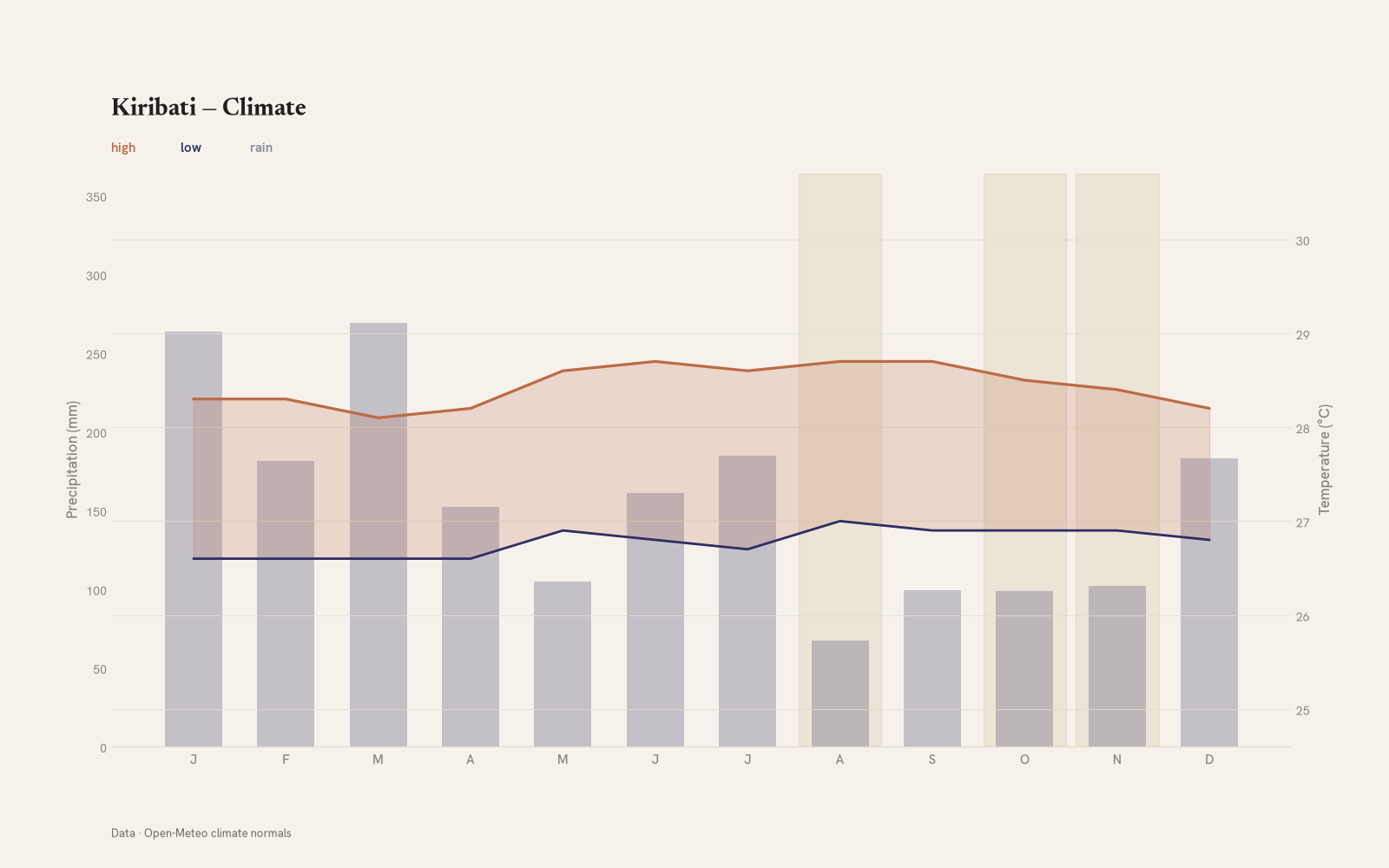
Weather & timing in Kiribati RIGHT NOW 29° mostly clear

Best Aug, Oct–Nov · Shoulder Apr–May, Sep

  1. Jan / -4°
  2. Feb / -2°
  3. Mar 12° /
  4. Apr 18° /
  5. May 24° / 14°
  6. Jun 28° / 18°
  7. Jul 30° / 20°
  8. Aug 28° / 18°
  9. Sep 24° / 14°
  10. Oct 18° /
  11. Nov 12° /
  12. Dec / -2°

Best time to visit

August – November

Best for
  • Culture
  • Cuisine
  • Landscape
  • History
At a glance
Sunshine 7 hr/day (est.)
Rain days 8 days/mo (est.)
Wettest December · 60mm
Driest June · 10mm
Part of Pacific Islands →
By season
Spring (Mar–May)

What to expect — Daytime highs average about 18°C with overnight lows near 8°C, and it stays largely dry.

What's best — Apr and May are comfortable, with thinner crowds.

Summer (Jun–Aug)

What to expect — Daytime highs average about 29°C with overnight lows near 19°C, and it stays largely dry.

What's best — Aug is among the best time to visit — good weather with manageable crowds.

Autumn (Sep–Nov)

What to expect — Daytime highs average about 18°C with overnight lows near 8°C.

What's best — Oct and Nov are among the best time to visit — good weather with manageable crowds. Sep also works well.

Winter (Dec–Feb)

What to expect — Daytime highs average about 7°C with overnight lows near -3°C.

What's best — Cold and quiet; some mountain roads and sights run reduced hours.

A little context

A little history

To read what you're looking at — the empires and eras that shaped Kiribati's food, art and streets.

Micronesian voyagers settled the Gilbert Islands around 3,000 years ago, building master navigation and the open-sided maneaba at the heart of village life
a British protectorate from 1892, joined with the Ellice Islands as a colony from 1916
the November 1943 Battle of Tarawa was among the Pacific War's bloodiest, leaving bunkers and wrecks on Betio
the Ellice Islands split off as Tuvalu in 1975; Kiribati became independent in 1979
its atolls reach all four hemispheres, and rising seas now make it a climate frontline
Before you book

Know before you go

The practical back-matter — safety, drones and the essentials, in one place.

Safety

Low risk FCDO advice →

Official UK Foreign, Commonwealth & Development Office guidance is the definitive source — check it close to your travel dates.

Drone rules (sub-250g)

  • Kiribati
    Kiribati has no published drone law; oversight sits with the Directorate of Civil Aviation, commercial flights reportedly need a permit, and guidance suggests foreign-visitor flights aren't permitted — seek written permission before flying. ⚠ Sparse and uncertain: there's no official registration portal or no-fly map, and at least one tracker states visitor flights are 'not allowed'. Keep clear of Bonriki and Cassidy airports and government sites, and confirm permission directly with the Directorate of Civil Aviation first. Rules checked: Jul 2026

National parks, protected sites and religious/heritage venues often have their own rules and permits — always check the specific site before you fly.

The essentials

Plug & voltage Type I · 240V
Daily budget Expensive
Region Micronesia