Marshall Islands — hero
← All destinations Country

Marshall Islands

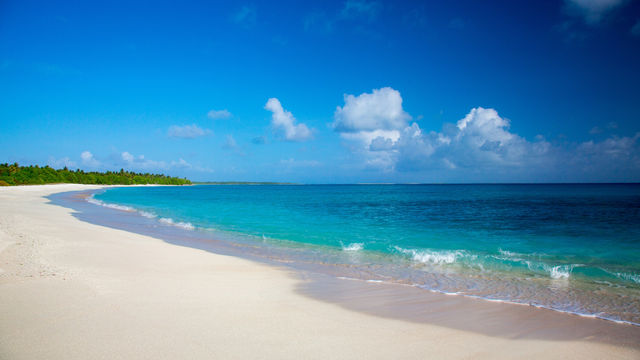
Remote Pacific atolls where turquoise lagoons meet legendary wreck diving. The Marshall Islands are the ultimate off-grid ocean frontier.

  • Currency $ United States Dollar ($)
  • Language English, Marshallese
  • Best time December – March
  • Visa Visa waiver on arrival (up to 90 days)
Why visit

Why Marshall Islands

Remote Pacific atolls where turquoise lagoons meet legendary wreck diving. The Marshall Islands are the ultimate off-grid ocean frontier.

  • Bikini Atoll 'ghost fleet' wreck diving (UNESCO)
  • Thread-thin Majuro atoll
  • WWII battle sites on Kwajalein
  • Remote atoll snorkelling and canoe culture
Read more

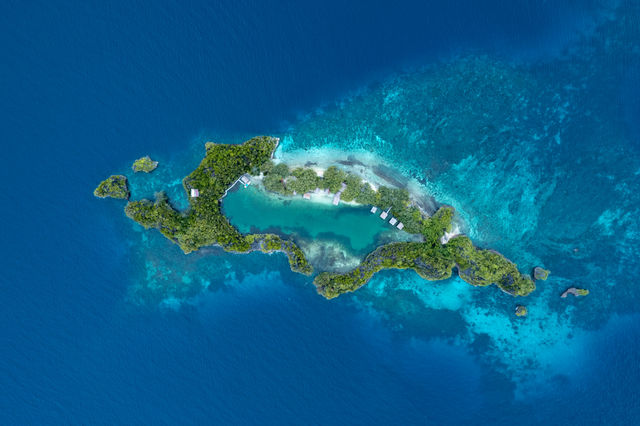
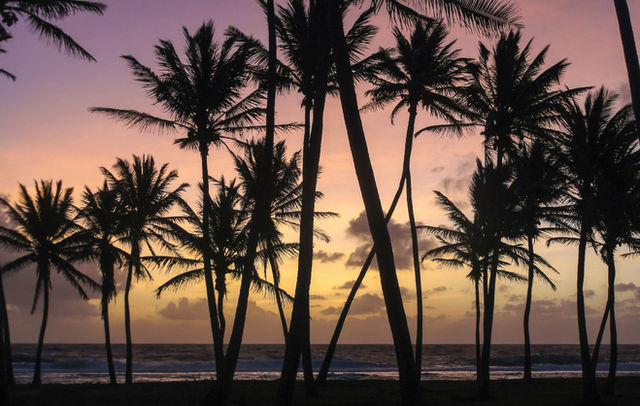
Scattered across the central Pacific, the Marshall Islands are a nation of low-lying coral atolls and shimmering lagoons — one of the planet's most remote and unspoilt ocean destinations.

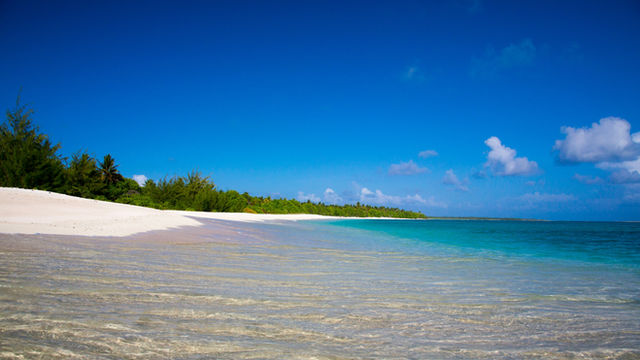
This is a frontier for soft adventure and diving: pristine reefs, some of the world's finest WWII wreck dives at Bikini and Kwajalein, and lagoons so clear the water seems to disappear.

The Marshallese live in intimate connection with the sea, offering travellers a rare, community-led glimpse of traditional Pacific culture — from master canoe-building to navigation by the stars and swell.

A pillar, not a footnote

Eat your way through Marshall Islands

The single reason many travellers come back — the food culture worth reshaping a trip around, and the dishes to seek out region by region.

Marshall Islands

Breadfruit, fermented bwiro and some of the world's most fish-heavy plates on low coral atolls.

Cooking on the Marshall Islands is atoll cooking — thin, sandy soil, no highlands, so the plate is built from the reef and a handful of hardy crops. Marshallese eat some of the highest volumes of fish on earth, reef catch and raw tuna sashimi straight from the lagoon, alongside breadfruit () roasted or baked in the earth oven. The most distinctive dish is bwiro, ripe breadfruit pounded to a paste, wrapped in leaves and fermented for days before baking dense and tangy.

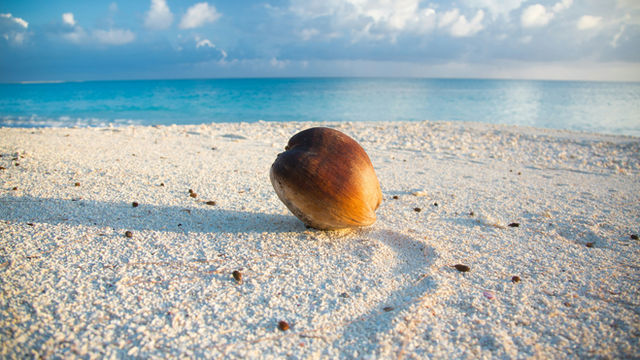
Coconut is total — flesh, milk, water (the national drink) and copra, the cash crop — while chewy orange pandanus keys are sucked for their juice or pressed into cakes that keep for years, drought insurance from leaner times. A century of US influence layered rice, tinned meat and doughnuts onto the everyday table. In Majuro you'll find sashimi and chicken-and-rice; on the outer atolls, you eat what the coconut and breadfruit trees provide.

Dishes to seek out
  • Breadfruit (mā)
  • Reef fish and sashimi
  • Bwiro (fermented breadfruit paste)
  • Pandanus (bōb)
  • Coconut crab and clams
  • Jekaro (coconut-flower sap)
  • Banana doughnuts
Things to do

Nature, culture & hidden gems

Editorial content coming soon

We're hand-picking the standout places, hidden gems and can't-miss activities in Marshall Islands. Meanwhile, the cities above are a great starting point.

Plan your trip

Curated Marshall Islands itineraries

Browse all Marshall Islands trips →
When to go

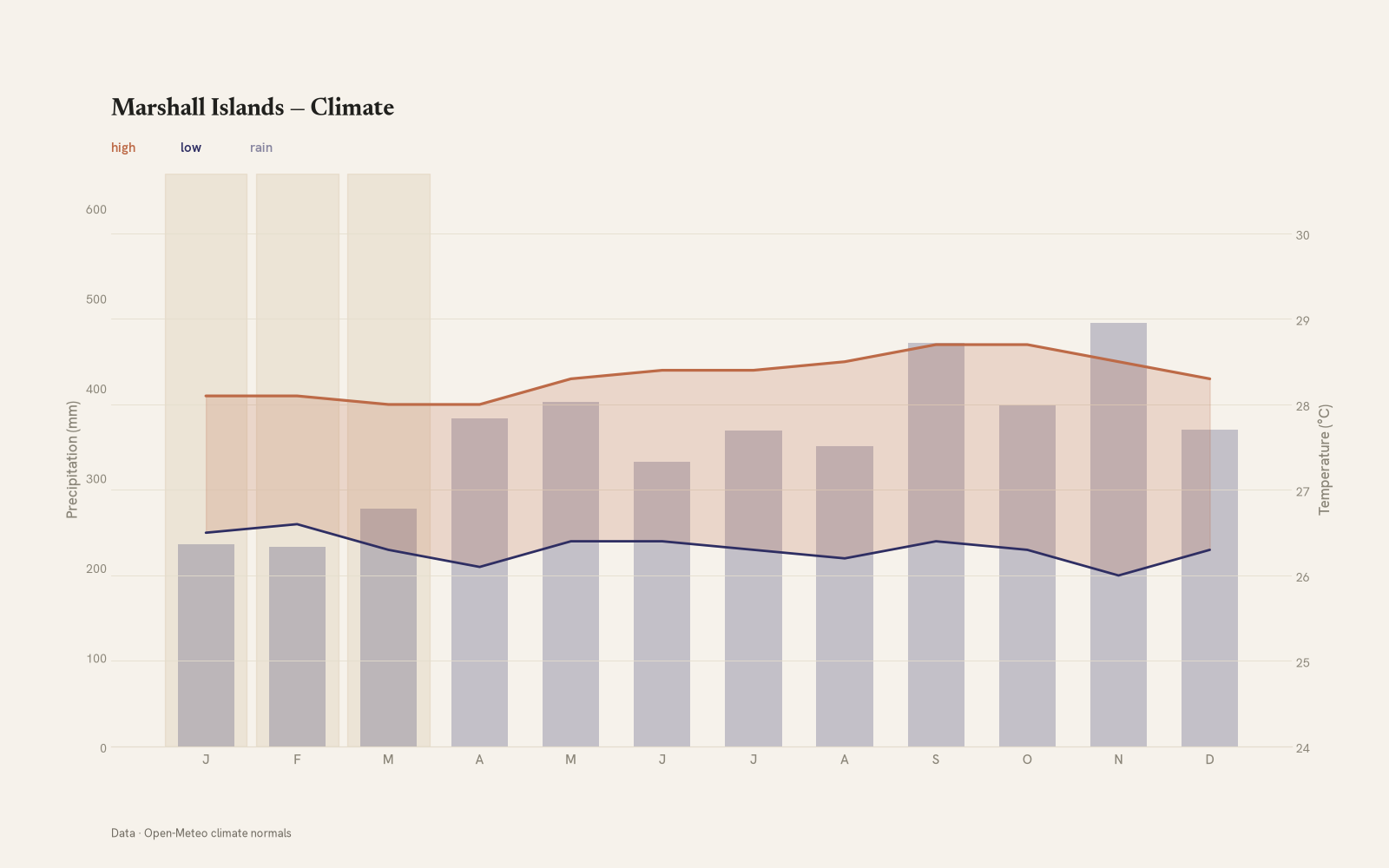
Weather & timing in Marshall Islands RIGHT NOW 27° drizzle

Best Jan–Mar · Shoulder Jun, Aug, Dec

  1. Jan / -4°
  2. Feb / -2°
  3. Mar 12° /
  4. Apr 18° /
  5. May 24° / 14°
  6. Jun 28° / 18°
  7. Jul 30° / 20°
  8. Aug 28° / 18°
  9. Sep 24° / 14°
  10. Oct 18° /
  11. Nov 12° /
  12. Dec / -2°

Best time to visit

December – March

Best for
  • Culture
  • Cuisine
  • Landscape
  • History
At a glance
Sunshine 7 hr/day (est.)
Rain days 8 days/mo (est.)
Wettest December · 60mm
Driest June · 10mm
Part of Pacific Islands →
By season
Spring (Mar–May)

What to expect — Daytime highs average about 18°C with overnight lows near 8°C, and it stays largely dry.

What's best — Mar is among the best time to visit — good weather with manageable crowds.

Summer (Jun–Aug)

What to expect — Daytime highs average about 29°C with overnight lows near 19°C, and it stays largely dry.

What's best — Jun and Aug are comfortable, with thinner crowds.

Autumn (Sep–Nov)

What to expect — Daytime highs average about 18°C with overnight lows near 8°C.

What's best — A quieter, less in-demand window than the shoulder months.

Winter (Dec–Feb)

What to expect — Daytime highs average about 7°C with overnight lows near -3°C.

What's best — Jan and Feb are among the best time to visit — good weather with manageable crowds. Dec also works well.

A little context

A little history

To read what you're looking at — the empires and eras that shaped Marshall Islands's food, art and streets.

Micronesian voyagers settled the atolls around 2,000 years ago, encoding ocean swells in wooden stick charts — a navigation tradition central to Marshallese identity
Spanish, German copra-trading and Japanese colonial layers reshaped trade and administration
the US seized the atolls from Japan in fierce 1944 battles
from 1946–58 the US ran 67 nuclear tests at Bikini and Enewetak, displacing and irradiating whole communities
self-governing via a 1986 Compact of Free Association, and among the lowest-lying nations, now a climate-change frontline
Before you book

Know before you go

The practical back-matter — safety, drones and the essentials, in one place.

Safety

Low risk FCDO advice →

Official UK Foreign, Commonwealth & Development Office guidance is the definitive source — check it close to your travel dates.

Drone rules (sub-250g)

  • Marshall Islands
    Effectively off-limits for visitors — there's no codified national drone law, and guidance reports foreign-visitor flights aren't permitted without advance clearance; default ICAO norms apply (in sight, about 150m, 8km from airports). ⚠ Kwajalein Atoll hosts a US Army garrison and the Reagan Ballistic Missile Defense Test Site — a hard military no-fly zone needing advance clearance from the National Range Commander. Do not fly anywhere near Kwajalein airspace. Rules checked: Jul 2026

National parks, protected sites and religious/heritage venues often have their own rules and permits — always check the specific site before you fly.

The essentials

Plug & voltage Type A/B · 120V
Daily budget Expensive
Region Micronesia