Nauru — hero
← All destinations Country

Nauru

The world's smallest island nation and one of its least-visited: a tiny Pacific speck of coral pinnacles, WWII relics and true off-grid calm.

  • Currency A$ Australian Dollar (A$)
  • Language English, Nauru
  • Best time August – November
  • Visa Visa required in advance (no visa on arrival)
Why visit

Why Nauru

The world's smallest island nation and one of its least-visited: a tiny Pacific speck of coral pinnacles, WWII relics and true off-grid calm.

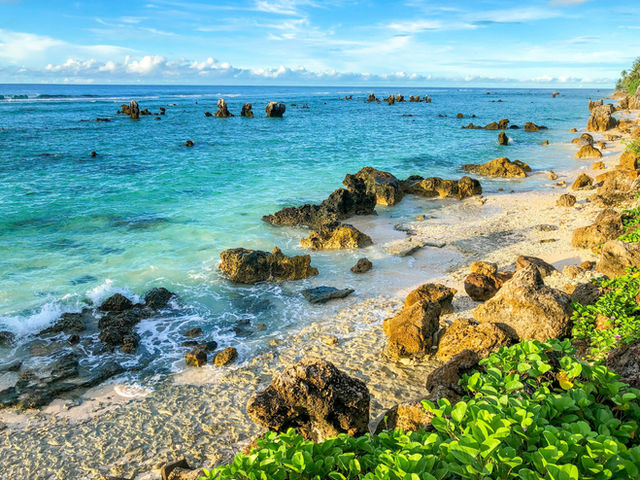
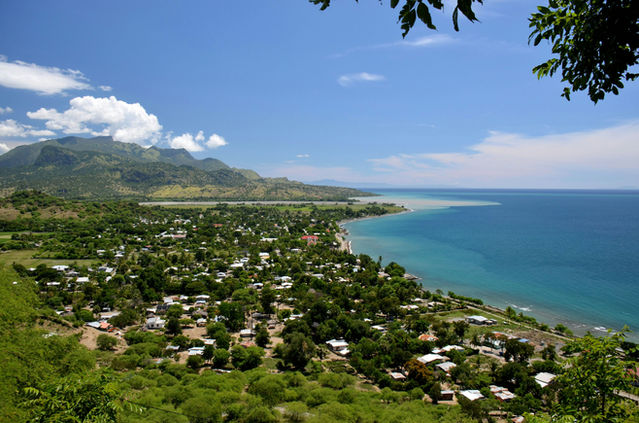
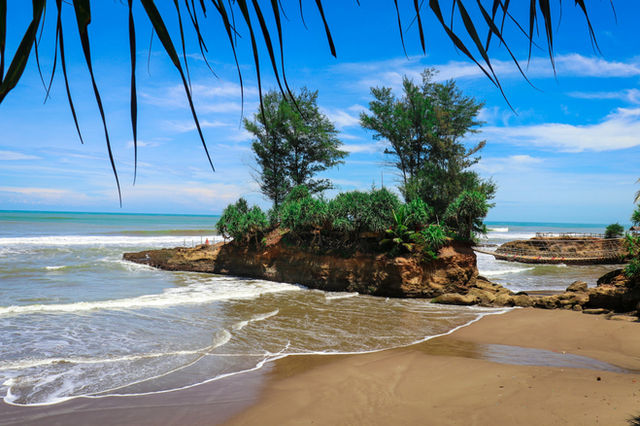
  • Anibare Bay's white sand and coral pinnacles
  • Buada Lagoon
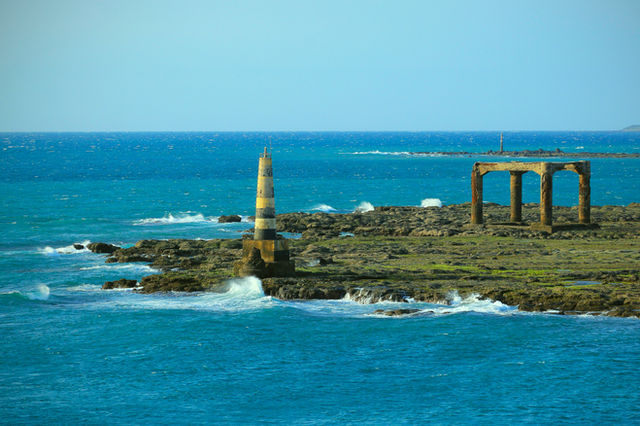
  • Command Ridge WWII relics
  • The phosphate-pinnacle moonscape of the interior
Read more

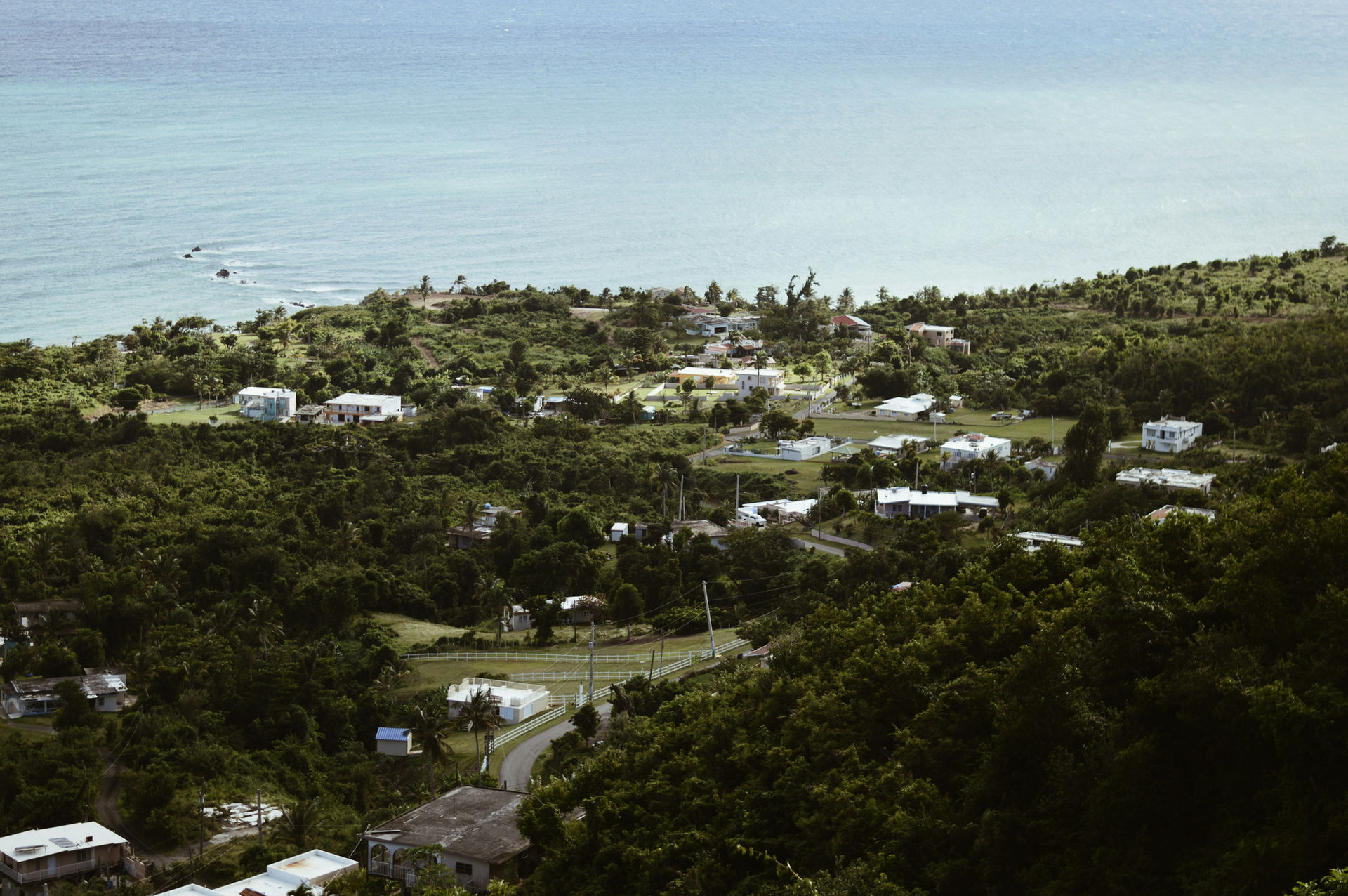
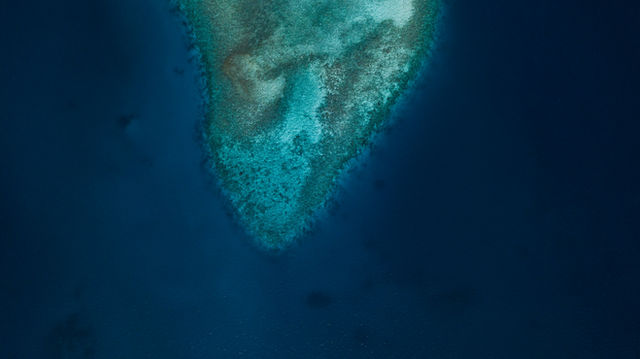
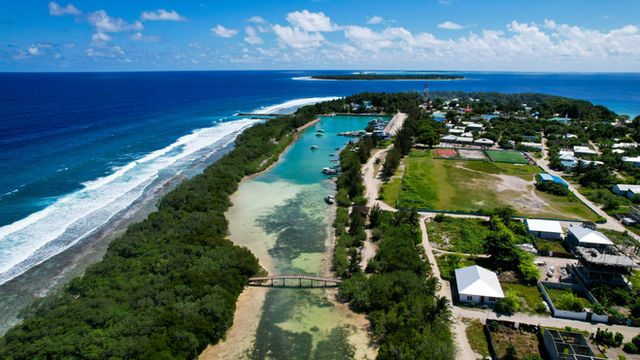
Nauru is a curiosity like almost nowhere else: an eight-square-mile coral island in the central Pacific, and one of the least-visited countries on Earth. There are no crowds here because there is no tourism machine, only a warm island community and a place utterly its own.

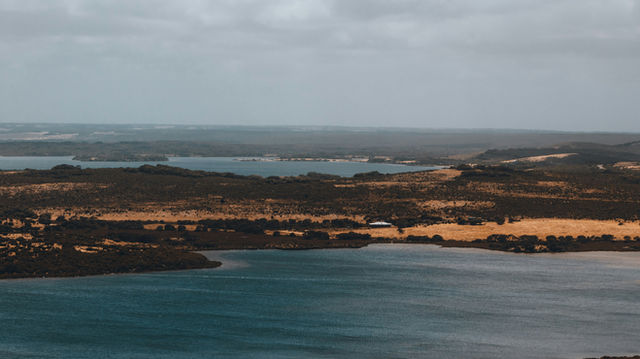
The story is written into the land. Decades of phosphate mining left a dramatic interior of jagged limestone pinnacles, now the focus of gradual ecosystem restoration, while the coast keeps its fringing reef, quiet lagoons and Buada Lagoon inland.

This is a destination for the true collector of places, the traveller drawn to the remote, the unusual and the genuinely uncrowded. Come for reef fishing, rusting wartime relics and the rare feeling of being somewhere hardly anyone goes.

A pillar, not a footnote

Eat your way through Nauru

The single reason many travellers come back — the food culture worth reshaping a trip around, and the dishes to seek out region by region.

Nauru

Coconut fish and reef catch on the world's smallest island nation, where most food arrives by ship.

Nauru is the world's smallest island nation, a raised coral speck with a narrow fertile ring around a mined-out interior, and its food tells that story. The national dish is coconut fish — raw reef fish or tuna dressed in coconut milk with lime — and the traditional plate leans on the same reef catch simmered in coconut cream, with pandanus and coconut the two crops that grow on the thin coastal soil. Ibija, a preserved pandanus-fruit paste folded with coconut cream, is the distinctive old preparation.

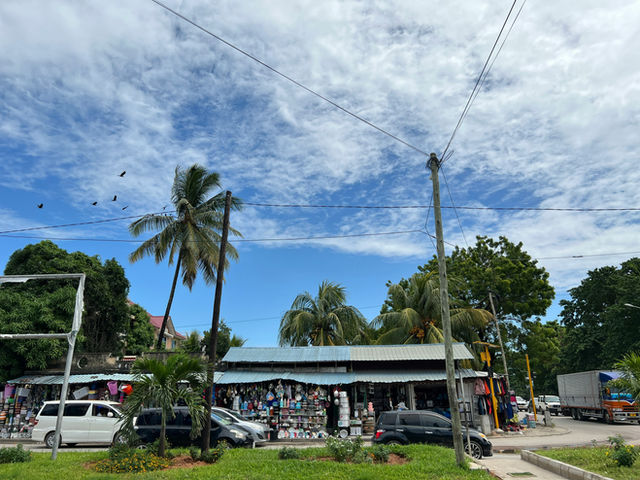
A century of phosphate mining stripped away most of the arable land, so the modern table depends heavily on imports — supply ships arrive only every six to eight weeks, and Chinese-run takeaways, a legacy of migrant labour, are the everyday go-to alongside tinned corned beef and rice. The freshest eating is still what comes off the reef. Take it to Anibare Bay, coral pinnacles at your back, and eat with the ocean.

Dishes to seek out
  • Coconut fish (raw fish in coconut milk)
  • Reef fish in coconut cream
  • Fresh tuna
  • Ibija (preserved pandanus with coconut)
  • Pandanus (epo)
  • Coconut (ini)
  • Banana-and-coconut cake
Things to do

Nature, culture & hidden gems

Editorial content coming soon

We're hand-picking the standout places, hidden gems and can't-miss activities in Nauru. Meanwhile, the cities above are a great starting point.

Plan your trip

Curated Nauru itineraries

Browse all Nauru trips →
When to go

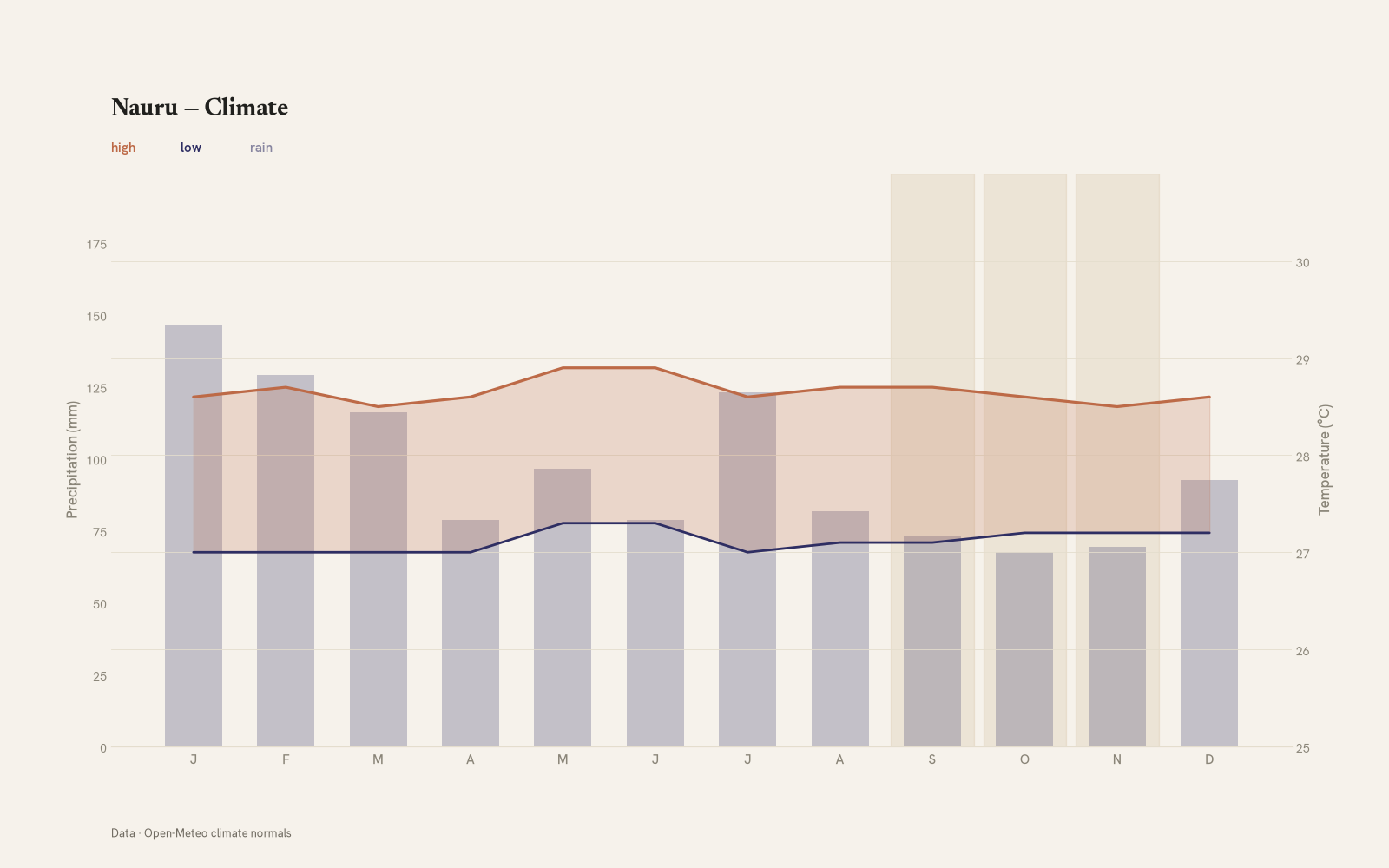
Weather & timing in Nauru RIGHT NOW 25° rain

Best Sep–Nov · Shoulder Apr, Jun, Aug

  1. Jan / -4°
  2. Feb / -2°
  3. Mar 12° /
  4. Apr 18° /
  5. May 24° / 14°
  6. Jun 28° / 18°
  7. Jul 30° / 20°
  8. Aug 28° / 18°
  9. Sep 24° / 14°
  10. Oct 18° /
  11. Nov 12° /
  12. Dec / -2°

Best time to visit

August – November

Best for
  • Culture
  • Cuisine
  • Landscape
  • History
At a glance
Sunshine 7 hr/day (est.)
Rain days 8 days/mo (est.)
Wettest December · 60mm
Driest June · 10mm
Part of Pacific Islands →
By season
Spring (Mar–May)

What to expect — Daytime highs average about 18°C with overnight lows near 8°C, and it stays largely dry.

What's best — Apr is comfortable, with thinner crowds.

Summer (Jun–Aug)

What to expect — Daytime highs average about 29°C with overnight lows near 19°C, and it stays largely dry.

What's best — Jun and Aug are comfortable, with thinner crowds.

Autumn (Sep–Nov)

What to expect — Daytime highs average about 18°C with overnight lows near 8°C.

What's best — Sep, Oct and Nov are among the best time to visit — good weather with manageable crowds.

Winter (Dec–Feb)

What to expect — Daytime highs average about 7°C with overnight lows near -3°C.

What's best — Cold and quiet; some mountain roads and sights run reduced hours.

A little context

A little history

To read what you're looking at — the empires and eras that shaped Nauru's food, art and streets.

Micronesian and Polynesian settlers arrived around 3,000 years ago, forming a society of 12 tribes — still the 12-pointed star on the flag
phosphate found in 1900 was strip-mined under German then British-Australian-New Zealand control, hollowing out the interior
Japan occupied Nauru in WWII, deporting over 1,200 Nauruans, whose survivors' return is marked as Angam Day
independent in 1968, it was briefly among the world's richest per capita before the phosphate — and the trust fund — ran out
Before you book

Know before you go

The practical back-matter — safety, drones and the essentials, in one place.

Safety

Low risk FCDO advice →

Official UK Foreign, Commonwealth & Development Office guidance is the definitive source — check it close to your travel dates.

Drone rules (sub-250g)

  • Nauru
    Effectively off-limits for visitors — Nauru has a permit/registration framework (the 2020 Drones Regulations), but guidance reports foreign-visitor flights aren't permitted, and the rules are sparse and inconsistent. ⚠ The single airport runway runs along the coast and effectively dominates the whole roughly 21km² island, so almost anywhere you could fly sits close to the airport and controlled airspace. Rules checked: Jul 2026

National parks, protected sites and religious/heritage venues often have their own rules and permits — always check the specific site before you fly.

The essentials

Plug & voltage Type I · 240V
Daily budget Expensive
Region Micronesia