Sao Tome and Principe — hero
← All destinations Country

Sao Tome and Principe

An off-radar Atlantic paradise of jungle-clad volcanic peaks, empty beaches, and world-class cocoa — the ultimate uncrowded eco-adventure.

  • Currency Db São Tomé And Príncipe Dobra (Db)
  • Language Portuguese
  • Best time June – September
  • Visa Visa-free for UK tourists for up to 15 days (€20 arrival fee); e-visa for longer stays
Why visit

Why Sao Tome and Principe

An off-radar Atlantic paradise of jungle-clad volcanic peaks, empty beaches, and world-class cocoa — the ultimate uncrowded eco-adventure.

  • Pico Cão Grande — the needle-shaped volcanic tower rising from the rainforest
  • Obô Natural Park — dense equatorial jungle, waterfalls and endemic birds
  • Cocoa roças — historic plantation estates with bean-to-bar tours and Creole meals
  • Príncipe island — a UNESCO Biosphere of pristine beaches and turtle and whale watching
Read more

Sao Tome and Principe is one of Africa's best-kept secrets — two lush volcanic islands adrift in the Gulf of Guinea, where jagged jungle peaks, deserted beaches, and old cocoa plantations create a genuinely off-radar paradise.

This is a haven for regenerative eco-tourism and soft adventure: forest-bathing in primary rainforest, sea-turtle nesting beaches, and farm-to-bar chocolate from some of the world's finest cocoa.

Untouched, biodiverse, and blissfully uncrowded, it rewards travellers seeking mindful, nature-first escape far from the tourist trail — with just enough comfort to make a slow, immersive stay a pleasure.

A pillar, not a footnote

Eat your way through Sao Tome and Principe

The single reason many travellers come back — the food culture worth reshaping a trip around, and the dishes to seek out region by region.

Sao Tome and Principe

Chocolate Islands cooking: fish, breadfruit and calulu under the equator, and cocoa from the old plantations.

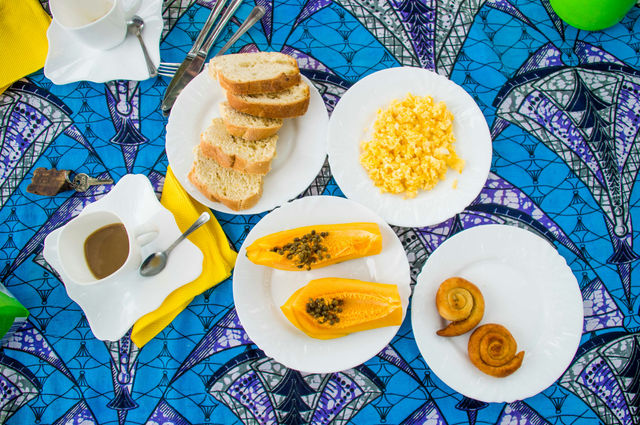
On these two tiny equatorial islands the cooking is Creole — African roots, a Portuguese overlay, fish at almost every meal. The national dish is calulu, smoked or fresh fish slow-stewed with okra, greens and aubergine in red palm oil, served over rice or mashed breadfruit. That fish-and-breadfruit pairing, and fish with cooked banana, is as island as it gets.

But the real story is cocoa. São Tomé was briefly the world's largest producer, and its plantation estates — the roças — now run bean-to-bar chocolate tours and serve multi-course Creole menus in their old kitchens. Pick at stewed land snails (búzios), sip fresh palm wine or a Rosema beer, and finish, of course, with the island's own chocolate. Small, green and genuinely delicious.

Dishes to seek out
  • Calulu (smoked-fish and vegetable stew)
  • Fish with breadfruit (fish and mashed breadfruit)
  • Banana and fish (fish with cooked banana)
  • Búzios (stewed land snails)
  • Molho no fogo (fish-and-plantain hotpot)
  • Cocoa / island chocolate
  • Palm wine (vinho de palma)
Things to do

Nature, culture & hidden gems

Editorial content coming soon

We're hand-picking the standout places, hidden gems and can't-miss activities in Sao Tome and Principe. Meanwhile, the cities above are a great starting point.

Plan your trip

Curated Sao Tome and Principe itineraries

Browse all Sao Tome and Principe trips →
When to go

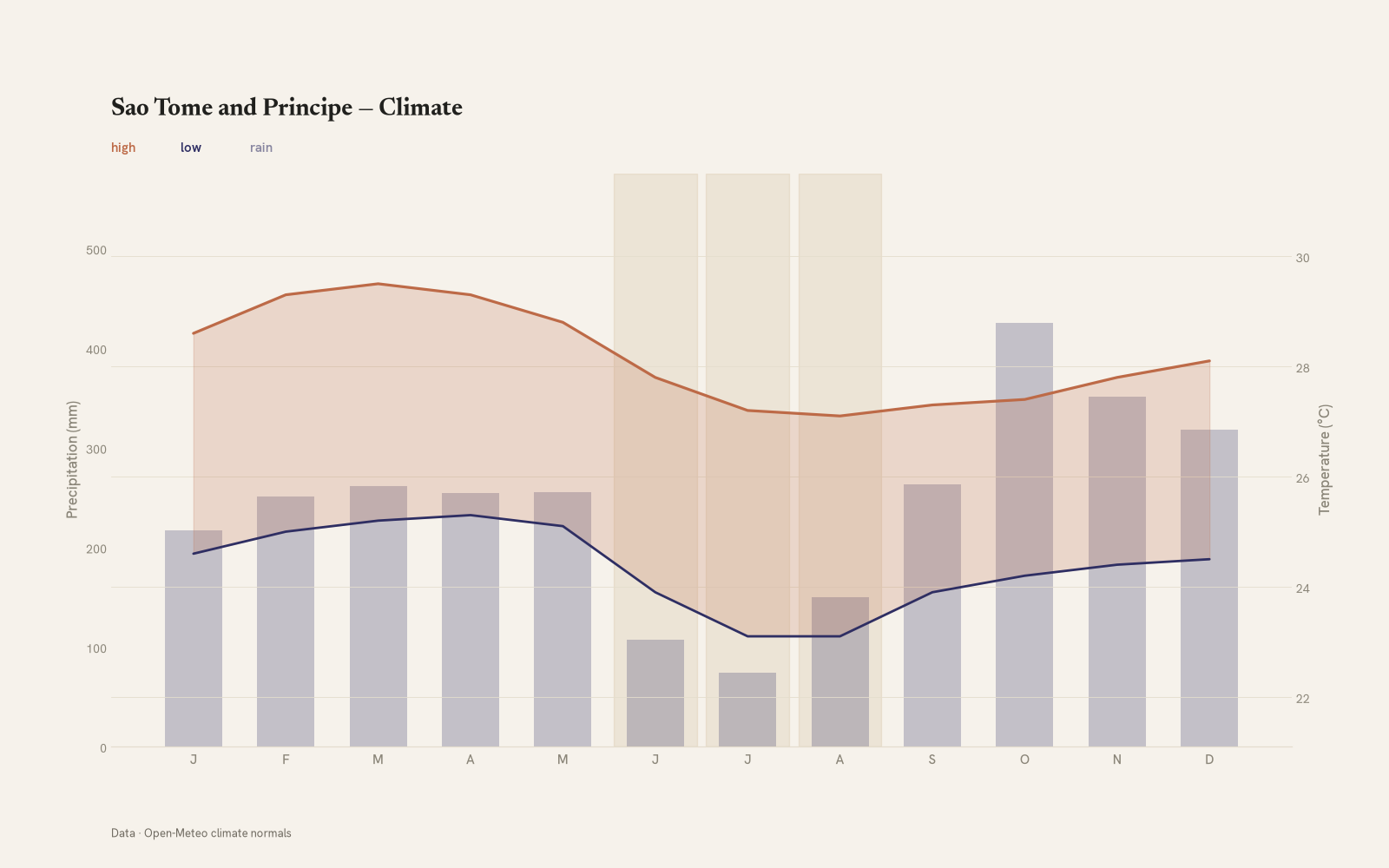
Weather & timing in Sao Tome and Principe RIGHT NOW 26° drizzle

Best Jun–Aug · Shoulder Jan–Feb, Sep

  1. Jan / -4°
  2. Feb / -2°
  3. Mar 12° /
  4. Apr 18° /
  5. May 24° / 14°
  6. Jun 28° / 18°
  7. Jul 30° / 20°
  8. Aug 28° / 18°
  9. Sep 24° / 14°
  10. Oct 18° /
  11. Nov 12° /
  12. Dec / -2°

Best time to visit

June – September

Best for
  • Culture
  • Cuisine
  • Landscape
  • History
At a glance
Sunshine 7 hr/day (est.)
Rain days 8 days/mo (est.)
Wettest December · 60mm
Driest June · 10mm
Part of West Africa →
By season
Spring (Mar–May)

What to expect — Daytime highs average about 18°C with overnight lows near 8°C, and it stays largely dry.

What's best — A quieter, less in-demand window than the shoulder months.

Summer (Jun–Aug)

What to expect — Daytime highs average about 29°C with overnight lows near 19°C, and it stays largely dry.

What's best — Jun, Jul and Aug are among the best time to visit — good weather with manageable crowds.

Autumn (Sep–Nov)

What to expect — Daytime highs average about 18°C with overnight lows near 8°C.

What's best — Sep is comfortable, with thinner crowds.

Winter (Dec–Feb)

What to expect — Daytime highs average about 7°C with overnight lows near -3°C.

What's best — Jan and Feb are comfortable, with thinner crowds.

A little context

A little history

To read what you're looking at — the empires and eras that shaped Sao Tome and Principe's food, art and streets.

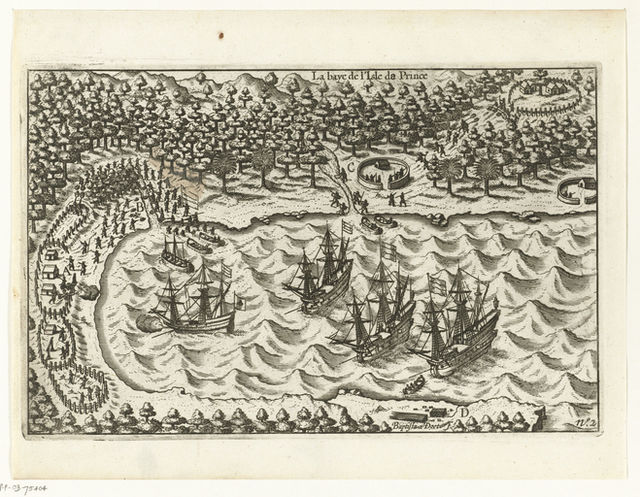
Uninhabited until Portuguese navigators arrived around 1470 and settled from the 1480s — creating a wholly Creole society built by settlers and enslaved Africans, with no indigenous predecessor — its sugar economy giving way to coffee and then cocoa grown on plantation 'roças' using slave and later forced labour, which left the roça landscape, Forro-Angolar Creole culture and the 'Chocolate Island' identity — briefly the world's largest cocoa producer around 1900 — independent from Portugal on 12 July 1975 — and shifted from one-party Marxist rule to multiparty democracy in 1990–91, becoming one of Africa's more stable small democracies on cocoa and tourism.
Before you book

Know before you go

The practical back-matter — safety, drones and the essentials, in one place.

Safety

Low risk FCDO advice →

Official UK Foreign, Commonwealth & Development Office guidance is the definitive source — check it close to your travel dates.

Drone rules (sub-250g)

  • Sao Tome and Principe
    Not a green light despite the calm: São Tomé has no drone framework, so there's no registration or permit — and customs may or may not let one in, with seizure possible. Email INAC before you travel with one. ⚠ Keep clear of São Tomé airport and any government site; Obô Natural Park, the private cocoa roças and turtle beaches may need landowner or operator permission, and Príncipe is a UNESCO Biosphere with conservation limits. Rules checked: Jul 2026

National parks, protected sites and religious/heritage venues often have their own rules and permits — always check the specific site before you fly.

The essentials

Plug & voltage Type C/F · 220V
Daily budget Mid-range
Region Middle Africa