Perugia is a hill town that behaves like a city: an Etruscan foundation with the original gate still standing, a medieval core on top of the ridge, and — because the papacy flattened a whole quarter in 1540 to build a fortress over it — an underground street you can walk through, the Rocca Paolina, complete with houses, arches and lanes, now used as a public escalator route from the car parks. It is a university town twice over (one Italian, one for foreigners), which keeps it young, and it fills each July with Umbria Jazz.
For the Galleria Nazionale dell'Umbria and Perugino's frescoes in the Collegio del Cambio; for a corso that is one of the best evening streets in Italy; and because it is the natural base for Umbria — Assisi, Orvieto, Spoleto, Gubbio and Lake Trasimeno are all within an hour.
Things to do
- The Rocca Paolina — A buried medieval quarter under a papal fortress — you walk the original streets on your way up from the car park. Free.
- Galleria Nazionale dell'Umbria — Piero della Francesca, Duccio, Beato Angelico, Perugino and Pinturicchio, in the Palazzo dei Priori on the main square.
- Collegio del Cambio — The bankers' guild hall, frescoed by Perugino in 1500 — a small, complete, gilded room, with a self-portrait in it.
- Fontana Maggiore — A thirteenth-century fountain by Nicola and Giovanni Pisano, carved with the months, the sciences and the Old Testament.
- The Etruscan Arch — A third-century BC gate, with a Roman inscription and a Renaissance loggia stacked on top of it — three eras in one structure.
- Umbria Jazz — Ten days in July, with the big names in the Arena Santa Giuliana and free stages on the corso all day.
- San Pietro's basilica and garden — A tenth-century abbey with a dark, gilded, entirely painted interior and a medieval garden behind it.
Where to base yourself
The Perugia neighbourhoods worth knowing before you book.
- Coming soon Corso Vannucci & Piazza IV Novembre The spine of the upper town, with the Fontana Maggiore, the cathedral and the Palazzo dei Priori on it. Stay within five minutes of this.
- Coming soon Porta Sole The highest point of the ridge, north-east of the centre — quiet lanes, long views over the Tiber valley.
- Coming soon Borgo Sant'Angelo The northern spur out to the fifth-century round church of Sant'Angelo — student flats, cheap eating, ten minutes from the corso.
- Coming soon Borgo XX Giugno & San Pietro South, around the medieval abbey and its garden — residential, calm, with the agriculture faculty.
- Coming soon Rocca Paolina & Piazza Italia The fortress-over-a-quarter and the terrace above it, with the best sunset view in the city and the escalators down.
- Coming soon Lake Trasimeno 30 minutes west — Castiglione del Lago, Passignano and three islands. A different and much cheaper base.
3 days in Perugia
- Day 1 The ridge
Up through the Rocca Paolina to Piazza Italia, then the corso to Piazza IV Novembre. Galleria Nazionale and the Collegio del Cambio before lunch. Torta al testo. Afternoon out to the Etruscan Arch and Sant'Angelo, back for aperitivo on the Piazza Italia terrace at sunset.
- Day 2 Assisi
Train and shuttle to Assisi. Basilica of St Francis in the morning — the Giotto and Cimabue cycles — then the Rocca and Santa Chiara. Lunch in the town. Back mid-afternoon, or on to Spello.
- Day 3 Southern Umbria
Orvieto for the cathedral façade and the underground city, or Spoleto and the Ponte delle Torri. Lake Trasimeno if the weather is good and the pace should drop.
Day trips
Worth the train or the drive from Perugia.
-
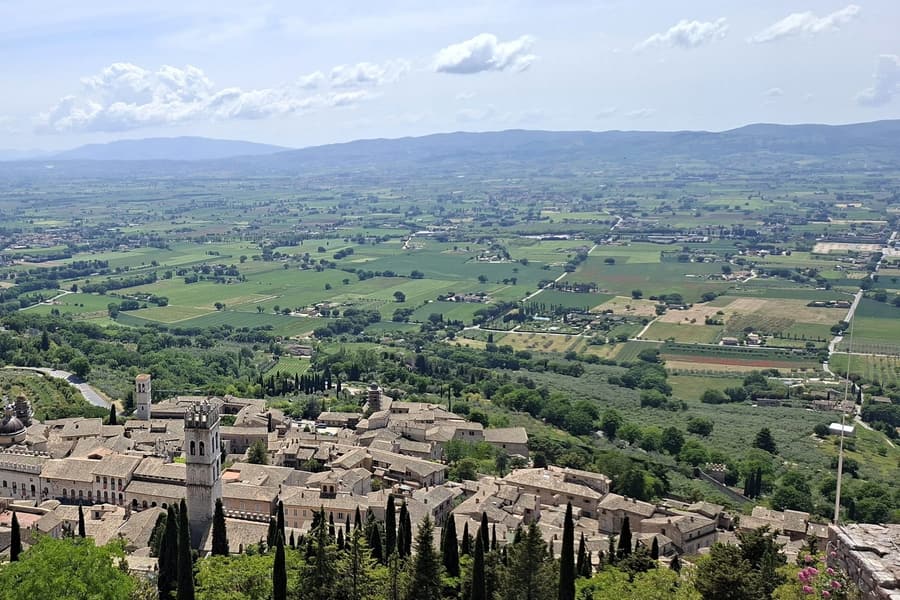 Assisi 25 minutes by train — St Francis's basilica and Giotto's frescoes.
 -
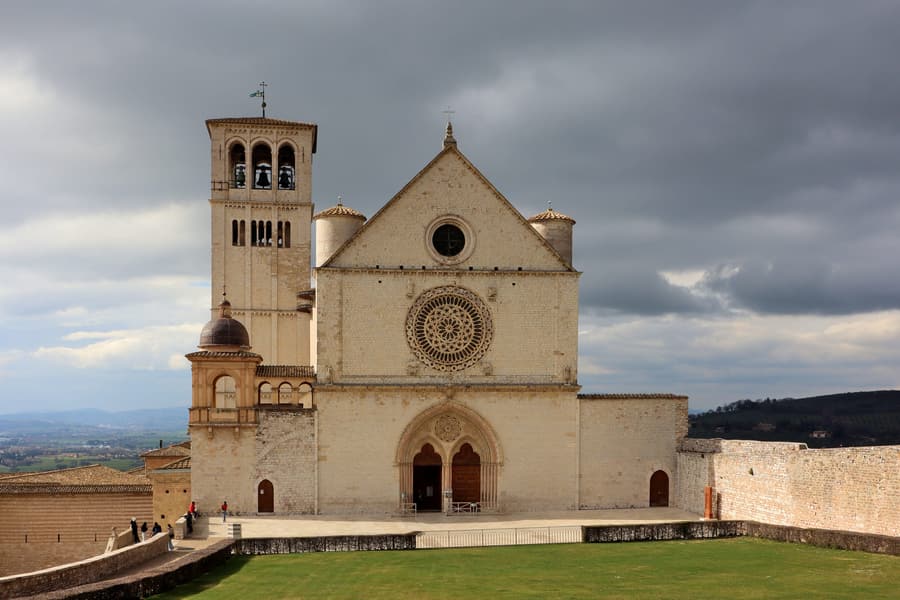 Basilica of St Francis, Assisi The basilica itself, with the upper and lower churches.
 -
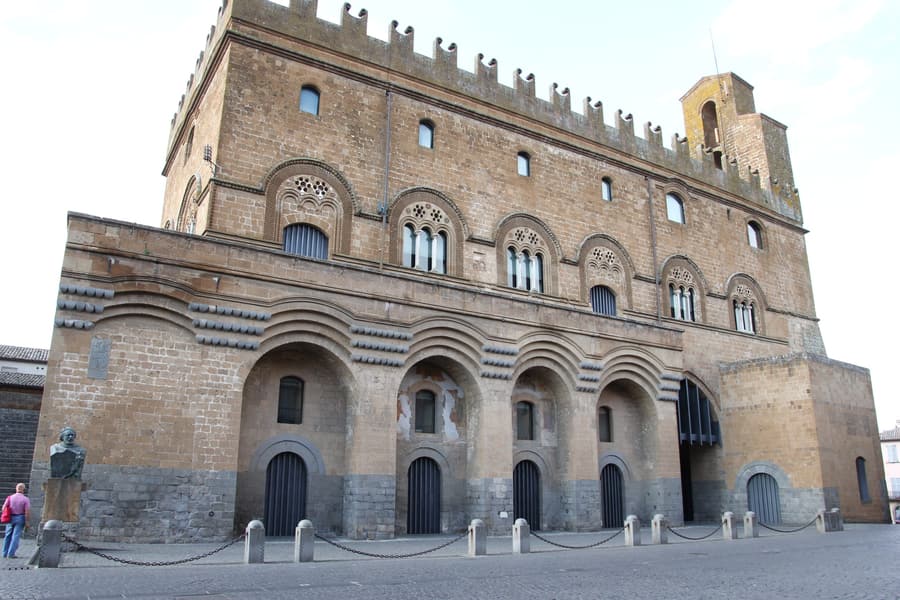 Orvieto An hour south-west, for the striped cathedral and the city beneath it.
 -
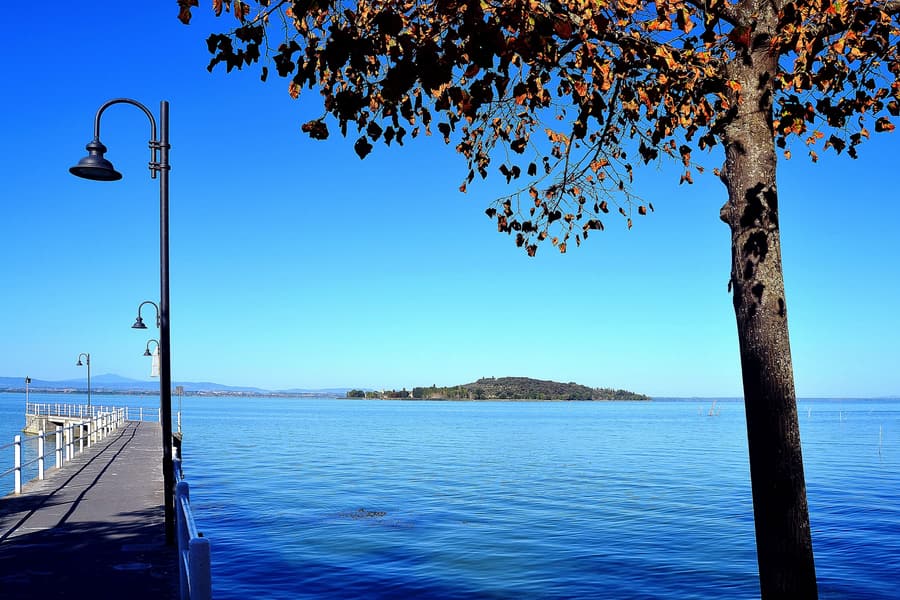 Lake Trasimeno Italy's fourth-largest lake and its three islands, 30 minutes west.
 -
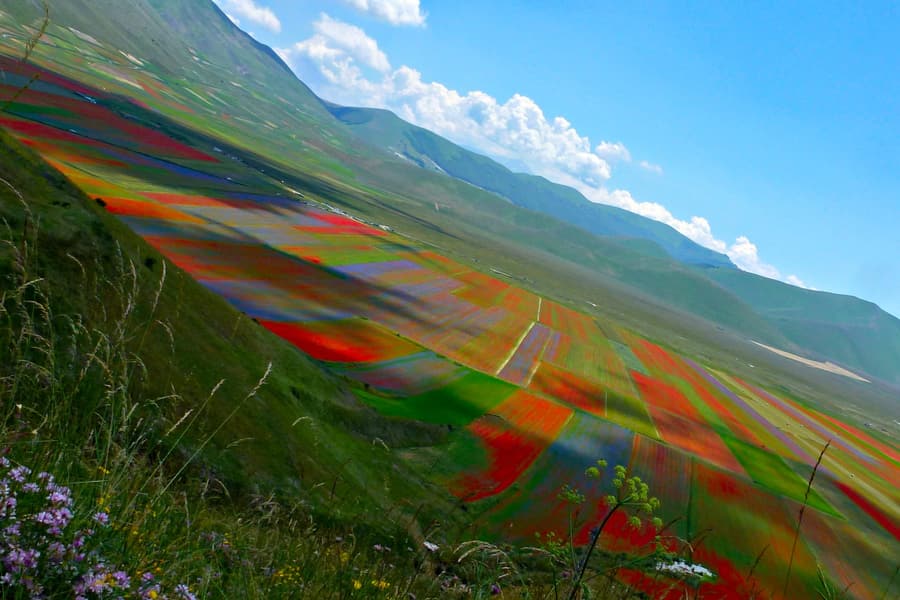 Castelluccio & the Piano Grande The high plain that flowers in late June, about 1h30 east.
 -
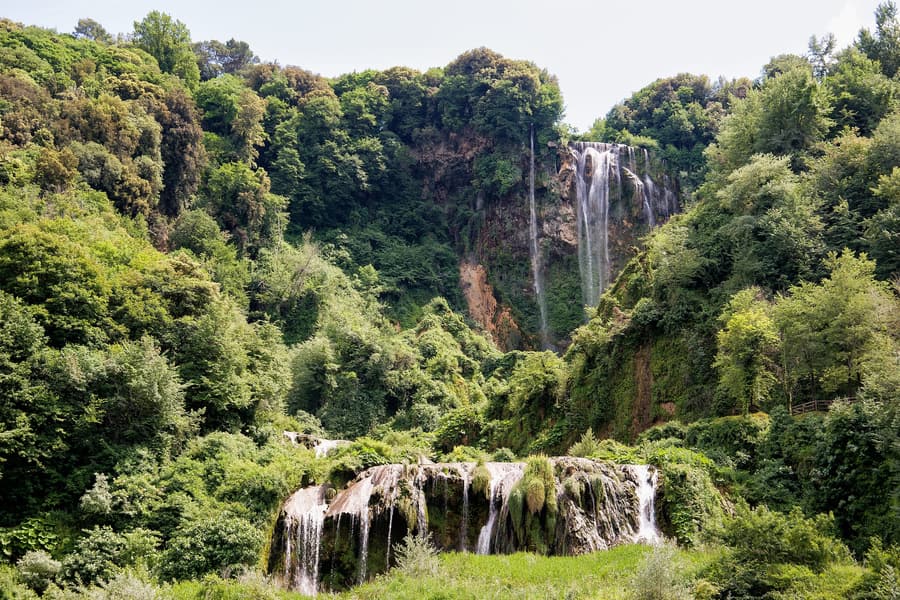 Marmore Falls A 165 m Roman-built waterfall, switched on twice a day, about an hour south.
Practical
- Best time to go
- April–June and September–October. Umbria Jazz runs ten days in mid-July and books out the city. Eurochocolate in October is enormous and equally busy. Winter is cold on the ridge, quiet and cheap. Late June is the moment for the Castelluccio flowering, 1h30 east.
- Getting there
- Perugia San Francesco (PEG) is small, 20 minutes out, with a handful of European routes. Most people come via Rome — 2h to Perugia by train — or Florence (2h). Driving is easy; the trick is the parking. Leave the car at Piazza Partigiani or Pian di Massiano and take the minimetro or the escalators up.
- Getting around
- The old town is small, on a ridge, and entirely walkable — but everything below it is a serious climb. The minimetro, a single-carriage automatic line, runs from the lower car parks to Pincetto; a chain of escalators runs up through the Rocca Paolina. Both are ordinary bus tickets.
- Eat & drink
- Umbrian cooking is inland and unfussy: strangozzi with black truffle from Norcia, torta al testo (a flatbread cooked on a hot stone, split and filled), porchetta, lentils from Castelluccio, and wild boar. Norcia gives its name to Italian pork butchery — a norcineria is a pork specialist anywhere in the country. Sagrantino di Montefalco is the region's serious red; Orvieto Classico the white. Perugina, of Baci fame, is made on the edge of town.
- Know before you go
- The city is steep, and the gap between the lower town where you park and the upper town where everything is can catch people out with luggage. Umbria Jazz closes streets and multiplies prices. Assisi is 25 minutes by train but its station is 4 km below the basilica — take the shuttle bus up.