Silvretta Arena
Cross-Border Austria–Switzerland · High, Snow-Sure Skiing · Ischgl's Big-Name Après
A high, lift-linked domain that crosses an international border: Ischgl on the Austrian side and duty-free Samnaun in Switzerland share one snow-sure area on a single pass, with quiet Galtür a ski-bus ride up the valley.
- 239 km Piste marketed
- 44 Lifts
- 1,352 m Base
- 2,868 m Summit
- 1,516 m Vertical
- 108 Pistes mapped
🎟 One pass: Silvretta Skipass covers every lift across the area.
Terrain & aspect
- Novice
- Easy
- Intermediate
- Advanced
- Freeride
Slopes mostly face W — 60% on snow-holding, poleward-facing slopes.
Aspect derived from run bearings · OpenSkiStats / © OpenStreetMap (ODbL).
The area
The Silvretta Arena links Ischgl, in Austria's Paznaun valley, with Samnaun, just over the border in the Swiss Engadin, into one connected ski area on one pass. Almost all of the skiing sits high — the marketed figure is around 239 km of piste plus a further stretch of marked ski routes, spread between roughly 1,360 m in the valley and a top station near 2,872 m, most of it above the treeline around the Idalp hub. The two sides are genuinely lift-linked: you ride up from either village and cross the ridge on lifts, no bus needed. Galtür, further up the Paznaun, is part of the same regional pass but a separate mountain of its own, reached by a short ski-bus hop rather than a lift. What holds the trip together is the combination — reliable high-altitude cruising, a real international crossing built into the day, and two very different evening moods depending on which side you sleep on.
Height and reliability, with a genuine border crossing thrown in. Because so little of the skiing dips below 2,000 m, the Silvretta Arena holds snow when lower resorts are struggling, and its long season runs from late autumn into spring. The terrain is overwhelmingly intermediate — wide, rolling, sunny reds you can link for hours across two countries — and the novelty of skiing from Austria into duty-free Switzerland and back is real, not a gimmick. Add Ischgl's outsized après and concert reputation on one side and Samnaun's calmer, cheaper Swiss feel on the other, and you can tune the trip hard in either direction.
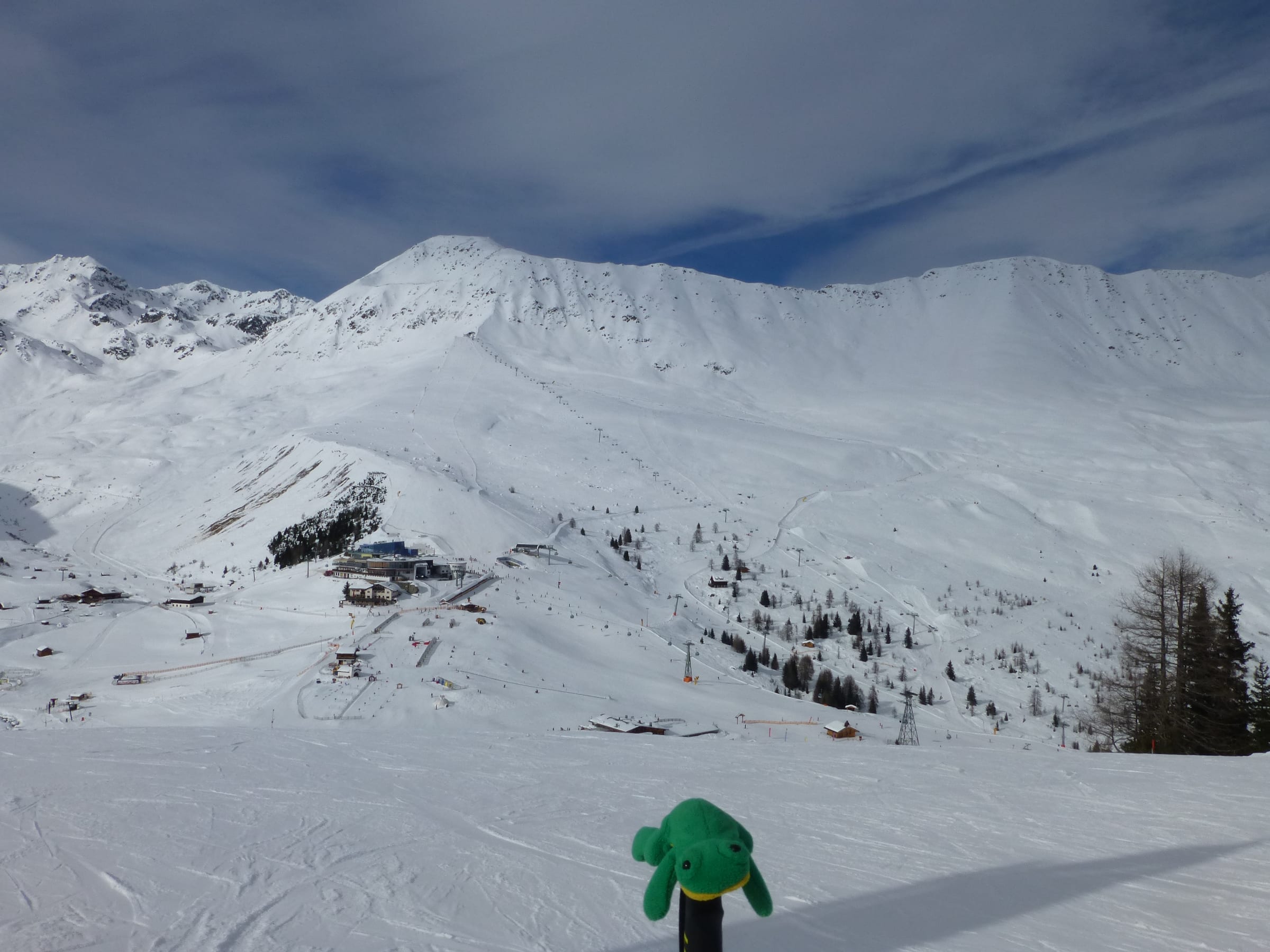
Open, high and mostly treeless. The core of the area is the Idalp plateau above Ischgl, a broad sunlit shelf around 2,300 m where the lifts fan out and the beginner terrain sits, with reds and blues rolling away in every direction and over the ridge into Switzerland. It skis as an intermediate's area first and last — long, wide, cruisy pistes rather than tight technical terrain — and because it's so high and exposed, it can be bright and superb one day and wind-scoured the next. The long runs home to Ischgl drop through the last of the trees to the valley floor; everything above is big-sky, above-treeline skiing.
Best known for
Explore the villages
The pass is the same everywhere — the village you base in shapes the holiday more than the valley you ski. 3 base villages, one lift pass.
Ischgl
1,377 mBig ski access and full-volume nightlife
The Austrian party base at around 1,377 m, with gondolas lifting you straight up to the Idalp hub and the biggest, quickest access to the linked Arena. It's also one of the loudest après towns in the Alps, with big-name season concerts and late nights — lively and pricey, and not shy about it.
Explore the village →Samnaun
1,840 mQuiet, higher, duty-free skiing on the Swiss side
The Swiss side of the Arena at around 1,840 m, higher and calmer than Ischgl and duty-free thanks to its border status. A quieter, more family-minded back door onto the same linked slopes, with cheaper shopping and a gentler evening pace.
Explore the village →Galtür
1,584 mQuiet family stays with the big area a bus ride off
A quiet, high family village further up the Paznaun at around 1,584 m, with its own separate ski mountain rather than a lift link into the main Arena. Snow-sure and calm, it suits families who want peace and reliable snow, with the big cross-border area a short ski-bus away.
Explore the village →- Ischgl The party base with the biggest ski access — loud, lively and pricey, best if the nightlife is part of the plan.
- Samnaun Higher, quieter and duty-free on the Swiss side, a calmer back door onto the same linked slopes.
- Galtür The quiet family village up the valley on a separate mountain, a ski-bus from the main Arena.
Base in Ischgl for the biggest, quickest ski access and the full party, accepting the noise, the crowds and higher prices that come with it. Cross to Samnaun on the Swiss side for a higher, calmer village with duty-free shopping and an easy back door onto the same slopes — better for families and anyone who wants the skiing without the racket. Galtür, further up the Paznaun, is the quietest of the three and the most family-minded, but its own ski mountain is separate from the linked Arena, so factor in a short ski-bus each day.
Skiing, by level
Fine, but with a catch. The main nursery and gentle terrain is concentrated up on the Idalp plateau around 2,300 m — high and snow-sure, and a good place to progress — but you reach it by riding up from the village rather than stepping out of your hotel. There is little easy skiing down in the valley itself, so beginners live up top.
This is the area's whole reason for being. Endless is the wrong word, but a strong intermediate can cruise wide reds and blues across both the Austrian and Swiss sides for days without repeating much, crossing the border as part of the ordinary flow of the day. The rolling, sunny terrain around Idalp and over towards Samnaun is as good as easy-going cruising gets.
Enough to hold your interest. There's a decent spread of black pistes — around the Palinkopf, the Greitspitz and the higher shoulders — plus some genuinely long top-to-valley descents that reward strong legs. It leans fast-cruising over steep, but the better skiers won't be bored.
The off-piste is where it gets serious. The Piz Val Gronda cable car opened access to a swathe of high freeride terrain that experienced skiers rate, and there's lift-served backcountry and marked ski routes scattered across the high ground on both sides of the border. All of it is above-treeline, exposed and best tackled with a guide, avalanche kit and the right conditions.
Ski from Austria into Switzerland and back
The area's signature is the border crossing itself. You ride up from Ischgl, work over the high ridge and drop into Samnaun in a different country, ski the Swiss side, then cross back before the last lifts — no bus, no faff, just lifts and pistes. Samnaun's duty-free status makes the lunch stop over there a small event in its own right, and the round trip is well within a confident intermediate's day.
An Ischgl après afternoon
On the Austrian side, the après is a set-piece worth doing at least once with eyes open. The slope-side bars start filling long before the lifts close, and on concert weekends the whole town orients around a stage up the mountain and a big name playing to skis and ski boots. It is unapologetically loud and busy — go in expecting that, and keep an eye on the last lift or gondola so the party doesn't strand you.
High freeride off the Piz Val Gronda
For strong off-piste skiers, the Piz Val Gronda cable car reaches a shoulder of high, open freeride terrain that changed what's possible here. It's committing, above-treeline ground where the right conditions matter and a guide with avalanche kit is the sensible way in — but on a good day it's the kind of descent people plan a trip around.
Snow & how the mountain faces
Among the more dependable areas in the Eastern Alps. The great majority of the pistes sit above 2,000 m, the top stations push towards 2,872 m, and the aspect and altitude let it open early and stay open late — a long season either side of the core winter. A large snowmaking system backs up the natural cover on the main arteries. The weak spots are the lowest runs home into Ischgl at around 1,377 m, which feel warm spells first and can turn thin or slushy late in the day; when they do, the gondolas take you down instead. Samnaun's side, higher and shaded in parts, tends to hold well.
On the map
The area and its base villages on the live map — pan and zoom to explore. The official piste maps are one tap away beneath it.
Legend
Run difficulty
- Novice
- Easy
- Intermediate
- Advanced / Expert
- Freeride / Extreme
- Unknown
Run types
- Downhill — groomed
- Downhill — ungroomed
- Downhill — gladed
- Nordic (groomed)
- Ski tour
- ☾Lit (night)
- △Not patrolled
- →One-way
- ❄Snowmaking
Lifts
- Operating
- Operating (private)
- Non-operating
- Lift station
Slope-gradient grading
Downhill / ski tour
- Flat<3°
- Easy3–14°
- Intermediate14–22°
- Advanced / Expert22–45°
- Freeride / Extreme>45°
Nordic
- Easy<6°
- Intermediate6–9°
- Advanced>9°
Aspect (sun exposure)
- N — least sun
- E — morning
- S — most sun
- W — afternoon
Legend after OpenSkiMap
How to get there
Innsbruck (INN) is the natural gateway for the Austrian side, ~approx 1.5 hours up the Paznaun valley by road. Zurich (ZRH) is around ~approx 2.5 hours and often the easier approach for Samnaun on the Swiss side; Friedrichshafen (FDH) and Munich (MUC) are further alternatives.
The nearest mainline station is Landeck-Zams on the Arlberg railway, served by fast trains; from there it's a bus up the valley (~approx 40 minutes) to Ischgl and on to Galtür. Samnaun is awkward to reach by rail and is usually better approached by road or on skis over the border.
A single valley road runs up the Paznaun through See, Kappl, Ischgl and Galtür. Samnaun sits over the mountain in Switzerland, reached either on skis by lift or by a separate road that climbs in from the Austrian side. Free ski buses link Ischgl and Galtür, and gondolas lift you out of each base, so a car is handy but not essential once you're settled.
Best time to go
Because it's so high, the Silvretta Arena skis reliably from December through April, with a genuine early start in late November and spring skiing that can run into early May in a good year. January and February give the coldest, most consistent snow; March and April bring longer, sunnier days with the high terrain still holding. The busiest, priciest stretches are Christmas and New Year, the February half-terms and the concert weekends at each end of the season; a non-holiday week in late January is the quiet sweet spot.
- Season opensLate November, snow-dependent
- Season closesEarly May in a good year, later than most
- Full lift coverageDecember to April
- Peak weeksChristmas / New Year, February half-terms and concert weekends
- Best spring snowMarch and April, up on the high ground
Good to know
Can you really ski from Austria into Switzerland?
Is Ischgl only for partygoers?
Is Galtür part of the same skiing as Ischgl?
Nearby resorts & areas
Other resorts within reach if you're combining trips or comparing.

Getting to Silvretta Arena
Book an airport transfer up to the resort, or pick up a car at Innsbruck (INN) — search and compare without leaving the page.
Ski data © OpenStreetMap contributors (ODbL), via OpenSkiMap & Skimap.org. Basemap © OpenFreeMap / OpenMapTiles. · Weather data © Open-Meteo.com (CC-BY 4.0), ERA5 reanalysis. Village grouping & editorial: mynext.holiday. Transfers via Kiwitaxi; car hire via Travelpayouts.