 Dramatic © Marc Ryckaert (MJJR) · CC BY 3.0
 Paleokastritsa Beach
Emerald coves cut into steep wooded cliffs below a hilltop monastery, over unusually clear, calm water.
Best for scenic swims & boat trips
The greenest of the Ionian islands — a Venetian old town, cypress hills and coves of clear Adriatic-blue water.
Corfu (Kerkyra in Greek) is the northernmost of the Ionian islands, sitting off Greece's north-west coast a short ferry hop from both the mainland at Igoumenitsa and the Albanian port of Saranda. At roughly 610 sq km with a population of around 100,000, it is one of the larger and more populous Greek islands, and unmistakably the greenest — an estimated three to four million olive trees, cypress groves and genuinely lush hillsides give it a soft, wooded character that surprises anyone expecting the bare rock of the Cyclades. The reason is simple: Corfu is considerably wetter than the Aegean, catching Adriatic weather systems that keep it verdant well into spring. The island's history sets it apart from most of Greece — it was never ruled by the Ottomans, passing instead through four centuries of Venetian control followed by brief French and then British administration until union with Greece in 1864. That inheritance is written into the old town's Italianate architecture, the French-built Liston arcade, the British-era cricket pitch on the Spianada and even the local ginger beer (tsitsibira). Corfu suits a wide range of travellers: culture-minded visitors drawn to the UNESCO old town, families and couples wanting green landscapes and swimmable coves, and — at the far southern tip in Kavos — a young crowd after cheap nightlife. It is a more varied, less monocultural island than its reputation as a package-holiday destination suggests.
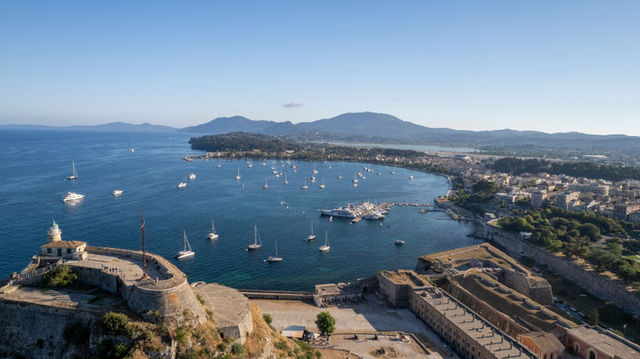
Corfu offers a combination you rarely find on a single Greek island: a genuinely important historic town and a strikingly beautiful, green coastline. Corfu Old Town is a UNESCO World Heritage Site and one of the best-preserved fortified port cities in the Mediterranean — its two Venetian fortresses (the Old Fortress on its rocky promontory and the New Fortress above the harbour), the arcaded Liston built under French rule, the vast Spianada esplanade and a warren of tall Venetian lanes make it a place to wander for a full day rather than tick off in an afternoon. Beyond the town, the west coast delivers the postcard scenery: Paleokastritsa's cliff-backed turquoise coves and hilltop monastery, and the eroded sandstone channels of the Canal d'Amour at Sidari. The Achilleion Palace, built for the Empress Elisabeth of Austria (Sisi), and Mount Pantokrator, the island's 906m summit, add day-trip variety. The north-east coast around Kassiopi, Kalami and the tiny taverna-bay of Agni — the Durrell family's Corfu — is the island's most beautiful and best for quiet swimming and boat hire. Corfu also pairs beautifully with the tiny islands of Paxos and Antipaxos on a day boat, and with the Albanian riviera at Saranda and the ruins of Butrint, both an easy fast-ferry away.
Corfu has one of the most distinctive regional cuisines in Greece, a legacy of its Venetian centuries rather than the Ottoman-influenced food of the mainland. The three signature dishes are worth seeking out: sofrito (thin slices of veal slow-cooked in a white wine, garlic and vinegar sauce), pastitsada (rooster or beef braised in a spiced tomato-and-cinnamon sauce, served over thick bucatini-style pasta) and bourdeto (fish, traditionally scorpionfish, stewed with plenty of red chilli and paprika — a stew that genuinely bites). You will also find bianco (a white garlic-and-lemon fish stew) and excellent local olive oil, the island being carpeted with olive groves. To finish, Corfu is unusual in Europe for commercially growing kumquats, and the sweet, citrusy kumquat liqueur (and kumquat sweets) is the classic local souvenir. The British left behind tsitsibira, a home-style ginger beer still made on the island. In town, the tavernas of the old-town lanes and the harbour serve the Corfiot classics; the north-east coast's waterside tavernas at Agni and Kalami are a highlight, best reached by boat, and specialise in fresh fish.




Live map of hotels and villas around Corfu — powered by Stay22. Pan, zoom and compare live prices to pick your base.
Pan, zoom and compare live prices — every stay in one map.
Corfu is a large island (about 65km north to south) with winding, hilly roads, so a hire car is the most practical way to explore beyond your base — the west-coast coves, the north-east villages and Mount Pantokrator are all far more accessible with your own wheels. Roads are generally decent but narrow and twisting in the mountainous interior and along the coast; allow more time than the map distances suggest. Scooters and quads are available in the resorts but the mix of coastal bends, local driving and summer traffic makes them riskier here than on flatter islands. Along the beautiful north-east coast, hiring a small self-drive boat (no licence needed for the lowest-powered ones) is the classic and often easiest way to reach the taverna-only bays like Agni and Kerasia. Within Corfu Town itself everything worth seeing is walkable, and it is best to park outside the old town's pedestrianised lanes. Boat excursions — to Paxos and Antipaxos, the Paleokastritsa sea caves, or across to Saranda and Butrint in Albania — are a major part of the Corfu experience and depart from the old port and the main resorts.
Corfu has two useful bus networks. The green KTEL long-distance buses run from the terminal near the new port in Corfu Town out to the main towns and resorts across the island — Paleokastritsa, Kassiopi, Sidari, Glyfada, Kavos and more — at low fares (roughly €2–5 depending on distance), though services are much less frequent on Sundays and out of season, and some remote coves are not served at all. The separate blue local buses cover Corfu Town and its immediate suburbs and nearby villages (Achilleion, Benitses, Dassia) very cheaply. Buses are a viable way to reach the bigger resorts and the main sights without a car, but timetables are limited and not built around beach days or late nights, so for the quieter north-east bays and flexible touring a hire car is far better. Taxis are metered and available in the town and resorts but can be scarce and pricey for longer cross-island runs; agree or confirm the fare for non-metered trips. For day trips, organised excursion boats rather than scheduled ferries are the norm to Paxos, Antipaxos and Albania.
Explore the old town early in the morning or in the evening — in the middle of a summer day the cruise-ship crowds fill the Liston and the main lanes, but the tall Venetian streets (the 'kantounia') are atmospheric and near-empty at either end of the day. For the north-east coast's best experience, hire a small self-drive boat from Kassiopi or Nissaki rather than driving: the taverna bays of Agni and Kerasia are far nicer approached from the water, and you can anchor for a swim on the way. Mount Pantokrator (906m) is worth the drive up through the mountain villages of Old Perithia — a semi-abandoned Venetian village now slowly reviving with a couple of good tavernas — for the panorama across to Albania. Skip the crowded, over-photographed 'swim' at the Canal d'Amour at Sidari midday and go for the rock formations at golden hour instead. For food, seek out the Corfiot classics (sofrito, pastitsada, bourdeto) in a backstreet town taverna rather than a seafront tourist menu, and buy kumquat liqueur from a proper shop rather than the airport. A day boat to Antipaxos delivers the clearest, most turquoise water in the region — better swimming than most of Corfu's own beaches.
The 7 shores actually worth the trip on Corfu — ranked, with the vibe of each and where to stay nearby. Tap a card to fly the map to it.
Dramatic © Marc Ryckaert (MJJR) · CC BY 3.0 Emerald coves cut into steep wooded cliffs below a hilltop monastery, over unusually clear, calm water.
Best for scenic swims & boat trips
Twin pebble bays meet back-to-back on a wild headland you reach by hiking down from Afionas village.
Best for adventurous walkers
 Snorkelling © Dr.K. · CC BY-SA 3.0
 Sea-carved sandstone tunnels and channels form sheltered pools ideal for masks and snorkels.
Best for rockpool snorkelling
A long golden strand with real sand underfoot and shallow, gently shelving water backed by green hills.
Best for families with toddlers
Wide sandy sweep framed by pointed rock stacks, with tavernas and shallow entry at its northern end.
Best for all-day beach days
Wild 3km dune beach between Korission Lagoon and open sea, a magnet for kitesurfers on windy days.
Best for space & wind sports
A sliver of sand under towering ochre cliffs where clifftop bars serve Corfu's headline sunsets.
Best for sunset drinks
Corfu · Around the island · 1 island · 7 beaches
Skip-the-line tickets and small-group tours in Corfu — compare across our partners.
We're still curating hand-picked tickets and tours for Corfu. In the meantime, the map above and the nearby cities are a great place to start.
May – October
Corfu has a Mediterranean climate but a notably wetter, greener one than the Aegean islands, which is exactly why it is so lush. Summers (June–August) are hot and dry, typically 28–33°C, with reliably warm, calm sea and long sunny days — the peak season for beaches but also the busiest and most expensive. Spring (April–May) is the island at its greenest and most beautiful: wildflowers, warm days of 18–24°C and manageable crowds, though the sea is still cool early on and there can be showers. September and October are excellent — warm sea, temperatures easing from the high 20s, quieter resorts and good value, with October beginning to see the first autumn rain. Winter (November–March) is mild but genuinely wet: Corfu catches Adriatic weather and can be one of the rainier parts of Greece, and many resorts and tavernas close, though the old town stays open and green all year. For the best balance of warmth, greenery and space, aim for May–June or September.
Corfu is a very safe destination, with low levels of crime against tourists; the main risks are practical rather than criminal. The island's roads are the biggest hazard — they are narrow, winding and hilly, particularly on the west coast and up Mount Pantokrator, and scooter and quad accidents are the most common cause of holiday injuries; if you hire two wheels, wear a helmet and ride cautiously. On the water, self-drive boat hire along the north-east coast is popular and generally safe but respect the weather, keep to sheltered bays if inexperienced, and watch for other boat traffic in the busy summer coves. Some of the pretty pebble coves shelve steeply and a few west-coast beaches (Myrtiotissa, parts of the west) can have currents and surf when the wind is up — check conditions before swimming out. Summer sun is strong; the classic mistake on a green, breezy island is under-estimating UV. In Kavos specifically, the usual party-resort cautions apply: pace alcohol, watch drinks and stay with your group at night. Petty theft is rare but keep valuables secure in crowded old-town streets and on busy beaches.
Corfu is Greek Orthodox and deeply attached to its patron saint, Spyridon, whose relics are paraded through the old town in four major processions a year; the church of Agios Spyridon with its distinctive red-domed bell tower is the spiritual heart of the town. When visiting churches and the clifftop monastery at Paleokastritsa, dress modestly — shoulders and knees covered — and behave quietly; some sites provide wraps at the door. The island wears its Venetian, French and British past comfortably, and you will notice the mixture everywhere, from cricket occasionally still played on the Spianada to Italian loanwords in the local dialect. Corfiots are generally warm and relaxed; a little Greek (kalimera, efharisto) is appreciated. Tipping is customary but modest — rounding up or leaving 5–10% in tavernas. Meal times run late by British standards, with dinner from around 8–9pm. Away from the mass resorts, dress and behaviour are fairly conservative in the villages, so save beachwear for the beach.
£95/day mid-range (budget £50, luxury £280+; north-east coast villas and old-town boutiques push the top end)
112 (European emergency), 100 (Greek police), 199 (fire), 166 (ambulance), 108 (Hellenic Coast Guard)
Corfu International Airport 'Ioannis Kapodistrias' (CFU) sits just 3km south of the old town, so transfers are short. It is a busy seasonal gateway with direct flights from the UK from roughly April to October — British Airways, easyJet, Jet2, TUI and Ryanair all fly from London and regional UK airports, with the London flight taking around 3h 15m. Outside the summer season, direct options thin out and you may need to connect through Athens on Aegean or Olympic (about 55 minutes on the domestic hop). The airport is small; taxis to the town are inexpensive and quick, and pre-booked transfers serve the coastal resorts. Corfu is also easily reached by sea: frequent car and passenger ferries cross from Igoumenitsa on the mainland (a short 1h–1h30 hop with up to around 25 sailings a day in summer), which is the standard route if you are driving down through Greece. Fast passenger boats also connect Corfu with Saranda in Albania in around 30 minutes (useful for a Butrint day trip, passport required), and seasonal day boats run to the small islands of Paxos and Antipaxos.
Flights, airport transfers and car hire to CFU — search and compare without leaving the page.
Parking, holiday extras, and more — coming soon.
We're lining up parking, holiday extras and activities you'll be able to add to any trip from here.