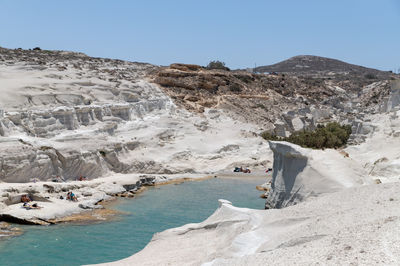
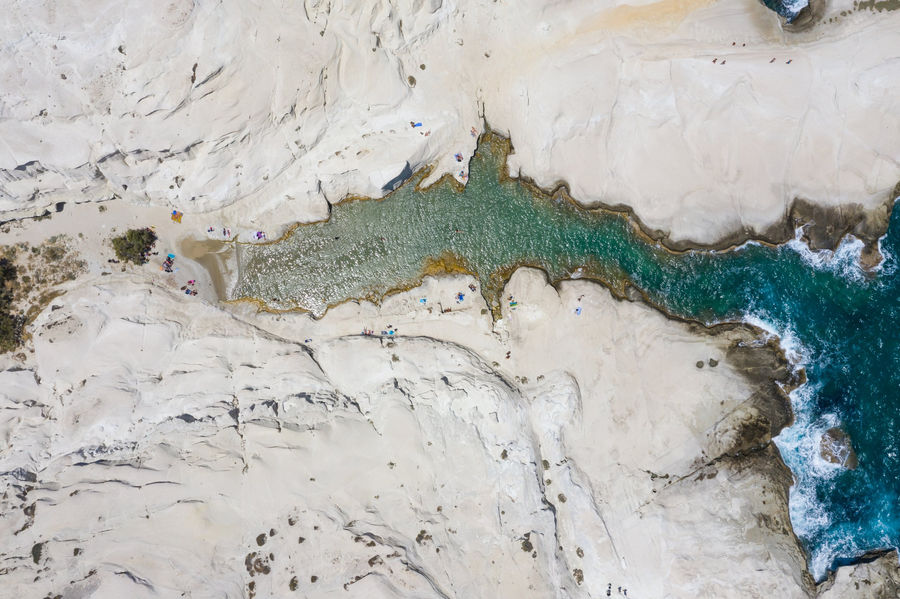
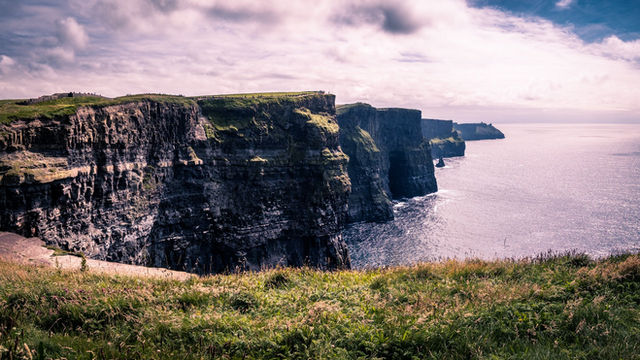
 Dramatic © dronepicr · CC BY 2.0
 Sarakiniko Beach
Blinding white volcanic rock carved into a lunar landscape that drops into deep navy water.
Best for photography & coves
The volcanic Cyclades island of surreal white rock and hidden sea caves — Sarakiniko's lunar shore, the boat-only chambers of Kleftiko and 70-odd beaches of every colour.
dronepicr / Wikimedia Commons (CC BY 2.0)
Milos is a volcanic island at the south-western edge of the Cyclades, a roughly horseshoe-shaped land mass wrapped around one of the largest natural harbours in the Mediterranean — the flooded crater of an ancient caldera, which is why the ferries and the main town of Adamas sit so deep inside the island. It is geology made scenery: mineral-streaked cliffs, sea caves, hot springs and rock in improbable whites, ochres, pinks and rust-reds, the legacy of millennia of volcanic and hydrothermal activity. Mining is not history here but a living industry — obsidian was quarried and traded across the Aegean in antiquity, and bentonite, perlite and other minerals are still extracted today, so you will pass working sites and the odd industrial scar alongside the beauty. The island's most famous export left long ago: the Aphrodite of Milos, the Venus de Milo, was dug out of a field near the ancient theatre at Tripiti in 1820 and now stands in the Louvre. Milos has more than seventy beaches of remarkable variety — white pumice coves, black-sand bays, geothermally warmed shingle — plus the surreal white moonscape of Sarakiniko and the boat-only cathedral of rock at Kleftiko. It suits independent travellers, couples and active families who will hire a car or a boat; without one, much of the island is simply out of reach. It is rising fast as the 'next Santorini' but remains, for now, quieter and less polished.
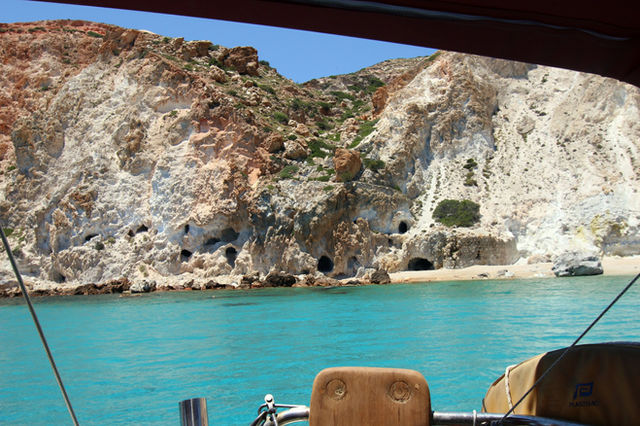
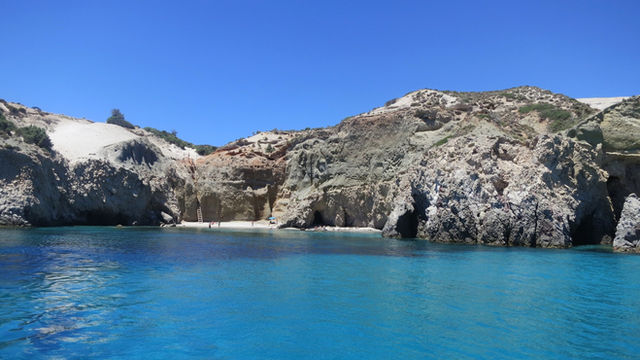
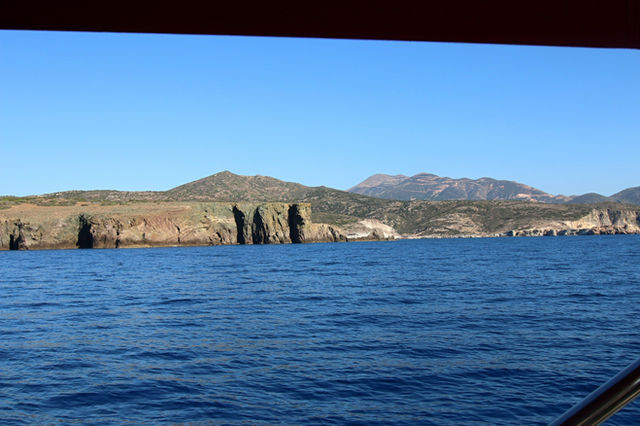
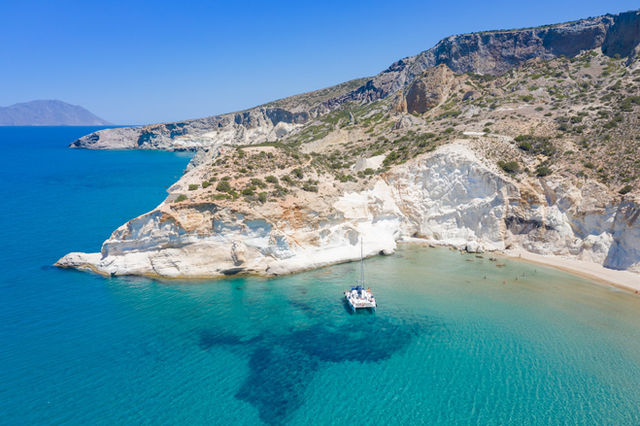
Milos offers the drama of a volcanic Cycladic island without the crush and the price ceiling of Santorini. The signature experience is a boat trip to Kleftiko, a cluster of white sea cliffs, arches and caves on the roadless south-west coast that can only be reached by water — half- and full-day sailings from Adamas or the little harbour at Agia Kyriaki drop anchor for swimming and snorkelling among the rock chambers, often taking in Poliegos and Sykia cave along the way. On land, Sarakiniko is unlike anywhere else in Greece: wind- and wave-sculpted white volcanic tuff that genuinely resembles a lunar surface, best at dawn or dusk when the low sun models the rock. Then there is the sheer beach count — Firiplaka and Tsigrado on the south coast, the warm shallows and geothermally heated sand at Paleochori, the postcard cove of Papafragas squeezed between cliffs. Add the hilltop capital of Plaka with its Venetian Kastro sunset, the colourful syrmata fishing-boat garages of Klima, Mandrakia and Firopotamos, an ancient theatre and early-Christian catacombs at Tripiti, and you have an island that rewards several days of exploration. It pairs naturally with tiny, low-key Kimolos (a 10–15 minute hop by local ferry from Pollonia) or with Sifnos and the other western Cyclades.
Milos eats well, with a cuisine that leans on the sea and on a few distinctive local specialities. Look for pitarakia (small fried cheese pies, a Milos signature), koufeto (a wedding sweet of pumpkin and honey with almonds), ladenia (a Cycladic flatbread topped with tomato and onion, often likened to a pizza without cheese), and karpouzopita (watermelon 'pie'). Seafood is the star: fresh grilled fish, octopus hung to dry and then charred, and sea urchin in season, best eaten at the waterside tavernas of Pollonia, Klima, Mandrakia (the fish taverna beside the syrmata is a local institution) and Adamas. The island produces its own capers and caper leaves, which appear in salads and dips, and there is a small but growing local wine scene. For the classic experience, book a table at a fishing-village taverna where the boats are moored a few metres away and the catch is genuinely of the day. Adamas has the broadest choice for everyday meals and self-catering supplies; the fishing hamlets have the atmosphere.
Live map of hotels and villas around Milos — powered by Stay22. Pan, zoom and compare live prices to pick your base.
Pan, zoom and compare live prices — every stay in one map.
A hire car is close to essential on Milos: the sights are scattered around a large, hilly island and many of the best beaches and villages sit at the end of rough or unsurfaced tracks. Book a car well ahead in July and August, when the island's limited fleet sells out. Some of the wildest southern beaches — Tsigrado in particular, reached by a rope-and-ladder scramble down a cliff — reward a small, high-clearance car and a willingness to walk the last stretch; a scooter or quad is fun for the paved routes but underpowered for the dirt roads and exposed in the summer wind. The single most important 'road', though, is water: Kleftiko and much of the south-west coast have no road access at all, so a boat trip (organised sailing, small-group cruise or self-drive rental where licensed) is the only way to see them. Boat tours depart mainly from Adamas and from Agia Kyriaki. Distances are short in kilometres but slow in practice thanks to winding, sometimes unpaved roads — allow more time than the map suggests, and keep the fuel topped up as filling stations are few.
Milos has a public bus network run by the local KTEL, radiating from the main square in Adamas to Plaka and Tripiti, Pollonia, Sarakiniko, Paleochori, Provatas and a few other points. Fares are cheap (roughly €2 per ride, paid on board), but the service is designed for locals and beach day-trippers rather than sightseers: frequencies are modest, timetables thin out sharply outside July and August, and many of the island's best spots — Kleftiko (boat only), Tsigrado, Firopotamos, Kastanas — are not served at all. In peak season buses to the popular beaches can be full. Taxis exist but there are very few of them on the island, so they are hard to flag on demand and best pre-booked; expect to wait. The practical upshot is that the bus can cover a car-free day or two around Adamas, Plaka and one or two beaches, but for genuine freedom to explore Milos you should hire a car. For Kimolos, the small passenger-and-car ferry runs several times daily from Pollonia to Psathi (10–15 minutes).
Go to Sarakiniko at first light or for the last hour before sunset — in the middle of a summer day the white rock throws back a blinding glare and the site is at its most crowded; early or late, the low sun models the shapes and you may have it nearly to yourself. Book your Kleftiko boat trip for early in your stay, not the last day, so you have spare days to rebook if the meltemi blows it out. For a quieter swim than the famous south-coast names, try the sheltered fishing coves of Firopotamos and Mandrakia on the north coast, or Gerakas. Tsigrado is spectacular but the rope-and-ladder descent is not for everyone — if in doubt, neighbouring Firiplaka gives you similar drama with an easy walk in. Time a late lunch at Paleochori around the geothermally warmed sand and the taverna that cooks in the volcanic heat of the ground. And keep the fuel tank half-full: petrol stations cluster near Adamas and there are none out at the far beaches. If you have a spare day, take the little ferry from Pollonia to Kimolos for an even slower, lower-key island next door.
The 7 shores actually worth the trip on Milos — ranked, with the vibe of each and where to stay nearby. Tap a card to fly the map to it.
Dramatic © dronepicr · CC BY 2.0 Blinding white volcanic rock carved into a lunar landscape that drops into deep navy water.
Best for photography & coves
Sculpted white sea-cliffs and arches ringing turquoise water — a former pirate hideout reached only by sea.
Best for boat trips & snorkelling
Colourful cliff-backed bay where underwater hot springs warm the shallows, with tavernas on the sand.
Best for warm-water swims
A 600m sweep of pale sand and pebbles beneath striped volcanic cliffs, with a swim-through rock arch.
Best for long beach days
A tiny turquoise cove hemmed by tall cliffs, with fine sand and glass-clear water made for snorkelling.
Best for adventurous swimmers
Small sheltered bay of soft golden sand with calm, shallow water and easy parking right behind it.
Best for young children
Sheltered horseshoe of golden sand below Plaka, calm for swimming and famed for its evening light.
Best for sunsets & calm swims
Milos · Around the island · 1 island · 7 beaches · 1 hotels nearby
Skip-the-line tickets and small-group tours in Milos — compare across our partners.
We're still curating hand-picked tickets and tours for Milos. In the meantime, the map above and the nearby cities are a great place to start.
May – October (June & September ideal)
Milos has a hot, dry Mediterranean climate. July and August are the peak: reliably hot (around 28–32°C), rainless, busy and increasingly pricey, and — like much of the Cyclades — subject to the meltemi, a strong north wind that can whip up the sea for days at a time and force boat trips (including to Kleftiko) to be rerouted or cancelled. May, June, September and October are the sweet spots: warm days (roughly 22–28°C), calmer seas, thinner crowds and a sea that stays swimmable well into autumn as it releases its stored summer heat. June and September in particular combine warmth, long light and manageable numbers. Spring greens the island briefly and brings wildflowers; late autumn and winter are quiet, mild and often windy, with many tourist businesses shut. Because so much of Milos is about the water — beaches you reach by boat, coves you swim into — wind matters more here than temperature: check the forecast and build flexibility into any boat plans.
Milos is a safe island with very low crime; the real hazards are practical and mostly about terrain and sea. The roads are the biggest one — narrow, winding, and in many places unsurfaced, with sudden loose gravel, blind bends and the occasional mining truck; drive slowly, especially on the dirt tracks to the southern beaches, and be wary of scooters and quads on the same roads. Several celebrated beaches involve a genuine scramble: Tsigrado is reached by a near-vertical descent using a fixed rope and a wooden ladder, and is not suitable for young children, the unsteady or anyone in flip-flops. Sarakiniko's white rock is beautiful but slippery when wet and has unfenced drops into the water — take care near the edges and mind children. On boat trips and at exposed beaches the meltemi can produce strong wind and swell; follow the skipper's judgement on whether Kleftiko is reachable. The summer sun is intense and shade is scarce on the pale rock and open beaches, so bring water, a hat and high-factor sun cream. Water shoes are useful on the pebbly and rocky shores.
Milos is a Greek Orthodox island and, away from the beaches, a fairly traditional one. The churches and the chapels dotted across the landscape are active places of worship: dress modestly to enter — shoulders and knees covered — and keep quiet inside. Beachwear belongs on the beach, not in the villages, tavernas or the lanes of Plaka. The catacombs at Tripiti are an early-Christian burial site and are treated as a place of some solemnity. Remember that Milos is a working mining island as well as a holiday one, and that many residents live here year-round; a little courtesy — a 'kalimera', patience on the single-track roads, respect for private land around the syrmata (the fishing-boat garages are people's property, not film sets) — goes a long way. Tipping is appreciated but not obligatory: rounding up or leaving five to ten per cent for good service is normal. Greeks eat late, and tavernas fill from around 9pm.
£110/day mid-range (budget £55, luxury £280+; a hire car and a Kleftiko boat trip are near-essential costs)
112 (European emergency), 100 (Greek police), 199 (fire), 166 (ambulance), 108 (Hellenic Coast Guard)
Milos Island National Airport (MLO) is a small domestic-only airport about 5km south-east of Adamas. There are no international flights: the main link is the 40–45 minute hop from Athens (ATH), flown year-round by Olympic Air (Aegean's regional arm) and Sky Express, with a handful of seasonal Aegean routes to other Greek airports. From London there is no direct option — you connect through Athens, either onward by air or by ferry. The more common and often cheaper route is the ferry: high-speed catamarans run from Piraeus (Athens' port) to Adamas in roughly 2.5–4 hours, while conventional car ferries take around 5–7 hours but cost less and are steadier in wind. Operators on the route include Seajets, Fast Ferries, Aegean Sea Lines and Minoan/ANEK Lines; services are daily and most frequent from June to September. Milos also connects by sea to neighbouring Cyclades — Sifnos, Serifos, Kimolos, Folegandros and (with changes) Santorini and Mykonos — making it easy to combine with an island-hopping route. Almost all ferries dock at Adamas.
Flights, airport transfers and car hire to MLO — search and compare without leaving the page.
Parking, holiday extras, and more — coming soon.
We're lining up parking, holiday extras and activities you'll be able to add to any trip from here.