 Long sandy © dronepicr · CC BY 2.0
 Tsambika Beach
A wide sweep of soft golden sand beneath a clifftop monastery, warm and shallow far from shore.
Best for iconic sandy day out
A sun-baked Dodecanese island crowned by the best-preserved medieval walled town in Europe, ringed by beaches and ancient ruins.
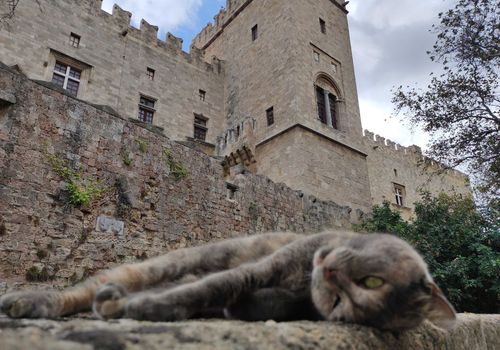
Rhodes (Greek: Ρόδος, Ródos) is the largest of the Dodecanese islands, lying in the south-eastern Aegean off the coast of Turkey, from which it is separated by a narrow strait. It is a substantial island — roughly 80km long — with a permanent population of around 115,000, most of it concentrated in and around Rhodes Town at the northern tip. What sets Rhodes apart from the Cyclades is its layered history worn openly on the surface: the medieval walled city of Rhodes Town, built by the Knights Hospitaller of St John in the 14th and 15th centuries, is a UNESCO World Heritage Site and the oldest continuously inhabited medieval town in Europe, its cobbled Street of the Knights, moated fortifications and reconstructed Palace of the Grand Master enclosing a living town of tavernas, shops and homes. Beyond the walls, the island offers the near-vertical whitewashed village of Lindos below its ancient acropolis, the sandy east-coast resorts around Faliraki, wooded interior hills, the seasonal spectacle of the Valley of the Butterflies, the wind-swept sandbar of Prasonisi and the ruins of Ancient Kamiros. The climate is one of the warmest and sunniest in Greece, with a long swimming season. Rhodes works for almost every kind of traveller — culture-seekers, families, beach holidaymakers and watersports enthusiasts — which is precisely why it is also one of Greece's busiest islands in high summer.
Rhodes gives you two islands in one: a serious historical destination and a straightforward sun-and-sea holiday. The medieval Old Town is the headline — you can walk the full circuit of the walls, cross the dry moat, climb through the Palace of the Grand Master and follow the Street of the Knights past the medieval inns of the different national tongues of the Order, all within a still-inhabited walled city rather than a museum. Add the ancient dimension: Lindos, whose Doric acropolis above a whitewashed village and the sheltered horseshoe of St Paul's Bay is one of the most photographed views in Greece; Ancient Kamiros, a remarkably complete Hellenistic town site; and the ghost of the Colossus of Rhodes, the vanished bronze giant counted among the Seven Wonders of the Ancient World that once stood at the harbour mouth. Then there is the coast — the emerald cove of Anthony Quinn Bay, the long beaches around Faliraki, and the double-sided sandspit of Prasonisi at the southern tip, one of Europe's best beginner-to-intermediate windsurfing and kitesurfing spots. The long, reliably sunny season means you can combine all of this comfortably from April to October. Rhodes pairs well with the smaller Dodecanese islands — Symi, Chalki, Kos and Kastellorizo are all reachable by boat — or with a day trip across to Marmaris or Fethiye in Turkey.
Rhodian cooking is Dodecanese island food with a few local signatures. Look for pitaroudia (chickpea-and-herb fritters, a Rhodian speciality), melekouni (a sesame-and-honey bar traditionally served at weddings and celebrations), giouvarelakia (meatball-and-rice soup), and fresh seafood — grilled octopus, calamari, red mullet and the small local shrimp. Local cheeses and the island's own honey and thyme feature widely, and the surrounding Aegean supplies the fish. Rhodes has a genuine wine tradition centred on the village of Embonas on the slopes of Mount Attaviros, where the white Athiri grape and the local red are the mainstays — several wineries (the CAIR cooperative and family estates such as Emery) welcome visitors for tastings. In Rhodes Town, avoid the tourist-trap tavernas on the busiest Old Town lanes and head for the quieter back streets or the New Town's local eateries; in Lindos, the rooftop tavernas trade partly on the view. Souma, a local grape-distillate spirit similar to tsipouro, is the traditional after-dinner drink. Frappé and freddo coffees fuel the afternoons, as everywhere in Greece.


Live map of hotels and villas around Rhodes — powered by Stay22. Pan, zoom and compare live prices to pick your base.
Pan, zoom and compare live prices — every stay in one map.
Rhodes is a big island and the sights are spread out, so a hire car is the most flexible way to see it — the coastal roads are good and it is an easy drive from Rhodes Town down the east coast to Lindos (about an hour) and on to Prasonisi at the southern tip. Car hire is widely available at the airport and in the resorts; drive on the right, and note that parking inside and around the Old Town is very limited (the walled city itself is pedestrianised). Scooters, ATVs and quad bikes are offered everywhere in the resorts and are popular for short hops, though the fast main roads make them riskier than on smaller islands. For those without a car, the island's public buses connect Rhodes Town with Faliraki, Lindos, the west-coast resorts and the airport reasonably well in season. Excursion boats and day-trip catamarans run from Mandraki harbour in Rhodes Town to Lindos, Symi and the Turkish coast. Within Rhodes Town, and within Lindos, walking is the only real option in the historic cores — both are car-free warrens of lanes and steps.
Rhodes has two intercity bus networks running from Rhodes Town: RODA serves the west coast, the airport and the interior, while KTEL serves the east coast down to Lindos and the south. Buses depart from the terminals beside the New Market (Nea Agora) near Mandraki harbour. Services to the main east-coast resorts — Faliraki, Kolymbia, Lindos — are frequent in high season (roughly hourly or better), with fares in the low single-digit euros; the run to Lindos takes around 1½ hours. Buy tickets at the kiosk or from the driver. Frequencies drop sharply out of season and on Sundays, and buses fill up on peak-summer afternoons, so check return times. Local city buses circle Rhodes Town and reach the nearer beaches. Taxis are metered and readily found in Rhodes Town and the resorts, with fixed tariffs from the airport; they are a sensible option for late arrivals or for reaching Lindos when the last bus has gone. Boat excursions (a form of transport in their own right) leave Mandraki daily in season for Lindos and the neighbouring islands.
Walk the Old Town after the day-trippers and cruise passengers leave in the late afternoon — the walled city transforms once the crowds thin, and the back lanes away from Sokratous (the main shopping street) are quiet and atmospheric at any hour. You can walk a section of the medieval walls and the dry moat, which most visitors miss. For Lindos, arrive at opening time or in the last hours before the acropolis closes to dodge both the heat and the tour groups; St Paul's Bay below the village is a beautiful, sheltered swim. Anthony Quinn Bay is stunning but small, rocky underfoot and packed by mid-morning in summer — go early and bring water shoes. Ancient Kamiros is far less visited than Lindos and rewards the drive with a remarkably complete Hellenistic town plan. For the Valley of the Butterflies, come in July or August when the moths are actually present (out of season it is a pleasant but butterfly-free wooded gorge), tread quietly and never clap to make them fly — it exhausts the resting insects. Serious wine drinkers should drive up to Embonas for a winery tasting and lunch. And for a memorable day out, take the fast catamaran to tiny Symi, whose neoclassical harbour is one of the prettiest in the Aegean.
The 7 shores actually worth the trip on Rhodes — ranked, with the vibe of each and where to stay nearby. Tap a card to fly the map to it.
Long sandy © dronepicr · CC BY 2.0 A wide sweep of soft golden sand beneath a clifftop monastery, warm and shallow far from shore.
Best for iconic sandy day out
 Secluded © Francesco Laffi · CC BY-SA 3.0
 A near-landlocked twin cove ringed by cliffs, with the Lindos Acropolis rising straight overhead.
Best for scenic sheltered swim
 Snorkelling © Pjotr Mahhonin · CC BY-SA 4.0
 Deep emerald water over rock and sea-grass makes this tiny pine-fringed cove the island's top snorkel.
Best for snorkelling over rocks
 Dramatic © Sal73x · CC BY-SA 3.0
 A wind-scoured sand spit where two seas meet: calm lagoon on one flank, breaking surf on the other.
Best for windsurfing & kitesurfing
 Swimming © dronepicr · CC BY 2.0
 Rhodes Town's own beach, where a tall diving platform lets you leap straight into deep, clear water.
Best for diving platform swims
A sheltered horseshoe of fine sand where the sea shelves so gently kids can wade out for metres.
Best for young families
A five-kilometre resort strand lined with water sports and beach bars that run well past sunset.
Best for watersports & nightlife
Rhodes · Around the island · 1 island · 7 beaches · 1 hotels nearby · 4 attractions
Skip-the-line tickets and small-group tours in Rhodes — compare across our partners.
Rhodes
🎧 2 hours
from £4.26
View & book →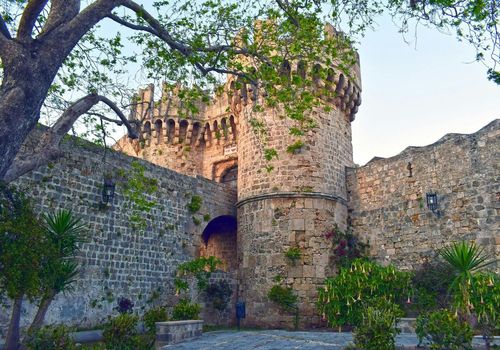
Rhodes
from £0
View & book →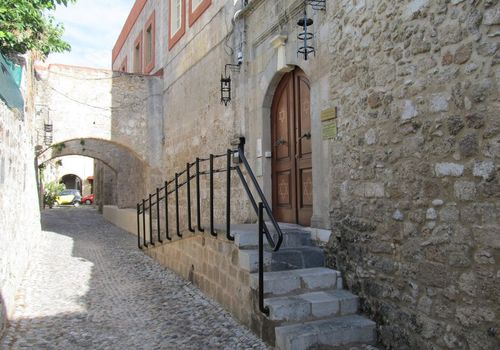
Rhodes
🎧 2 hours
from £8.53
View & book →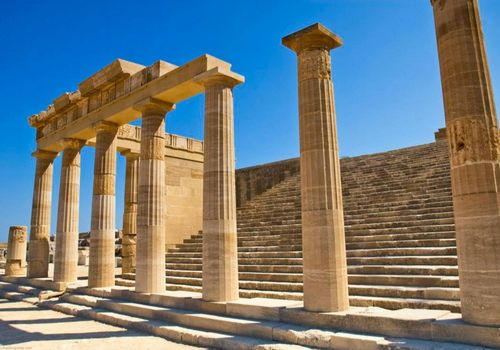
Rhodes
from £25.91
View & book →May – October
Rhodes has a hot-summer Mediterranean climate and is among the sunniest places in Greece, with a long, dependable warm season. July and August are hot and dry (typically 30–33°C by day, occasionally higher), busy and expensive; the sea is at its warmest and the swimming excellent, but midday heat at exposed sites like Lindos acropolis and the Old Town walls can be punishing. The prevailing summer wind is a north-westerly (a local meltemi) that cools and roughens the west and southern coasts — welcome for windsurfers at Prasonisi, less so for calm-water swimmers, who should favour the sheltered east coast. The best months for a general visit are May–June and September–early October: warm (22–28°C), the sea swimmable well into autumn, and the crowds thinner. April and late October are pleasant but cooler and unsettled, with some tourist businesses still shut or already closing. Winters are mild and green but wet, and much of the resort infrastructure closes down. The Valley of the Butterflies is a summer phenomenon — the Jersey tiger moths gather from around June to September, peaking in August.
Rhodes is a safe destination with very low levels of violent crime; the main risks are the ordinary ones of a busy Mediterranean holiday island. Scooter, quad and ATV accidents are the most common cause of serious injury to visitors — the fast main roads, unfamiliar machines and, too often, no helmet make these genuinely dangerous; if you hire one, wear the helmet and stay off the highways. Driving generally is easy but watch for aggressive overtaking on the coast roads. In the sea, the windward west and south coasts can be choppy with strong offshore winds — fine for experienced windsurfers, hazardous for casual swimmers and inflatables, so prefer the sheltered east-coast beaches with families. The summer sun is strong: the Old Town, the Lindos acropolis and Ancient Kamiros offer little shade, so carry water, a hat and high-factor sun cream, and time visits for early morning or late afternoon. Petty theft is uncommon but takes normal precautions in crowded tourist areas. In summer, be wildfire-aware in the wooded interior and heed any local warnings — parts of the island were affected by fires in recent years. The standard Greek emergency number is 112.
Rhodes is a Greek Orthodox island, and its churches and monasteries (including the hilltop Filerimos and the monastery of Tsambika) are active places of worship — cover shoulders and knees to enter, and behave quietly inside. The Old Town also carries deeper layers of history: an Ottoman-era mosque and hammam, and a Jewish Quarter (La Juderia) with a surviving synagogue and a moving Holocaust memorial recording the near-total deportation of the island's ancient Jewish community in 1944 — worth visiting with the respect the place deserves. Greeks are hospitable and relaxed; a little courtesy (a greeting, patience over the leisurely pace of service) goes a long way. Dress is casual in the resorts, but beachwear is out of place in town churches, tavernas and the Old Town's shops. Tipping is appreciated but not obligatory — rounding up or leaving a few euros is normal. Bargaining is not customary in shops or restaurants, though it is sometimes expected in the Old Town's tourist souvenir stalls. As across Greece, lunch and dinner run late by British habits.
£95/day mid-range (budget £45, luxury £250+; Lindos and Old Town boutique stays cost more)
112 (European emergency), 100 (Greek police), 199 (fire), 166 (ambulance), 108 (Hellenic Coast Guard)
Rhodes International Airport "Diagoras" (RHO) sits on the west coast about 14km southwest of Rhodes Town, near Paradeisi, and is one of Greece's busiest airports. Through the summer season (roughly April–October) it receives direct flights from London and other UK cities on easyJet, Jet2, TUI, Ryanair and British Airways, plus charter and package flights from across Europe; the flight from London takes around 4 to 4½ hours. Outside the summer season, direct UK flights thin out and most itineraries connect through Athens, with Aegean and Sky Express running frequent domestic hops (about 55 minutes). By sea, Rhodes is the hub of the Dodecanese: overnight and daytime ferries from Piraeus (Athens) take roughly 12–15 hours on conventional vessels (Blue Star Ferries), while high-speed catamarans (Dodekanisos Seaways, Sea Dreams) and conventional ferries link Rhodes to the other Dodecanese islands — Kos, Symi, Chalki (Halki), Tilos, Nisyros, Patmos and remote Kastellorizo. Rhodes is also the main Greek gateway to south-west Turkey: seasonal fast catamarans and ferries cross to Marmaris (about 1 hour) and Fethiye (roughly 1½–2 hours), running morning and evening from about May to October — useful for a day trip or an onward connection.
Flights, airport transfers and car hire to RHO — search and compare without leaving the page.
Parking, holiday extras, and more — coming soon.
We're lining up parking, holiday extras and activities you'll be able to add to any trip from here.