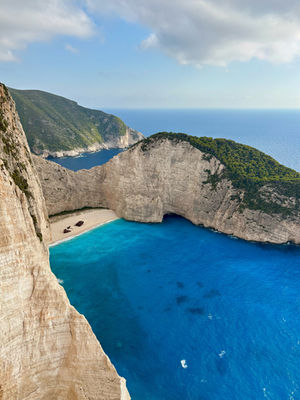
 Dramatic © kallerna · CC BY-SA 4.0
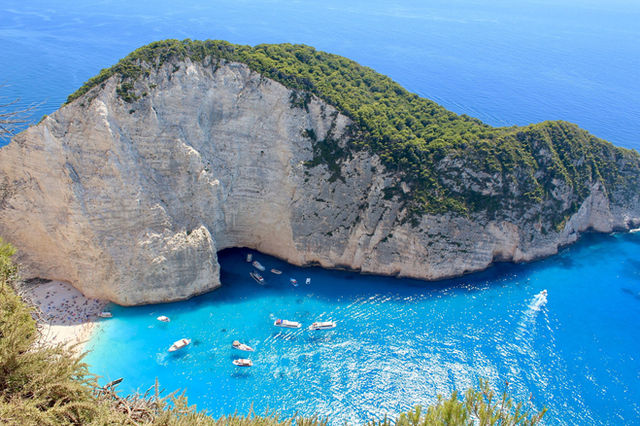
 Navagio Beach (Shipwreck Beach)
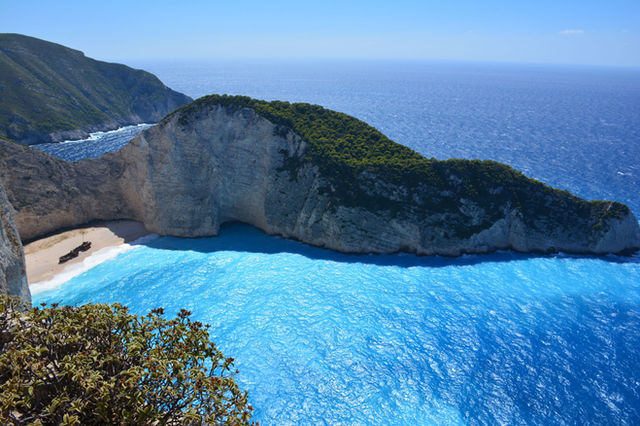
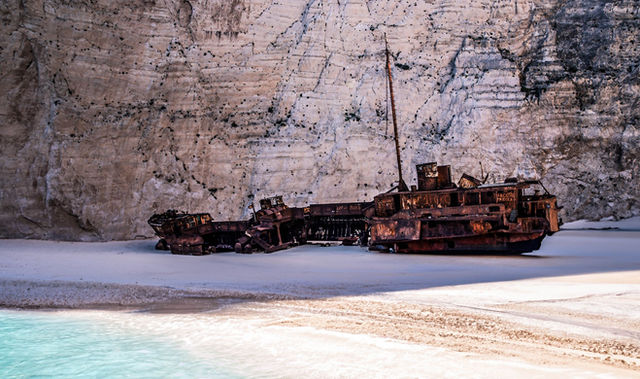
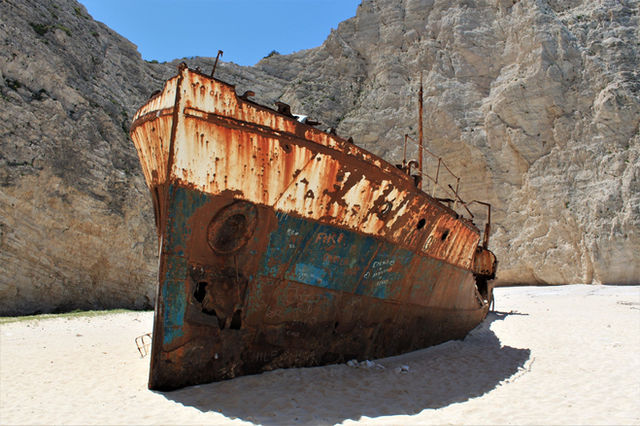
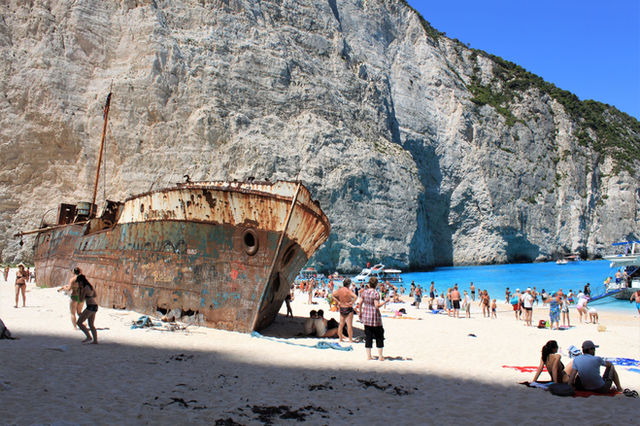
A rusted shipwreck on white sand walled in by sheer cliffs above glowing turquoise water.
Best for iconic photos & boat trips
Home to the iconic Navagio 'shipwreck' beach and the electric-blue caves — a Ionian island of dazzling turquoise.
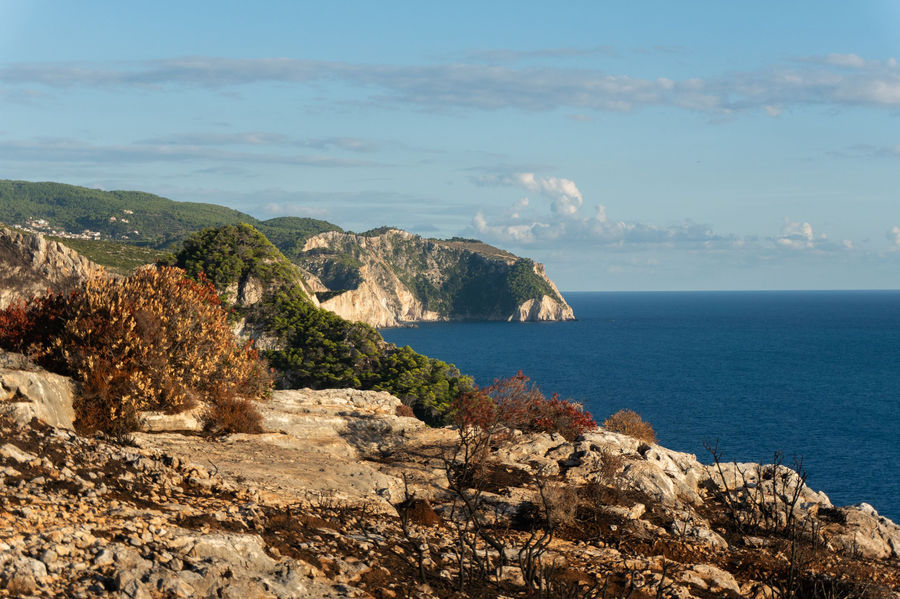
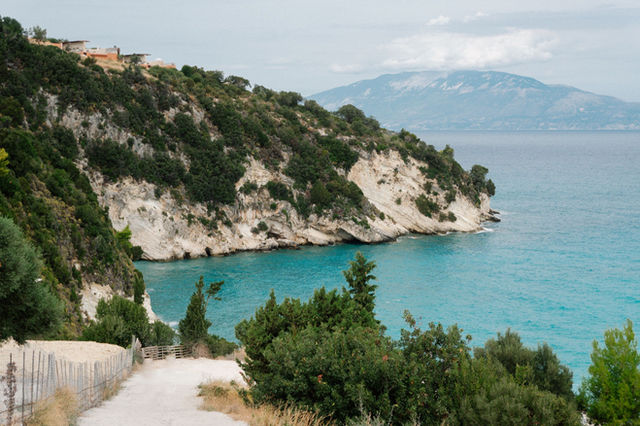
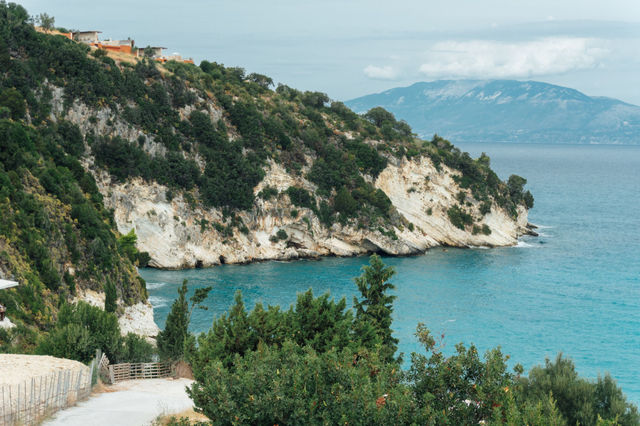
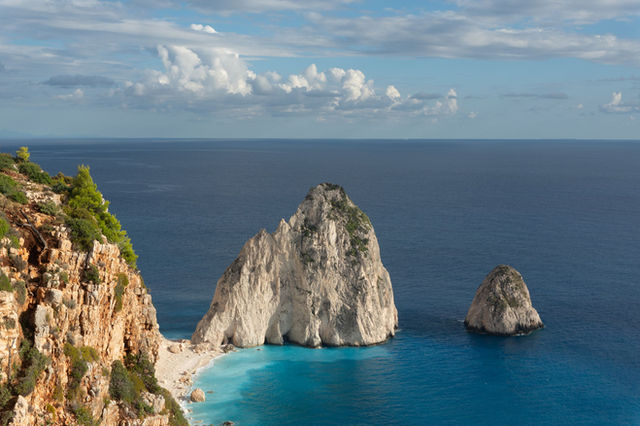
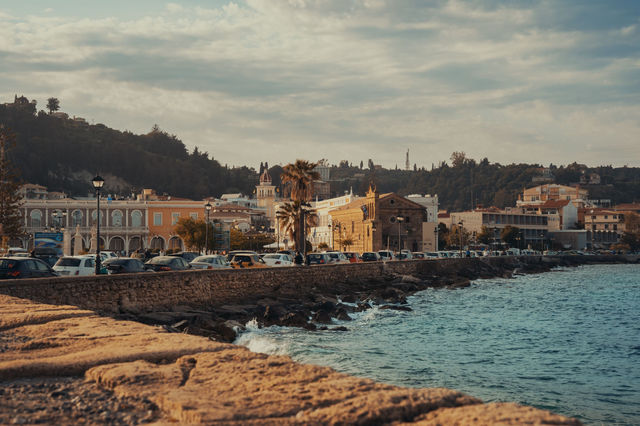
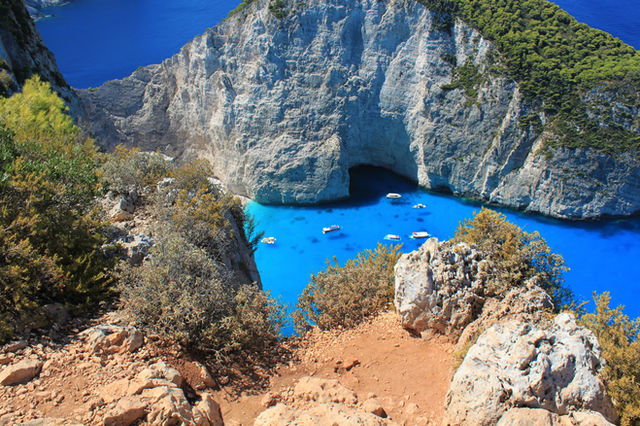
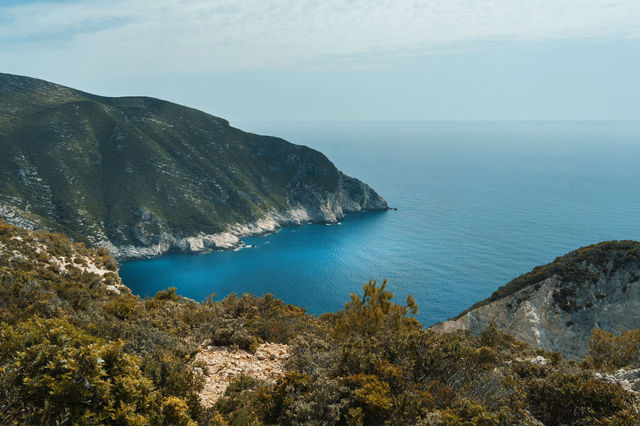
Zakynthos (Zante in Italian, still widely used) is the southernmost of the large Ionian islands, lying off the west coast of the Peloponnese in the Ionian Sea. It is a substantial island — around 410 sq km with a year-round population of roughly 40,000 — and geographically it is a place of two halves. The west and north are mountainous and dramatic: sheer white limestone cliffs plunge into an intensely turquoise sea, hiding coves such as Navagio (the famous Shipwreck cove) and the sea caves of the northern Cape Skinari. The east and south are gentler, with the island's beaches, resorts, olive groves and the fertile central plain that gives Zakynthos its notably green, verdant character — a contrast to the arid Cyclades. The capital, Zakynthos Town, sits on the sheltered east coast beneath the hilltop suburb of Bochali, rebuilt in a Venetian-influenced style after the catastrophic 1953 earthquake that levelled much of the island. Zakynthos carries two very different reputations at once. It is a serious wildlife destination — Laganas Bay hosts one of the Mediterranean's most important loggerhead sea turtle nesting populations, protected within Greece's first National Marine Park. It is also, in Laganas resort itself, one of Greece's most concentrated cheap-package party strips. Which island you experience depends almost entirely on where you choose to base yourself, and this guide is candid about that trade-off.
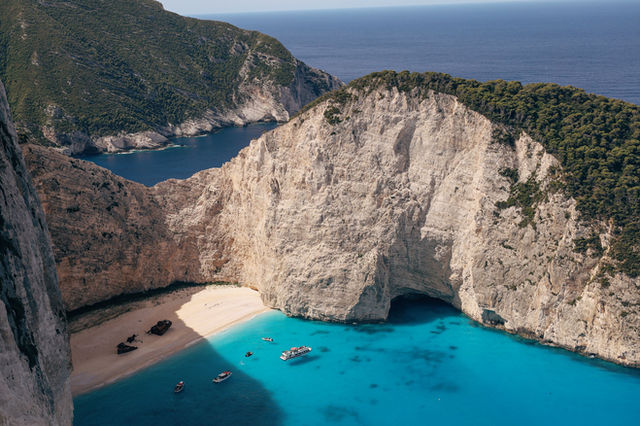
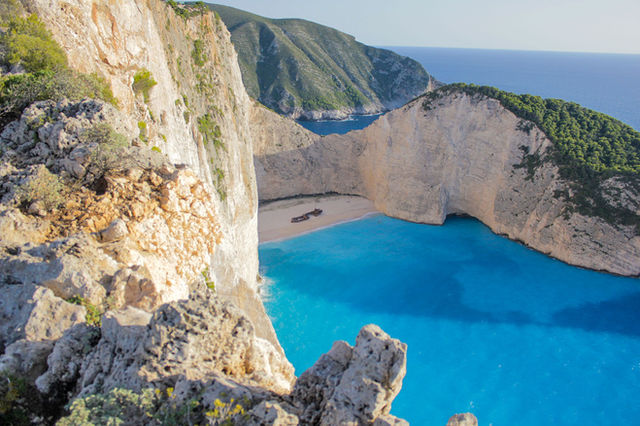
The headline is Navagio — the Shipwreck cove, where the rusting hull of the MV Panagiotis (a smuggler's coaster wrecked in 1980) sits on a crescent of white sand hemmed by towering pale cliffs, reachable only by boat. It is the single most photographed beach in Greece and, seen from the clifftop viewpoint above, one of the great coastal panoramas of the Mediterranean. But Zakynthos rewards travellers who look past the one image. The Blue Caves at the northern tip of Cape Skinari are a network of sea grottoes where the water glows an unreal electric blue; small boats from Agios Nikolaos take you right inside. The island's protected loggerhead turtles (Caretta caretta) can be seen from responsible boat trips in Laganas Bay and, with luck and patience, swimming near Keri and Marathonissi islet. The Keri caves and the dramatic sea arches of the southwest coast, the sulphur springs at Keri, the green mountain villages of the interior, and the Venetian-flavoured cafés of Zakynthos Town and Bochali all add depth. Zakynthos pairs naturally with neighbouring Kefalonia (a short ferry hop north) for a two-island Ionian trip, or with the Peloponnese mainland (Olympia is a feasible day's excursion via the Kyllini ferry) for a coast-and-classical-sites combination.
Zakynthos has a distinct Ionian food culture with Venetian and Italian echoes, richer and more herb-driven than Aegean island cooking. Local specialities to seek out include ladotyri (a hard, oil-cured island cheese), skordostoumbi (aubergines stewed with plenty of garlic and tomato), sartsa (a slow-cooked beef-and-tomato dish), rabbit stifado, and abundant fresh fish and grilled octopus in the coastal tavernas. The island is famous for its mandolato — a soft nougat of honey, egg white and almonds sold everywhere as the local sweet — and for pasteli (sesame-and-honey bars). Zakynthos also has a genuine wine tradition: look for the local Verdea, a traditional dry white blend, at village tavernas and small producers in the interior. For character, eat away from the Laganas strip (where the offering skews to British-package fare and international fast food): the tavernas of Zakynthos Town's back streets and Bochali, the fishing-village kitchens of Limni Keri and Agios Nikolaos, and the family tavernas of Vasilikos serve the real thing. Café culture on the town waterfront — a frappé or a Greek coffee watching the harbour — is a fixture of local life.

Live map of hotels and villas around Zakynthos — powered by Stay22. Pan, zoom and compare live prices to pick your base.
Pan, zoom and compare live prices — every stay in one map.
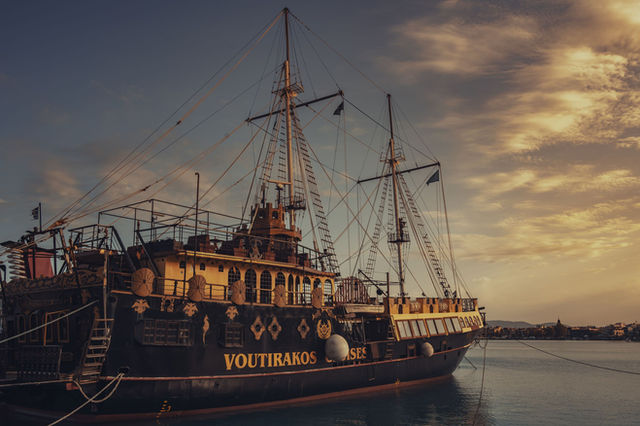
Zakynthos is a big island by Greek-holiday standards and the best sights are spread far apart — the Shipwreck viewpoint and Blue Caves are a good hour's drive north from the southern resorts — so hiring a car is strongly recommended for anyone wanting to explore beyond their base. Car hire is widely available and roads are generally decent, though the mountainous north and west have steep, winding, narrow sections that demand care. Scooters and quad bikes (ATVs) are popular in the resorts and cheap to rent, but they have a poor accident record here as elsewhere in Greece; a licence and helmet are legally required. Boat trips are effectively part of the transport network: the classic full-day cruise from the east-coast ports or from Agios Nikolaos loops up to the Shipwreck cove (viewed from the water — you can no longer land, see the FAQ) and into the Blue Caves, while smaller local boats from Agios Nikolaos and Skinari run shorter Blue Caves trips. In the south, boats from Keri and Laganas run responsible turtle-spotting and Marathonissi-islet excursions. Taxis are metered and reasonable for short hops but expensive for cross-island journeys.
The island's public transport is the KTEL bus network, based at the terminal in Zakynthos Town. Buses radiate from the capital to the main resorts and larger villages — Laganas, Kalamaki, Tsilivi, Alykes, Argassi and Keri among them — and fares are low (a few euros per journey; buy from the terminal or on board). Frequency is reasonable on the busy southern and eastern resort routes in high season, but thin to the mountainous north and west, where some villages get only a couple of buses a day and none conveniently timed for sightseeing. There is no bus that meaningfully serves the Shipwreck viewpoint or Blue Caves. In practice the buses are fine for getting between town and the main beach resorts on a budget, but they are not a substitute for a car if you want to reach the island's dramatic north and west or travel on your own schedule. Taxis fill the gaps but the cost of long cross-island fares adds up quickly.
See the Shipwreck cove twice, in two ways: from the water on a boat trip for the wreck-and-cliffs perspective, and from the clifftop viewing platform above (reached via the road past Anafonitria) for the aerial panorama — go early morning or late afternoon to dodge both the tour-bus crush and the harsh midday glare. For the Blue Caves, take the small local boats from Agios Nikolaos or Skinari rather than the big cruise boats: they go right inside the grottoes where the water glows blue, and early morning light is best. In the south, book turtle-spotting from Limni Keri rather than Laganas — smaller boats, quieter water and reputable skippers who keep their distance from the animals. The Vasilikos peninsula's Gerakas is the most beautiful of the protected beaches and far calmer than Laganas. For sunset, Cape Skinari's windmill terraces and the Kampi cliffs on the west coast (with its clifftop taverna) are the island's finest, well away from the resort crowds. And spend an evening in Bochali above the town for the harbour view and genuinely local tavernas.
The 7 shores actually worth the trip on Zakynthos — ranked, with the vibe of each and where to stay nearby. Tap a card to fly the map to it.
Dramatic © kallerna · CC BY-SA 4.0 A rusted shipwreck on white sand walled in by sheer cliffs above glowing turquoise water.
Best for iconic photos & boat trips
 Snorkelling © dronepicr · CC BY 2.0
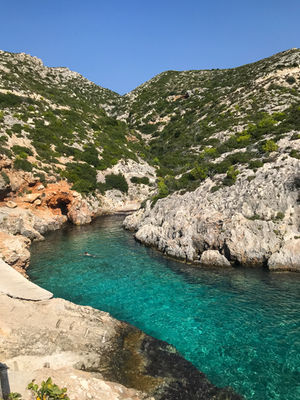
 A narrow rocky fjord-like inlet where you leap from limestone ledges into deep, glass-clear water.
Best for snorkelling & cliff jumping
 Family © kallerna · CC BY-SA 4.0
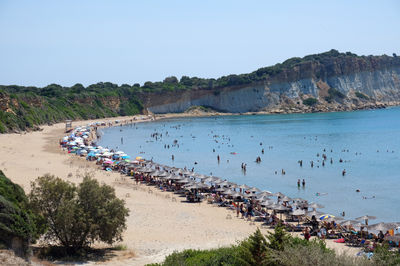
 Soft golden sand and warm shallow water backed by sculpted clay cliffs on the protected Vasilikos tip.
Best for young kids & calm shallows
Nearly a kilometre of fine golden sand with watersports, sunbeds and bars on the sheltered coast.
Best for watersports & sunbathing
 Swimming © dronepicr · CC BY 2.0
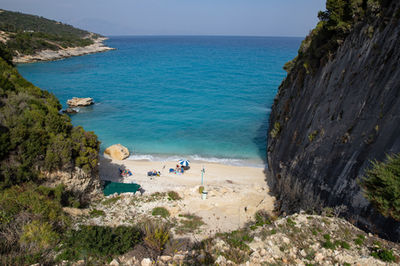
 A tiny pebble cove where cold sulphur springs turn the sea milky and cool — a natural, bracing spa swim.
Best for therapeutic dip
A pocket-sized pebble cove backed by cliffs, with sea caves and clear water made for exploring by mask.
Best for sea caves & quiet swims
A vast sweep of shallow sandy shore fronting the island's loudest strip of bars, clubs and tavernas.
Best for nightlife & lively days
Zakynthos · Around the island · 1 island · 7 beaches
Skip-the-line tickets and small-group tours in Zakynthos — compare across our partners.
We're still curating hand-picked tickets and tours for Zakynthos. In the meantime, the map above and the nearby cities are a great place to start.
June – October
Zakynthos has a Mediterranean climate, but as an Ionian island it is noticeably greener and wetter in winter than the Cyclades, which is what keeps its interior so verdant. Summers (June–September) are hot, dry and reliably sunny, with July and August daytime temperatures around 30–33°C and warm seas — this is peak season, busiest and most expensive, and Laganas at its loudest. May, June, September and early October are the sweet spot: warm (mid-20s°C), the sea comfortably swimmable (the Ionian holds its warmth into autumn), fewer crowds and better value. May and October bring occasional rain but plenty of fine weather and green landscapes. Winter (November–March) is mild but genuinely wet and windy, with many resorts, tavernas and boat operators closed; the island turns lush and quiet, and only Zakynthos Town keeps a normal rhythm. The turtle nesting and hatching season runs roughly June to October, overlapping the main summer visitor window.
Zakynthos is a safe destination with very low violent crime; the main risks are practical rather than criminal. Scooter, quad-bike and car accidents on the steep, winding mountain roads of the north and west are the most serious hazard — drive cautiously, wear a helmet, and be wary of loose gravel and blind bends. The famous clifftops, above all the Shipwreck (Navagio) viewpoint, have genuinely dangerous exposed edges with limited or no barriers, and the surrounding slopes are geologically unstable (landslides prompted the beach's closure — see the FAQ); stay well back from the edge and heed all barriers and signs. Sea conditions are usually calm on the sheltered south and east coasts, but the open west can have swell and currents. In Laganas, the ordinary caution of any busy party resort applies — pace alcohol, watch drinks, and keep valuables secure. The Mediterranean summer sun is strong; sunburn and dehydration are the commonest complaints. For turtle-watching, choose reputable operators (see culture and etiquette): careless boats are a real hazard to the animals, not just an ethical concern.
Zakynthos is a Greek Orthodox island with a strong devotion to its patron, St Dionysios, whose grand church in the capital is an active place of pilgrimage — dress modestly (shoulders and knees covered) and behave quietly when visiting churches and monasteries such as Anafonitria in the north. The most important local etiquette, though, concerns the turtles. Laganas Bay and the beaches of Gerakas, Sekania, Daphni, Kalamaki, East Laganas and the Marathonissi islet lie within the National Marine Park of Zakynthos, Greece's first, established to protect the loggerhead nesting population. On the nesting beaches, access is permitted only from 07:00 to sunset, and umbrellas, sunbeds, vehicles, dogs, music and water sports are prohibited or tightly restricted (at Gerakas visitors must keep within a few metres of the waterline); do not touch turtles or nests, flatten any sandcastles before leaving so hatchlings aren't trapped, and never use flash photography. For boat turtle-watching, choose operators who keep engines slow, keep their distance and don't crowd or chase the animals — the responsible ones advertise this, and it matters. Beyond that, ordinary Greek courtesies apply: a relaxed pace, generous hospitality, and later dining hours (tavernas fill from 8pm).
£95/day mid-range (budget £50, luxury £220+)
112 (European emergency), 100 (Greek police), 199 (fire), 166 (ambulance), 108 (Hellenic Coast Guard)
Zakynthos International Airport "Dionysios Solomos" (ZTH), 4–6km south of Zakynthos Town near Laganas, is the island's gateway. In summer (roughly April–October) it receives a heavy programme of direct flights and charters from the UK — Jet2, easyJet, Ryanair and TUI fly from London Gatwick and Luton, Manchester, Birmingham, Leeds Bradford, Bristol, Glasgow and other regional airports, with a flight time of about 3.5–4 hours. Direct UK service is highly seasonal; outside summer you generally connect through Athens on Aegean/Olympic (a short domestic hop) and then transfer, or arrive by ferry. By sea, the standard route is the Levante Ferries crossing from Kyllini on the western Peloponnese to Zakynthos Town, taking roughly 1 hour 15 minutes on the fast service, with multiple daily sailings in summer and space for cars — the practical option if you are combining Zakynthos with a Peloponnese road trip. A separate smaller ferry links Agios Nikolaos in the island's north with Pesada on Kefalonia in high season, useful for island-hopping.
Flights, airport transfers and car hire to ZTH — search and compare without leaving the page.
Parking, holiday extras, and more — coming soon.
We're lining up parking, holiday extras and activities you'll be able to add to any trip from here.