
← Poland
POLAND · CITY

Warsaw

The 'phoenix city' — a resilient Polish capital whose old town was rebuilt brick by brick after wartime destruction.

  • City
  • May to September for warmth; late spring and early autumn for the best balance
  • ~approx 2–3 days
  • Rebuilt Old Town
  • Chopin & Palaces
  • Vodka & Milk Bars
  • A City That Came Back

A pastel market square that looks medieval but isn't quite, a Stalinist skyscraper glowering over it all, and Chopin drifting out from a lakeside park on a Sunday afternoon.

Warsaw was flattened in the war and rebuilt from paintings and memory, and that story is the key to it — a faithfully reconstructed old town beside a hard, modern capital of glass towers, green parks and one of Europe's best food scenes. It is a city with something to prove, and it delivers.

Type
metropolis
Ideal length
~approx 2–3 days
Getting around
a metro, extensive trams, and a walkable core
Neighbourhoods
6 areas
Best season / months
May to September for warmth; late spring and early autumn for the best balance
Language
Polish
Currency
Polish złoty (zł)
Budget level
low to moderate — excellent value for a capital
Good for
  • History
  • Museums
  • Food
  • Music
▸ Discover

About Warsaw

Warsaw sits on the Vistula in central Poland, the river splitting the grand, rebuilt left bank from the grittier, artsy right-bank district of Praga. Almost nothing here is genuinely old — the city was systematically destroyed in 1944 and reconstructed afterwards, the old town brick by brick from pre-war paintings. The result is a capital of layers: a reconstructed medieval core, a Stalinist landmark, communist-era blocks, and a shiny new business district, all threaded with generous parks. The metro and trams tie it together.

Why go

Warsaw is not the postcard-pretty Poland of Kraków — it is more interesting than that. The reconstruction story is extraordinary, the wartime and Jewish-history museums are among the best in Europe, and the modern city is energetic, green and eating and drinking exceptionally well for the price. It rewards curiosity over box-ticking, and it costs a fraction of a western capital.

Don't miss

  • The Old Town — meticulously rebuilt after wartime destruction
  • The Palace of Culture and Science — the Stalinist landmark skyscraper
  • Łazienki Park — the palace-on-the-water and Sunday Chopin concerts
  • POLIN Museum — the history of Polish Jews on the ghetto site
  • The Warsaw Uprising Museum — the 1944 rising told in full

Signature experiences

The reconstruction story — Start in the Old Town, but read it right: this is a rebuild, raised from rubble after 1944 using pre-war paintings and photographs, and the more you know that, the more moving the pastel square becomes. The Warsaw Uprising Museum tells the story of the rising that led to the city's destruction; the Royal Castle shows what was recreated inside. It is a city defined by loss and stubborn recovery. **Jewish Warsaw and its memory** — Before the war, a third of Warsaw was Jewish; the ghetto and its people were destroyed. The POLIN museum, built on the ghetto site, tells a thousand years of Polish-Jewish life brilliantly, and the memorials around Muranów mark what was lost. It is essential, sobering history, told with care. **Chopin and the parks** — Warsaw claims Chopin, and it shows in the best way in Łazienki Park, where free open-air piano recitals play by the Chopin monument on summer Sundays, peacocks wandering the lawns. The city is unusually green — Łazienki, the Saxon Garden, the riverbanks — and a park afternoon is part of the rhythm. **Vodka, milk bars and the new food** — Warsaw eats well at both ends. The milk bar (bar mleczny) serves home-style pierogi and soup for pennies, a communist-era relic worth trying; at the other end, a genuinely exciting modern-Polish restaurant scene has grown up, and the vodka — flavoured, chilled, taken with food — is done properly. The Koneser distillery in Praga tells the story.

Neighbourhoods

Warsaw neighbourhood by neighbourhood — the character of each and who it suits.

  • Stare Miasto

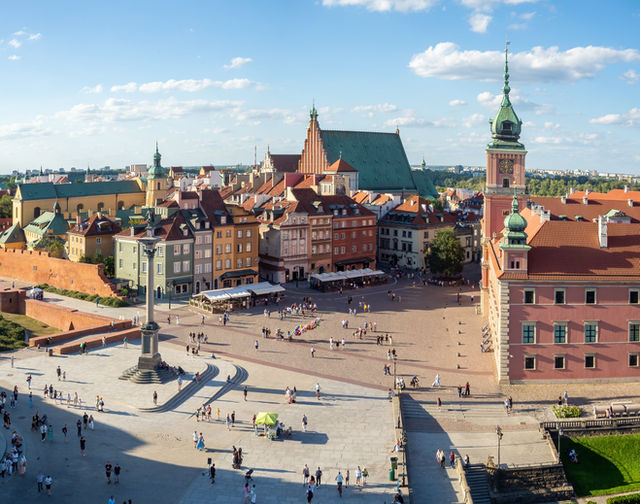
    The reconstructed old town — a pastel market square, city walls and a royal castle rebuilt after 1944 so faithfully it earned a place on the heritage list for the reconstruction itself.

    Why go
    The rebuilt medieval core and its remarkable back-story.
    Best for
    First-time sightseeingthe market squarehistory
    Known for
    The Royal Castle and Castle Square with its column, the Old Town Market Square and the Mermaid statue, the rebuilt city walls and Barbican, and St. John's Cathedral.
  • Śródmieście

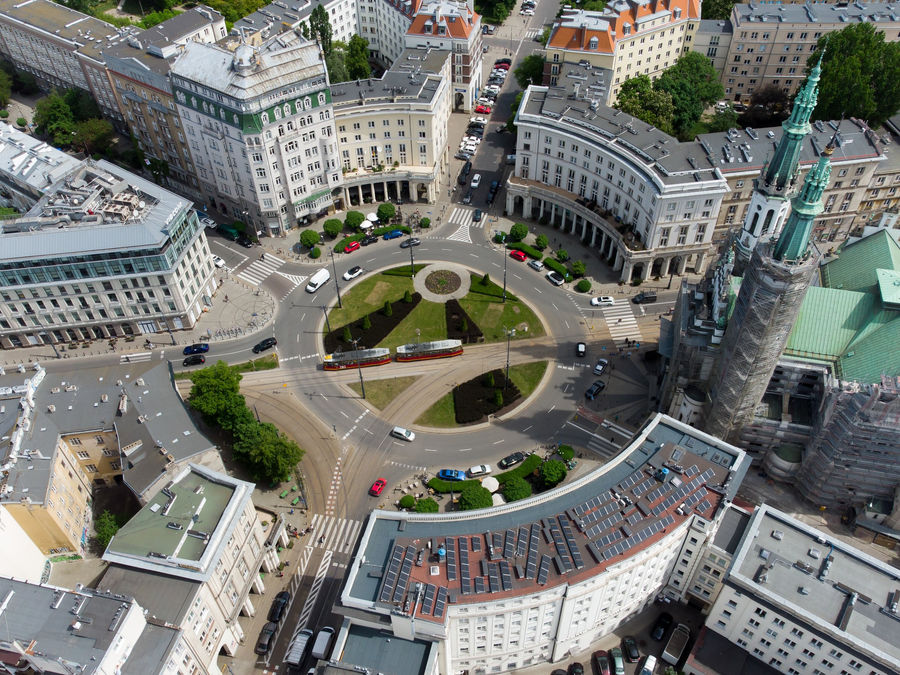
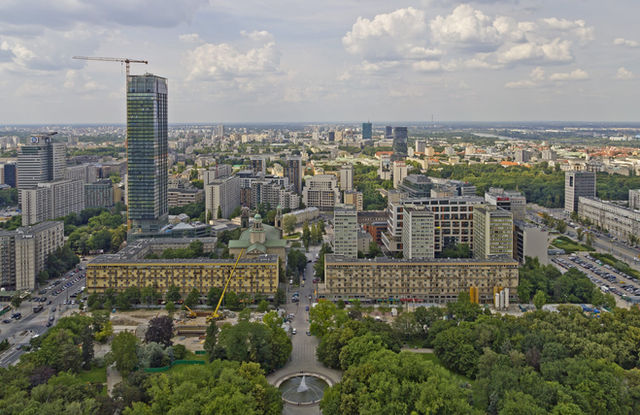
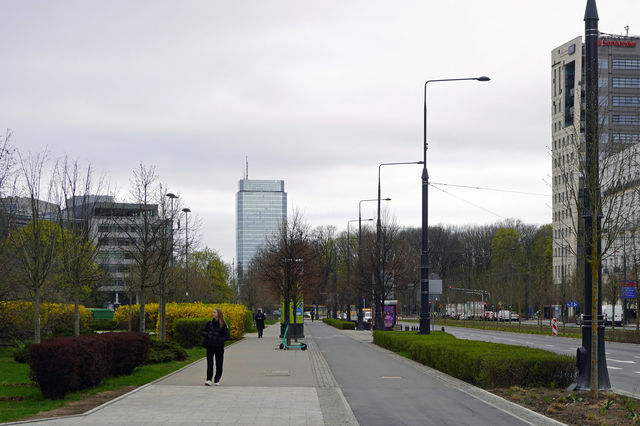
    The grand, busy city centre — the royal route of boulevards, the Stalinist skyscraper, and the new glass district rising behind it.

    Why go
    The main sights strung along one grand walk, plus the modern city.
    Best for
    Architectureshoppingthe royal route
    Known for
    The Palace of Culture and Science, the Nowy Świat and Krakowskie Przedmieście royal route, the university and Chopin sites, and the new-build skyline around the central station.
  • Powiśle

    The riverside slope below the centre — once industrial, now the city's young, creative pocket of cafés, bars and a famous rooftop garden.

    Why go
    The riverbank, the cool cafés, and the university library gardens.
    Best for
    Cafésriverside eveningsa local vibe
    Known for
    The University of Warsaw Library's rooftop gardens, the Vistula boulevards and beaches, the Copernicus Science Centre, and the bars strung along the river.
  • Muranów

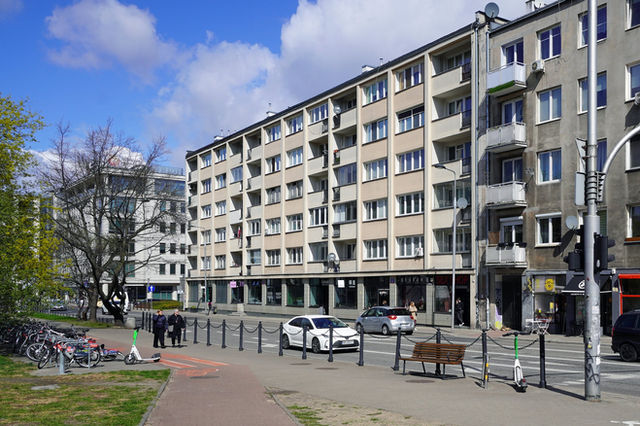
    The quiet residential district built over the wartime ghetto — plain post-war blocks above a heavy history, anchored by a world-class museum.

    Why go
    The POLIN museum and the memory of Jewish Warsaw.
    Best for
    Historymuseumsreflection
    Known for
    The POLIN Museum of the History of Polish Jews, the Ghetto Heroes Monument, the surviving fragments of the ghetto wall, and the memorial route through the district.
  • Praga

    The right-bank district that escaped the worst of the destruction — pre-war tenements, courtyards and shrines, long rough and now the city's arts-and-nightlife frontier.

    Why go
    The real old buildings, the street art, and the edgy nightlife.
    Best for
    Artnightlifeatmospheremurals
    Known for
    The Koneser vodka-distillery complex and its museum, the courtyard shrines, the Neon Museum of salvaged communist-era signs, and a run of galleries, bars and clubs.
  • Wilanów

    The green, genteel outer district built around a baroque royal palace — the "Polish Versailles" — with formal gardens and a slower pace.

    Why go
    The palace and its gardens, a half-day out of the centre.
    Best for
    Palacesgardensa slower day
    Known for
    Wilanów Palace and its baroque gardens, the poster museum, and the parkland around it.

Views & hidden gems

Best views

  • The Palace of Culture terrace — the whole city from the Stalinist tower's 30th-floor viewing deck
  • The University Library rooftop gardens in Powiśle — greenery over the river
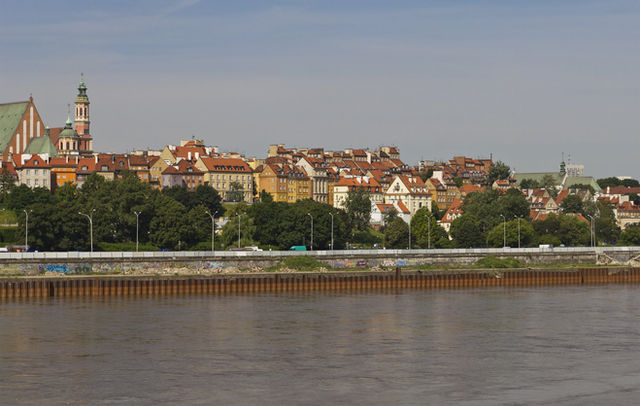
  • The Vistula boulevards at dusk — the old town and the new skyline across the water
  • Castle Square from the Barbican — the rebuilt walls and the market square beyond

Hidden gems

  • The Neon Museum in Praga — salvaged communist-era neon signs in a warehouse
  • A working milk bar (bar mleczny) — canteen pierogi at giveaway prices; long-running Warsaw examples such as Bar Bambino or Prasowy
  • The Warsaw Uprising bunkers and monuments scattered through Śródmieście
  • The Praga courtyards and their folk shrines — a pre-war city that survived
  • The Saxon Garden and the Tomb of the Unknown Soldier's guard change

Food & drink

Warsaw eats hearty Polish classics and, increasingly, some of central Europe's most inventive modern cooking. The staples hold — pierogi, sour rye soup, herring, hunter's stew — and the milk bar keeps them cheap and unpretentious. But the city has moved on too: bistros reworking Polish tradition, a strong café culture in Powiśle, and craft beer and proper vodka bars. The chocolate is a Warsaw thing (the old Wedel brand runs a café), and the vodka is best flavoured, chilled and paired with food.

  • Pierogi — dumplings, savoury or sweet, the national staple
  • Żurek — sour rye soup, often in a bread bowl with sausage and egg
  • Śledzie — herring, pickled or in oil, a vodka companion
  • Bigos — hunter's stew of cabbage, sauerkraut and meat
  • Pączki — rich jam-filled doughnuts, a Warsaw treat
  • Flavoured vodka — chilled, sipped, taken with the meal
Dietary notes

Vegetarians manage well — pierogi ruskie, potato and cabbage dishes, and a strong modern veggie-and-vegan scene in Śródmieście and Powiśle — though check that soups and stews aren't meat-stocked. Vegan spots are plentiful in the centre. Halal food is found around the centre's Middle Eastern and kebab spots; kosher is limited but present given the city's history and museums. Gluten-free is understood in newer restaurants.

Warsaw in photos

▸ Where you'll stay

Where you'll stay in Warsaw

The Śródmieście centre is the practical base — walkable to the old town, the royal route and the station, with the widest range of hotels. The Old Town itself is atmospheric but small and pricier. Powiśle by the river is the young, characterful choice, cafés and bars at the door. Praga across the river is cheaper and edgier, good for nightlife and art but a tram from the main sights. Even central rooms are a bargain by western standards.

  • Budget
    Śródmieście / near the central station hostels and budget chains, superb transport links, walkable to the old town.
  • Mid-range
    Powiśle or the old-town edge boutique stays by the river or the royal route, cafés at the door.
  • Luxury
    Central Śródmieście / royal route grand hotels among the landmarks, steps from the old town and the palaces.
Stay

Hotels & rentals around Warsaw

Pan, zoom and compare live prices — every stay in one map.

▸ Getting around

Getting around Warsaw

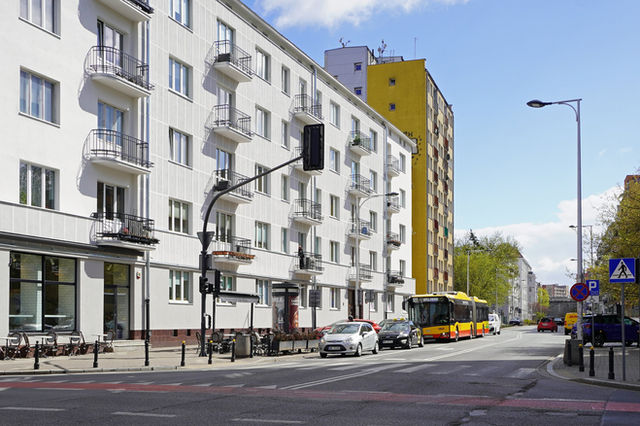
Two metro lines cross the city, backed by an extensive tram and bus network — trams are often the quickest way across the centre. The old town and central royal route are walkable; the sights are spread out, so lean on trams for the longer hops. A car is unnecessary. Buy a ticket or day pass and validate it.

The old town, royal route and centre are walkable end to end (~approx). For POLIN and Muranów take a tram north; for Praga cross the river by tram or metro; for Wilanów, a bus or tram out to the palace.

▸ Plan your days

Suggested itineraries

Ready-made day plans for Warsaw — from a single day to a long weekend.

One day

Start in the rebuilt Old Town — Castle Square, the market square and the Mermaid — then walk the royal route down Krakowskie Przedmieście past the university and Chopin sites to the Palace of Culture. Spend the afternoon at the Warsaw Uprising Museum for the city's defining story, and end with dinner and vodka in Śródmieście.

Two days

Give day two to memory and the river. Spend the morning at POLIN in Muranów and the ghetto memorials, cross to Powiśle for a riverside lunch and the library rooftop gardens, then take an evening in Praga for the Neon Museum, murals and bars.

Three days

Use day three to slow down and go green. Spend the morning in Łazienki Park with the palace-on-the-water and, on a summer Sunday, a Chopin recital, then head out to Wilanów Palace and its baroque gardens before a last dinner back in the centre.

▸ What you'll do

Insider tips

  • Warsaw's best museums (POLIN, Uprising, Copernicus) get busy and some need timed tickets — book ahead and don't try to cram more than two heavy ones into a day.
  • The milk bar is a genuine experience — Polish-only menus, a queue, food for pennies; point, pay and share a table.
  • The city is spread out — plan by district (old town, museums, Praga) rather than crisscrossing, and lean on the trams.
  • Free Chopin concerts run in Łazienki Park on summer Sundays — check the schedule and arrive early for a lawn spot.
Explore

Explore the area

© OpenFreeMap · OSM · terrain Mapterhorn
Do

Local attractions & tours

Skip-the-line tickets and small-group tours in Warsaw — compare across our partners.

We're still curating hand-picked tickets and tours for Warsaw. In the meantime, the map above and the nearby cities are a great place to start.

▸ Budget

What it costs in Warsaw

Backpacker
roughly €35–55 a day as a rough guide.
Mid-range
roughly €80–140 a day as a rough guide.
Luxury
from around €250 a day.
Cash vs card
Cards and contactless are near-universal, but keep some złoty for milk bars, market stalls and small bars. Prices are in złoty — decline euro conversion.
Tipping
Around 10% is normal in restaurants; say the total as you pay, and don't tip at milk bars or counters.
▸ When you'll go

When to visit Warsaw

May to September for warmth; late spring and early autumn for the best balance

Spring

What to expect — Cool and changeable early, warming into pleasant weeks by May, with the parks greening and the riverbanks reopening. Some rain, moderate crowds.

What's best — Mild sightseeing weather, blossom in Łazienki and the Saxon Garden, and the city before the summer peak.

Summer

What to expect — Warm to hot, long days, and the liveliest season, with the Vistula beaches and bars in full swing and the Chopin concerts running. Occasional storms.

What's best — Free Chopin recitals in Łazienki, riverside beach bars, open-air events, and long evenings. The best all-round time to visit.

Autumn

What to expect — Crisp, golden and comfortable, the summer crowds gone, the light soft. Cooling and wetter as it goes.

What's best — Comfortable museum-and-walking weather, turning leaves in the parks, and quieter sights.

Winter

What to expect — Cold, grey and often snowy, with short days and hard frost. December brings a Christmas market and lights; deep winter is quiet and cheap.

What's best — Snow on the rebuilt old town, Christmas markets, warm milk bars and vodka bars, and the lowest prices of the year — a city made for indoor culture.

▸ Know before you go

Know before you go

Honest swaps

Skip the tourist-menu restaurants on the Old Town square → eat pierogi in a milk bar or a modern bistro in Śródmieście for a fraction of the price.

Skip judging Warsaw against Kraków's medieval prettiness → come for the history and the modern city instead, which is where it wins.

Skip the pricey hotel-bar vodka → do a proper flavoured-vodka tasting at a dedicated bar or the Koneser distillery.

Skip a taxi to Wilanów → the bus or tram out is cheap and easy for the palace.

Crowds & timing

POLIN and the Warsaw Uprising Museum are deservedly busy — book timed tickets and allow a half-day for each.

The Palace of Culture viewing terrace and the Old Town square are busiest midday; go early or late.

Local rules & etiquette

Treat the wartime and Jewish-history sites with the gravity they deserve — quiet, no eating, modest behaviour.

Validate transport tickets when you board; inspectors check and fine.

Cover shoulders and knees in churches.

Money

Pay in złoty and decline "pay in your currency" prompts, which use poor rates.

Use bank ATMs over independent tourist machines, and skip the old-town exchange kiosks.

After dark

Powiśle and the riverbanks are the young, summer nightlife — cafés, bars and beach clubs by the Vistula.

Praga across the river is the arty, late scene — clubs, galleries and bars in old courtyards.

The centre around Nowy Świat and the side streets has the mainstream bars and restaurants.

▸ Ready to book your trip?

Getting there

Warsaw has two airports — Chopin (WAW), close to the centre and linked by train and bus (~approx 20–30 min), and Modlin (WMI) further out for budget flights, reached by shuttle-and-train. Warszawa Centralna is the main rail station, with fast domestic and international trains and the metro alongside.

Book

Ready to book your trip?

Flights, airport transfers and car hire — search and compare without leaving the page.

▸ Trip extras
Book

More trip extras

Parking, holiday extras, and more — coming soon.

Coming soon

We're lining up parking, holiday extras and activities you'll be able to add to any trip from here.