
One day
Pick one side: the Argentine circuits and the Garganta del Diablo for a full day of walking, or the Brazilian trail and Parque das Aves for the panorama.
About 275 falls on the Iguazú River, shared by Argentina and Brazil, each side a national park and a World Heritage site.
Always check the latest FCDO travel advice for Argentina before you book. Travel advice on our Argentina page
Spray rising from the Devil's Throat, a rainbow over the forest, and walkways that take you out above the water on one side of the river and across to the whole curve of falls on the other.
The Iguazú Falls are a horseshoe of about 275 falls on the border between Argentina and Brazil. Argentina's side takes you along and above the water to the Garganta del Diablo; Brazil's side looks across at the whole curve. Allow a day for each, staying in Puerto Iguazú or Foz do Iguaçu.
Iguazú National Park in Argentina covers more than 67,000 hectares and has been a national park since 1934; UNESCO listed it in 1984. Brazil's Iguaçu National Park is larger, at about 170,000 hectares, and was listed in 1986. Visitors see a small part of either park; the walkways run through the subtropical forest that both parks protect.
The falls sit where the Iguazú meets the Paraná, close to the point where Argentina, Brazil and Paraguay meet. Puerto Iguazú, a small town on the Argentine side, is about 18 km from the Argentine park entrance. Foz do Iguaçu, a larger city on the Brazilian side, is the base for the Brazilian park, Parque das Aves and Itaipu. The two towns are linked by the Tancredo Neves bridge.
The two sides of Iguazú complement each other. In Argentina, a small park train and a network of walkways take you along the top of the falls, down closer to the spray and out over the river to the edge of the Garganta del Diablo, the Devil's Throat. In Brazil, a single trail runs along the canyon with views across to the Argentine falls and ends on a walkway towards the Devil's Throat. Two days covers both; a third leaves time for Parque das Aves, the Itaipu dam or a boat trip below the falls. From Buenos Aires it is a short flight north.
The Devil's Throat — On the Argentine side, take the park train to the Garganta del Diablo station and walk out over the river to the edge of the falls.
Both sides in two days — Spend one day on the Argentine circuits and one on the Brazilian trail; the Brazilian view across the canyon is the best way to see the whole curve at once.
Below the falls — Boat trips run up the river towards the falls on both sides; expect to get soaked.
Birds and the dam — Parque das Aves, next to the Brazilian park, has a self-guided walk of about 2 km through aviaries; Itaipu, the hydroelectric dam that Brazil shares with Paraguay, runs bus tours from its visitor centre.
Iguazú Falls neighbourhood by neighbourhood — the character of each and who it suits.
Walkways along, below and above the falls, linked by a small park train that is included in the ticket.
One trail along the canyon, with views across to the Argentine falls.
A small Argentine town where the Iguazú meets the Paraná, about 18 km from the Argentine park.
A larger Brazilian city, with many hotels on the road out to the Brazilian park and the airport.
Stay on either side: the parks are a short drive from both towns, and tours, taxis and buses cross the bridge every day. Puerto Iguazú suits travellers who want a small, walkable town and an early start on the Argentine side. Foz do Iguaçu has more hotels, many of them on the road to the Brazilian park, and is the better base if you also want Itaipu.
Puerto Iguazú (Argentina): See stays in Puerto Iguazú →
Foz do Iguaçu (Brazil): See stays in Foz do Iguaçu →
Pan, zoom and compare live prices — every stay in one map.
We may earn a commission if you book through these links, at no extra cost to you. How we make money
On the Argentine side, the park train runs from the central station to the Cataratas station and on to the Garganta del Diablo; it is included in the ticket. On the Brazilian side, a park bus runs from the visitor centre to the trail. To cross between the two, organised tours, taxis and buses use the Tancredo Neves bridge. Take your passport even for a day trip, and check the entry rules for both countries before you cross. Queues at the bridge can be long at busy times, so allow extra time.
Organised tours, taxis and buses cross the Tancredo Neves bridge between Puerto Iguazú and Foz do Iguaçu. On the day you cross the border, a tour is the simplest option, as it handles the transfers.
Ready-made day plans for Iguazú Falls — from a single day to a long weekend.
Pick one side: the Argentine circuits and the Garganta del Diablo for a full day of walking, or the Brazilian trail and Parque das Aves for the panorama.
One day on each side. Start with the Argentine park from Puerto Iguazú, then cross the bridge for the Brazilian trail.
Add a boat trip below the falls, Parque das Aves or the Itaipu dam, and keep a spare morning in case of rain.
Skip-the-line tickets and small-group tours in Iguazú Falls — compare across our partners.

Iguazu Falls
Tickets via Viator
from £38.06
View & book →
Iguazu Falls
Tickets via Viator
from £65.14
View & book →
Iguazu Falls
Tickets via Viator
from £92.44
View & book →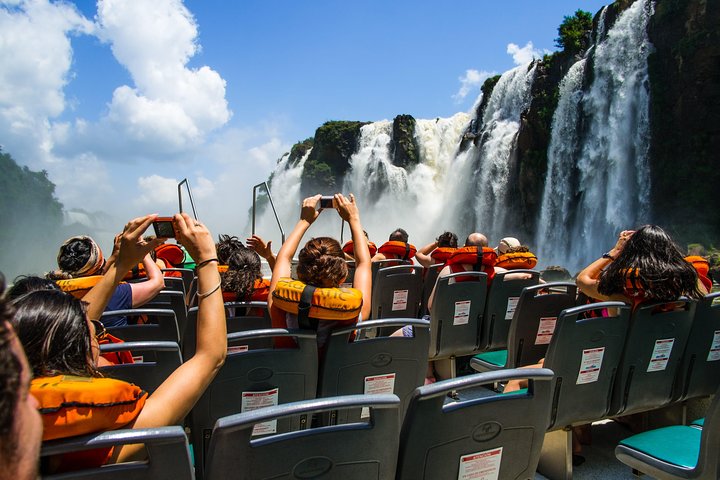
Iguazu Falls
Tickets via Viator
from £122.6
View & book →
Iguazu Falls
Tickets via Viator
from £43.14
View & book →
Iguazu Falls
Tickets via Viator
from £74.77
View & book →
Iguazu Falls
Tickets via Viator
from £37.78
View & book →
Iguazu Falls
Tickets via Viator
from £84.93
View & book →
Iguazu Falls
Tickets via Viator
from £300.71
View & book →
Iguazu Falls
Tickets via Viator
from £36.57
View & book →
Iguazu Falls
Tickets via Viator
from £208.18
View & book →All year: the flow depends on rain upriver and on the dams, so it can change from week to week
What to expect — The falls run all year. How much water comes over depends on rain upriver and on the dams on the river, so the flow can change from week to week.
What to expect — Hot and humid.
What to expect — Milder weather for walking. Expect spray in any season.
Buy the Argentine ticket online; a second day within 72 hours costs half price. The Brazilian ticket is sold online only, for a time slot, and includes the park bus.
The Argentine park opens every day from 08:00 to 18:00, with the last entry and the last train to the Garganta del Diablo earlier in the afternoon; check the times on the day. The Brazilian park opens every day: 09:00 to 16:00 on weekdays and from 08:30 at weekends.
Very high water can close the Garganta del Diablo walkway for a time. Check the park's notices before you travel, and expect spray on every visit.
Take your passport, even for a day trip, and allow extra time at the bridge at busy times.
There are no direct flights from the UK to either airport. For the Argentine side, fly to Cataratas del Iguazú International Airport (IGR), which has flights from Buenos Aires. For the Brazilian side, fly to Foz do Iguaçu International Airport (IGU), which has flights from São Paulo and other Brazilian cities. Connect via Buenos Aires, or via São Paulo or Rio.
Flights, airport transfers and car hire to IGR — search and compare without leaving the page.


