Iceland's F-roads: a map for your highland road trip
F-roads are Iceland's rough mountain tracks into the highland interior. We have mapped them from OpenStreetMap so you can see where they go, which ones lead to Landmannalaugar, Þórsmörk, Askja, Kerlingarfjöll and Hveravellir, and when the road authority has recorded them opening in past years. For whether a road is open today, use the live map on umferdin.is.
Tap a road for its number, route and the opening dates Vegagerðin has recorded in past years. Those dates are history, not a forecast, and river crossings are only those mapped in OpenStreetMap, so this map is a planning aid and not a safety guide.
Choose your car, choose your Iceland
The car you drive decides the holiday you have
Iceland is one country but several different trips, and the vehicle is what picks between them. This is how we would think about it. Legal and insurance points come from the road authority and SafeTravel; the rental contract is the final word, so check your own.
A 2WD compact
Ring Road and the classics
Where it can take you
The Ring Road (Route 1), the Golden Circle and the south coast, all on paved roads.
Trade-offs
F-roads are off limits: Visit Iceland says a 4x4 is required, and your rental contract will say the same. Gravel needs care. SafeTravel advises slowing down before you leave the pavement, and the limit on rural gravel roads is 80 km/h unless signs say otherwise.
Typical itinerary
Reykjavík, the Golden Circle and a south coast day trip, over a week or less.
A small 4x4 SUV (Duster class)
Gravel and the easier F-roads
Where it can take you
Gravel roads and, if your contract allows them, the easier F-roads. SafeTravel notes that some F-roads suit a Duster-type vehicle.
Trade-offs
Limited for river crossings, and your contract may bar particular roads even when the vehicle could cope. Always check which F-roads your hire terms allow before you rely on one.
Typical itinerary
The Ring Road with one easier highland day, planned around the live road map.
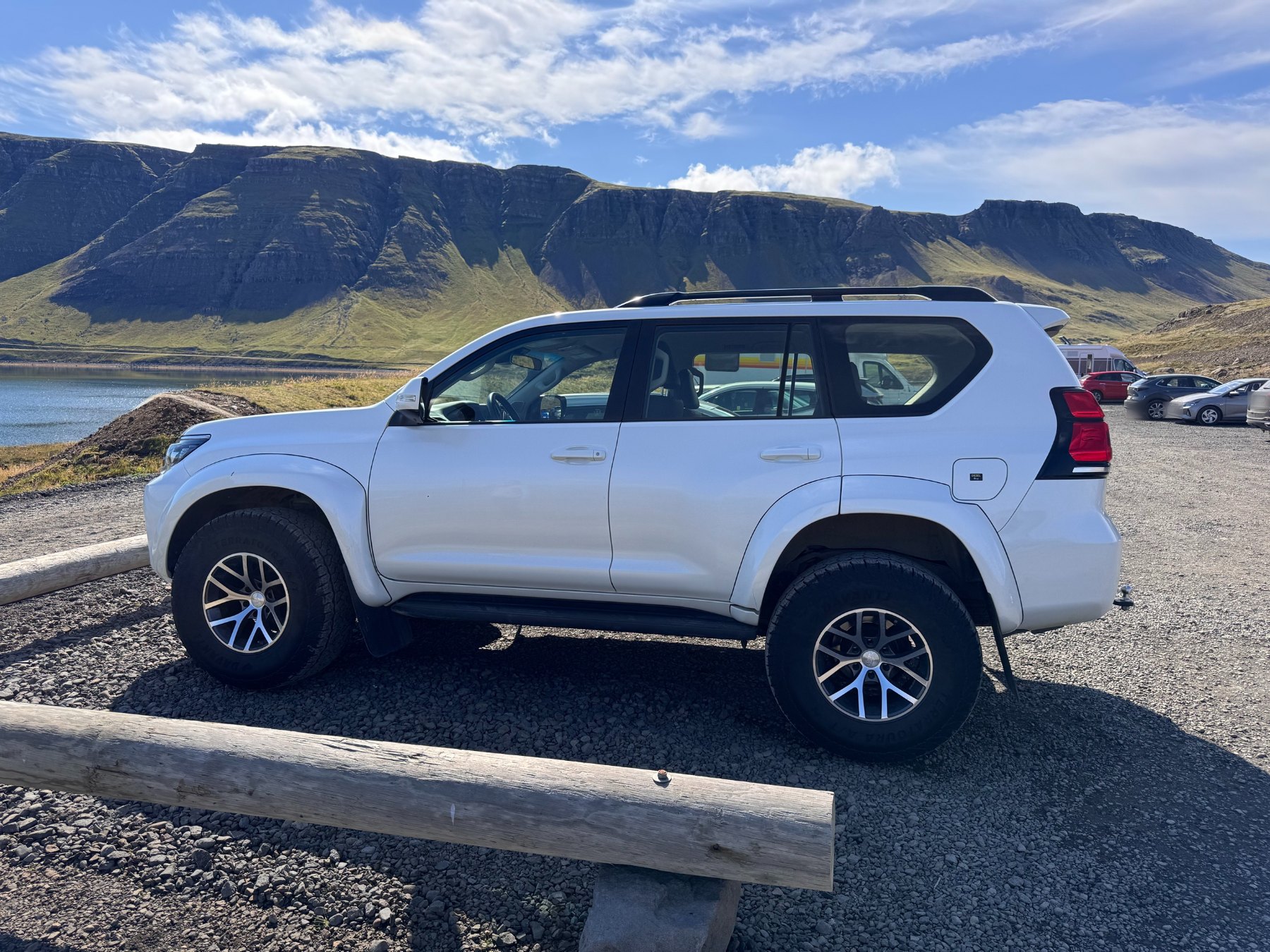
Our F-road 4x4, Iceland highlands
A large, high-clearance 4x4
The highland interior
Where it can take you
The highland interior and deeper river crossings. Vegagerðin says Sprengisandur can be driven only by large 4x4s and super jeeps.
Trade-offs
Costlier to hire and run. You still check every crossing yourself, and SafeTravel is clear that no insurance covers damage to a vehicle while crossing a river. A modified, lifted vehicle on big all-terrain tyres is the kind that opens up the interior, but it does not change the insurance position.
Typical itinerary
Two or three highland days inside the short summer window, with Landmannalaugar by F208 as a classic first F-road.
A campervan
Check the 4x4 designation
Where it can take you
Paved roads and gravel. On F-roads only a camper your rental company designates as 4x4.
Trade-offs
Rental terms, not the vehicle's looks, decide where a camper may go, and breaking them can void your cover. Read the road list in your contract.
Typical itinerary
A slower Ring Road loop, with F-roads only if the camper is 4x4-designated.
Winter, in anything
Short days, closed highlands
Where it can take you
Main roads in good conditions. The F-roads are closed: SafeTravel says they are usually closed from mid-September until June or July.
Trade-offs
SafeTravel says rental cars should have winter equipment such as winter tyres, that a 4x4 helps but does not remove the risk of skidding on ice, and that winter days are short, so allow extra time. Keep the lights on and check the forecast and umferdin.is every day.
Typical itinerary
Reykjavík and the south coast, with slack in the plan for weather.
Compare 4x4 hire →Check each company's F-road rules and insurance before you book. We earn a small commission if you book through the comparison below; it never changes your price.
Insurance
Read the small print before you book
Insurance is where an F-road trip goes wrong. We read the published terms of the main Icelandic rental companies on 28 October 2026 so you can ask the right questions. This is not legal advice and we do not recommend a company: your own rental agreement decides what is covered.
The excess is not your worst case
For excluded damage, such as a river crossing gone wrong, none of the companies we read states a cap. Several say the renter is liable without limit: Hertz says liability can reach the full value of the vehicle, Lotus says you may be held liable up to the full value, and Go describes unlimited self-risk, holds up to EUR 7,000 as a deposit and says you pay any repair above that. SafeTravel puts river damage at thousands of euros or dollars, and the risk is entirely yours. On a large 4x4 that can be a very large bill, so be careful, and think hard about extra cover.
Water damage from river crossings
SafeTravel's advice is blunt: no insurance covers damage to a vehicle while crossing a river, so if you are unsure, do not cross. The published terms are more varied than that. Most companies exclude river water damage from every package. A few sell an upgrade that covers it, with conditions. Here is what we read on 28 October 2026:
Company
Water damage, as published
Blue Car Rental
Excluded in the base package. The optional Liability Waiver lists water damage at 0 ISK excess, but the company's own pages limit it to legal, marked crossings and disagree with each other, so get the wording in writing.
Conditional
Lotus Car Rental
Excluded in Silver and Gold. Platinum has River Crossing Protection: water damage to engine, transmission and radiator, for authorised 4x4s only, and never the Krossá river on F249.
Conditional
Go Car Rental
Excluded from every package, including zero excess. Up to EUR 7,000 can be held as a deposit.
Excluded
Lava, Hertz, Avis, Europcar, Geysir
Excluded in the terms we read. Hertz also bars passenger vehicles from F-roads.
Excluded
Kuku Campers
Excluded, even in the Platinum package. Only 4x4 categories may cross rivers.
Excluded
Last checked 28 October 2026; terms change, so check the current wording, and the exact clause, before you drive an F-road. We did not survey every company.
Other things the terms say
Is the road allowed? Contracts allow F-roads only for approved 4x4s, and some ban named roads even for those. Examples in the terms we read: F249, F88 and F210 for one company's 4x4s, Kjölur and Þórsmörk's F249 for others. Driving where your contract bans you can void your cover and bring a fine.
Gravel protection is about stone chips: windscreen, headlights, mirrors and paint. It does not cover the undercarriage.
Undercarriage damage is excluded by most companies, often unless you buy a top package.
Sand and ash protection is a separate add-on at some companies and included in higher packages at others. It matters on the south coast and in the highlands. Two companies' own pages put sand and ash repairs at roughly ISK 500,000 to 3,500,000 without it.
Wind damage to doors is a common exclusion, and one company says it can hold a deposit for it.
Zero excess packages remove the excess on covered damage only. They do not turn excluded damage into covered damage.
Off-road driving (leaving roads and marked tracks) is illegal under Iceland's Nature Conservation Act and is uninsured. F-roads are roads; leaving them is not allowed.
Third-party excess insurance and credit-card cover usually reimburse the excess after you have paid the rental company. None of the pages we read says they cover excluded damage, so read that policy's own exclusions.
Questions to ask your rental company
Does my package cover water damage from river crossings? Which clause of the rental agreement says so?
Is my liability capped for water and undercarriage damage, or do I pay the full repair or replacement cost? Where does the contract say so?
Which rivers or roads count as a permitted ("legal") crossing, and which are named exclusions (for example Krossá on F249)?
Is my exact vehicle on your approved list for F-roads and for river crossings? Which F-roads are banned for my class even though it is a 4x4 (for example F249, F88, F210)?
Are undercarriage, tyre and wheel damage covered, and does the zero-excess package change that?
Does gravel protection cover the windscreen, headlights, paint and mirrors, and is the radiator or engine excluded?
Is sand and ash protection included or a separate add-on, and what is the excess?
Is wind damage to doors covered, and can a deposit be held for it?
If I buy third-party excess cover or rely on my credit card, do I pay you first and claim back? What does that policy exclude?
What happens if I leave a marked road or track? (Off-road driving is illegal and uninsured.)
Sources: each company's published rental terms and insurance pages; SafeTravel highland driving; Vegagerðin; the Environment Agency of Iceland (off-road driving). Checked 28 October 2026; part of our monthly fact check.
Plan your F-road day
The road is the destination: plan for it
An F-road day takes longer than the map says, and that is mostly a good thing. You slow down for the rough ground, and then you stop, again and again. Plan for it.
1
Slow down, and expect to stop
SafeTravel says slow driving is important on highland roads: they are rough, conditions change quickly, and the 80 km/h gravel limit is a maximum, not a target. The tracks are slow, and you will want to stop: for the viewpoints, hot springs, craters, short hikes and waterfalls that are the reason to go. Plan the day around them, not around the drive time on a map app.
2
Know where the fuel and the services are
Visit Iceland says to carry enough fuel to reach the next station, and most pumps accept only chip-and-PIN cards. Vatnajökull National Park says there are no shops, restaurants or fuel stations at Askja, Kverkfjöll or Nýidalur. Hrauneyjar Highland Centre is described as the last outpost before the highlands, with a rangers' information desk in summer. Fill up before the interior and carry food and water.
3
Leave a travel plan and take the app
Leave a travel plan with someone who can react, through SafeTravel, and use the SafeTravel app and the 112 app, which can send your location to the emergency services. The government says satellite SOS on newer phones is especially relevant in the highlands, and SafeTravel suggests considering a personal locator beacon or satellite messenger.
4
Check the road, the weather and the rivers
Look at umferdin.is for whether a road is open and what it is like, and at the Icelandic Met Office for weather. Rivers rise: Katla Geopark says normally easy streams can become fast rivers within hours, and SafeTravel notes that rivers often have lower water levels in the morning. If you are unsure, do not cross, turn back, or wait for another traveller.
5
Build in buffer, and one F-road leg a day
We would never stack long F-road days back to back. Leave slack for stops, weather and a river you decide not to cross, be off the track well before dark (headlights must be on at all times, all year), and plan one F-road leg a day.
Times are our estimate from the mapped length at 20 to 40 km/h, from our own F-road trip. There is no official figure, and rivers, weather and stops change the day. Stops are from the national park, Environment Agency, North Iceland and Visit Iceland pages, listed in our sources. Mapped length is from OpenStreetMap and includes side tracks.
Five things to know before you drive an F-road
They are mountain roads. The F stands for fjall, mountain. They are rough, often steep or uneven, and can have unbridged rivers you must ford.
You need a 4x4. Visit Iceland says it is required by law; we could not find the statute, and in practice your rental contract is what enforces it. SafeTravel adds that some roads suit a Duster-type SUV, others need a Land Cruiser-sized vehicle or a super jeep.
Rivers are not insured. SafeTravel is clear that no insurance covers damage while crossing a river. If you are unsure, do not cross.
They are closed in winter. SafeTravel says F-roads are usually closed from mid-September until June or July. Snow cover decides when each opens, so check the live map rather than a calendar.
Stay on the road. Off-road driving is strictly forbidden, and Kjölur (Route 35), often still called F35, is no longer an F-road but is still summer only.