← Ireland
IRELAND · CITY

Cork

Ireland's second city on the River Lee: the English Market, the Shandon bells, a hilltop gaol and harbour day trips to Cobh, Kinsale and Spike Island.

  • City
  • May to September for the driest, brightest weather; the October bank holiday weekend for the jazz festival
  • ORK
  • ~approx 2–3 days
  • City on the River Lee
  • Ireland's Food Capital
  • Harbour Day Trips
  • Jazz in October

Church bells you ring yourself over a city of quays and steep lanes, a Victorian market smelling of fish and spiced beef, and a commuter train that drops you at a Titanic pier within half an hour.

Cork is the Republic of Ireland's second city, built on an island in the River Lee with hilly northside quarters, a covered market that has traded since 1788 and a food and pub scene locals rank above Dublin's. Cobh, Fota, Kinsale, Blarney and the Midleton distillery all sit within an easy day trip, and the October jazz festival fills every bar in town.

Type
city
Ideal length
~approx 2–3 days
Getting around
a flat, walkable island centre, Bus Éireann city buses with a Leap card, and commuter trains to the harbour
Neighbourhoods
6 areas
Best season / months
May to September for the driest, brightest weather; the October bank holiday weekend for the jazz festival
Language
English (Irish on signs and in place names)
Currency
euro (€)
Budget level
moderate — cheaper to get around than most cities, with hotel prices the big variable
Good for
  • Food lovers
  • Couples
  • Families
  • History
  • Music
▸ Discover

About Cork

Cork sits at the head of one of the world's largest natural harbours on Ireland's south coast, its centre built on an island where the River Lee splits into two channels before meeting the sea. That makes it a city of quays and bridges, with St Patrick's Street curving across the middle and the hills of Shandon and Sunday's Well rising steeply to the north. With a population of around 220,000 it is the Republic's second city, big enough for a serious food and music scene, small enough that most of the sights are within a twenty-minute walk of each other.

The appeal is the texture of everyday life as much as any single monument: the English Market, trading since 1788; the bells of St Anne's that visitors ring themselves; a cathedral on the spot where the city was founded in the seventh century; and the harbour towns, forts and distilleries a short train or bus ride away. For the wider picture see the Ireland country guide.

Why go

Cork rewards the traveller who likes a city to feel lived in rather than staged. It has a genuine market culture, a dense run of traditional pubs with live music most nights, and a reputation as Ireland's food capital that it backs up with stalls, cafés and a Michelin-recognised restaurant scene. The compact island centre is easy on foot, and the commuter train puts Cobh, Fota Wildlife Park and the Midleton distillery within half an hour. Add Kinsale at the start of the Wild Atlantic Way and the jazz festival over the October bank holiday, and a long weekend fills itself.

Don't miss

  • The English Market — Cork's covered food hall, trading since 1788
  • The Shandon Bells — climb St Anne's tower and ring them yourself
  • St Fin Barre's Cathedral — Burges's masterpiece on the city's founding site
  • Cobh and Spike Island — Titanic's last port and the prison island ferry
  • Kinsale and Charles Fort — the start of the Wild Atlantic Way, by bus 226

Signature experiences

The English Market — Cork's covered market has traded on this site since 1788 and remains a working food hall rather than a tourist set: fishmongers, butchers selling spiced beef, cheese stalls and bakers under a Victorian roof between Grand Parade and Princes Street. Look for the old city dishes, drisheen, tripe, buttered eggs and battlebord (dried salted ling), then eat upstairs at the Farmgate Café overlooking the hall.

Ringing the bells of Shandon — St Anne's Church, built in 1722, lets visitors climb its 50-metre tower, pull the ropes on eight bells weighing six tonnes between them (sheet music is provided), inspect the clock works and step out to a view over the whole city, under a three-metre golden fish weathervane. Allow about an hour, and expect narrow stone stairs.

The founding hill: St Fin Barre's and Elizabeth Fort — The cathedral stands where Cork began as a seventh-century monastic school; the present building, by William Burges and consecrated in 1870, carries more than 1,260 sculptures, Pyrenean marble mosaics, a cannonball from the 1690 siege and the gilded angel on the east end. Across Barrack Street, the star-shaped Elizabeth Fort is free to enter, with a daily guided tour for €5 (2026) and walls to walk if you can manage a steep stone staircase.

Cork City Gaol — Up in Sunday's Well, the nineteenth-century prison is now a museum with restored cells, figures of real inmates and the option of being locked in yourself. It opens daily from 10am to 5pm with a guided tour at 2pm; adults €12, family €37 (2026). Walk back down over the Shakey Bridge into Fitzgerald's Park.

Cobh and Spike Island — The commuter train reaches Cobh in 26 minutes. This was Queenstown, the Titanic's last port of call, and the Titanic Experience in the old White Star Line office follows the 123 passengers who boarded here (adult €13, 2026). St Colman's Cathedral and its 100-metre spire tower over the painted Deck of Cards houses, and from Kennedy Pier a 15-minute ferry crosses to Spike Island, monastery, fortress and prison until 2004; allow three and a half hours and book ahead (adult €27.95, 2026).

Kinsale and Charles Fort — Bus 226 runs from Kent station via the airport to Kinsale, the southern end of the 2,600 km Wild Atlantic Way and the start of Cork's self-styled Culinary Coast. Charles Fort, a star fort built between 1677 and 1682 at Summercove about 3 km from the town, is open year round with ramparts over the harbour (adult €5, 2026).

Whiskey at Midleton — Twenty-three minutes by train, the Midleton Distillery Experience is home to Jameson, Redbreast, Powers and Midleton Very Rare. Tours take in the world's largest pot still, the micro-distillery and a live maturation warehouse; the café, shop and bars are free to enter, but book tours ahead.

Neighbourhoods

Cork neighbourhood by neighbourhood — the character of each and who it suits.

  • The City Centre Island

    The flat heart of Cork between the two channels of the Lee: St Patrick's Street curving through the middle, Oliver Plunkett Street and the lanes off it, Grand Parade and the quays, with Elizabeth Fort and the cathedral just over the south channel.

    Why go
    The market, the shops, the pubs and the murals, all on foot.
    Best for
    First-timersfoodnightlife
    Known for
    The English Market, St Patrick's Street, Oliver Plunkett Street's bars and music, the Ardú murals, and a short hop over the river to St Fin Barre's Cathedral and Elizabeth Fort.
  • Shandon

    The steep old northside quarter above the river, a tangle of lanes and painted houses climbing to the tower of St Anne's and the former butter exchange.

    Why go
    To ring the bells and see the city laid out below.
    Best for
    Viewshistorya slow morning
    Known for
    St Anne's Church and the Shandon Bells, the Butter Museum on O'Connell Square, the Cathedral of St Mary and St Anne, and the climb up Shandon Street.
  • The Victorian Quarter

    The strip around MacCurtain Street on the north bank by Kent station, where Victorian terraces now hold bars, restaurants and two of the city's best music venues.

    Why go
    Arrive by train and eat and drink without crossing a bridge.
    Best for
    Arrivalsdinnerlive music
    Known for
    MacCurtain Street's restaurants and bars, Live at St Luke's and the Everyman, both jazz festival venues, the Aircoach stop on Lower Glanmire Road, and Kent station itself.
  • Sunday's Well and the Mardyke

    A leafy residential ridge west of Shandon with the old gaol at its top, linked by a swaying footbridge to the park and university grounds on the south bank.

    Why go
    The gaol, the park and the quietest river walk in town.
    Best for
    Historya green afternoonfamilies
    Known for
    Cork City Gaol, Daly's Shakey Bridge of 1926, Fitzgerald's Park with its Sky Garden and the Public Museum, and the Glucksman gallery at University College Cork.
  • Blackrock, Douglas and the Marina

    The south-eastern suburbs along the estuary, where a car-free promenade follows the river from the stadium out to a castle observatory and on along an old railway greenway.

    Why go
    A flat, easy walk or cycle with water views and a castle at the end.
    Best for
    Walkingcyclingfamilies
    Known for
    The Marina Promenade from Centre Park Road to Blackrock village, Blackrock Castle Observatory, the Passage West greenway, Páirc Uí Chaoimh, and Douglas's pubs on the jazz festival trail.
  • Cobh (day-trip area)

    The harbour town 26 minutes down the line, a crescent of painted houses under a cathedral spire that was the Titanic's last port of call and the gateway to a prison island.

    Why go
    Titanic and emigration history, the ferry to Spike Island, and sea air.
    Best for
    Day tripshistoryfamilies
    Known for
    The Titanic Experience in the old White Star Line office, St Colman's Cathedral, the Deck of Cards houses, Cobh Heritage Centre, the Annie Moore statue and the Spike Island ferry from Kennedy Pier.

Views & hidden gems

Best views

  • The top of the Shandon tower — 50 metres up, the whole city under a golden fish weathervane
  • Charles Fort's ramparts — across Kinsale Harbour from the seventeenth-century star fort
  • Bandon Hill, Cobh — down over the Deck of Cards houses and the harbour, with the cathedral spire alongside
  • The Marina Promenade — along the Lee estuary to Blackrock Castle Observatory

Hidden gems

  • Elizabeth Fort — the star-shaped fort above Barrack Street, free to enter and rarely busy
  • The Ardú murals — 16 large street-art works at 14 sites across the centre, with a self-guided audio tour
  • The Glucksman — University College Cork's free contemporary gallery, open Tuesday to Sunday
  • Fitzgerald's Park and the Shakey Bridge — the 1902 exhibition grounds and the 1926 suspension footbridge that still wobbles
  • The Butter Museum — the story of the butter exchange that was once the world's largest, with a keg of thousand-year-old butter

Food & drink

Cork calls itself Ireland's food capital and the English Market is the proof: fishmongers, butchers selling spiced beef, cheesemakers and bakers under one Victorian roof since 1788, with the Farmgate Café upstairs cooking what is sold below. Old Cork dishes still turn up here, from drisheen (a blood pudding) and tripe to buttered eggs and battlebord, dried salted ling. Beyond the market, Goldie holds a Michelin Bib Gourmand for its seafood, Kinsale has built a whole identity around its harbour restaurants, and the county's cheeses show well at Midleton's farmers market. Drink the local stouts, Murphy's and Beamish, in old pubs such as The Oval or Costigan's, and catch a session at Sin É.

  • Spiced beef — the Cork delicacy, sliced at the English Market counters
  • Drisheen and tripe — the old city's blood pudding and offal dish, still sold at the market
  • Buttered eggs — a traditional Cork market staple
  • Battlebord — dried salted ling, a taste of the market's past
  • Fresh seafood — from the market's fish stalls to Kinsale's harbour restaurants
  • Murphy's and Beamish — the two Cork stouts, poured in the city's old pubs
Dietary notes

Vegetarians and vegans are well served in a city this food-minded; the market stalls and cafés make plant-based eating straightforward, and most restaurants mark options clearly. Gluten-free is widely understood. Halal choices cluster in the centre; kosher food is scarce and best arranged ahead. Tell staff about allergies, and expect dairy to feature heavily, this being butter country.

▸ Photos

Cork in photos

▸ Where you'll stay

Where you'll stay in Cork

Decide first whether you want to be on the island or beside the station. The city centre island puts the market, the pubs and the shops outside your door, with the noise that goes with it. The Victorian Quarter around MacCurtain Street is minutes from Kent station and the Aircoach stop, with its own restaurants and music, and is the natural base for day trips by train. Shandon and Sunday's Well are quieter and steeper, Douglas and Blackrock suburban and calm. Over the jazz weekend, book months ahead.

  • Budget
    The Victorian Quarter / around Kent station guesthouses and simpler hotels on the north bank, handy for trains and the Aircoach, ten minutes' walk to the centre.
  • Mid-range
    The city centre island hotels on the quays and around St Patrick's Street and the South Mall, everything on foot, livelier at night.
  • Luxury
    The Western Road edge and Cork Harbour the smartest city addresses near the university and the Mardyke, plus resort and country-house hotels out towards Fota and the harbour.
Stay

Hotels & rentals around Cork

Pan, zoom and compare live prices — every stay in one map.

We may earn a commission if you book through these links, at no extra cost to you. How we make money

▸ Getting around

Getting around Cork

The island centre is flat and best walked; Shandon and Sunday's Well are steep but only minutes away across the north channel. Bus Éireann runs the city buses, and since July 2026 a TFI Leap card gives a 90-minute fare with unlimited changes and a daily cap on city routes. The Cork commuter train from Kent station is the easy way to Fota, Cobh and Midleton, half-hourly on weekdays. A car is only worth hiring for West Cork or the coast.

Buy a TFI Leap card (sold at WHSmith in the airport terminal and at agents across the city) and tap on; it is up to 30% cheaper than cash and works on Bus Éireann city buses and the Cork commuter trains. Route 205 links Kent station, the centre and the university; the 215 runs through Blarney; the 225 and 226 serve the airport, the 226 continuing to Kinsale. The airport and Kinsale routes sit outside the 90-minute city fare.

▸ Plan your days

Suggested itineraries

Ready-made day plans for Cork — from a single day to a long weekend.

One day

Start at the English Market when the counters are fresh, then cross the south channel to St Fin Barre's Cathedral and up to Elizabeth Fort for the free walk on the walls. Lunch at the Farmgate or in the lanes, then climb to Shandon to ring the bells and visit the Butter Museum. Finish with a pint of Murphy's and a session on Oliver Plunkett Street.

Two days

Give the second day to the harbour. Take the commuter train from Kent to Cobh, do the Titanic Experience as it opens, then the pre-booked Spike Island ferry from Kennedy Pier. Back in Cobh, see St Colman's Cathedral and the Deck of Cards, and ride home for dinner on MacCurtain Street.

Three days

Head west and south on day three. Take bus 226 to Kinsale for the harbour, the restaurants and Charles Fort, or bus 215 to Blarney Castle and its gardens; families may prefer the train to Fota Wildlife Park and whiskey lovers the one to Midleton. Return for the Gaol in Sunday's Well and a walk back over the Shakey Bridge through Fitzgerald's Park.

▸ What you'll do

Insider tips

  • Crawford Art Gallery, the city's main art museum, is closed for redevelopment until 2028, so do not build a wet-day plan around it; the Glucksman at University College Cork is free (suggested donation €5, 2026) and open Tuesday to Sunday.
  • Get a TFI Leap card on arrival. Since July 2026 city buses charge a 90-minute fare of €1.70 with unlimited changes and a daily cap of €5.10 (2026); the card also works on the commuter trains, though the airport and Kinsale buses are outside the city fare.
  • Use the train, not a hire car, for Fota and Cobh: Fota Wildlife Park has its own station 15 minutes from Kent, Cobh is 26 minutes, and each branch runs half-hourly on weekdays.
  • Book the Spike Island ferry online before you travel; a visit takes about three and a half hours including the crossing and the island runs daily only from April to October.
  • The jazz festival weekend (22 to 26 October in 2026) drew more than 100,000 visitors in 2023; book a bed months ahead or come the following week when the city is quiet again.
  • Elizabeth Fort is free and often overlooked; go late afternoon when the tour groups have left, then walk down to the cathedral.
  • Hunt out the Ardú street-art murals, 16 large works at 14 sites across the centre with a self-guided audio tour, a good way to see the south-side lanes.

Frequently asked

Official map

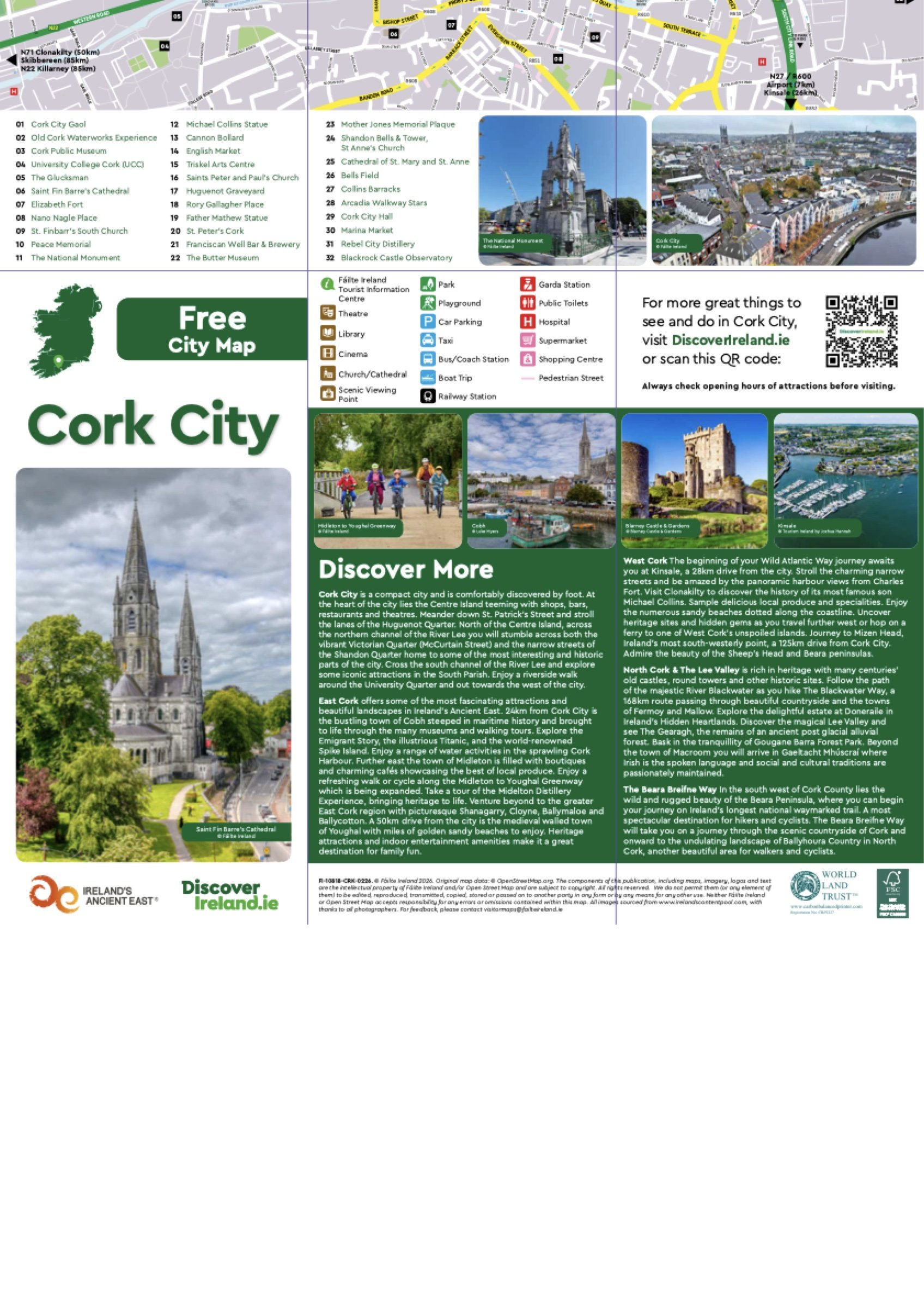
Cork walking map

Fáilte Ireland's free visitor map of Cork: the centre with numbered sights, walks and the practical points (tourist office, parking, stations). Tap to open it full size, or save the PDF to your phone before you go.

Fáilte Ireland official visitor map of Cork

Download the PDF map Map: Fáilte Ireland (Ireland's Content Pool)

Explore

Explore the area

© OpenFreeMap · OSM · terrain Mapterhorn
Do

Local attractions & tours

Skip-the-line tickets and small-group tours in Cork — compare across our partners.

We're still curating hand-picked tickets and tours for Cork. In the meantime, the map above and the nearby cities are a great place to start.

▸ Budget

What it costs in Cork

Backpacker
modest: a hostel or budget room, the market and cafés for food, a Leap card for the buses (daily cap €5.10 in 2026) and the free sights, the fort, the Glucksman, the Marina walk.
Mid-range
comfortable: a central hotel, a restaurant dinner, a couple of paid attractions a day such as the Gaol (€12 adult, 2026) or Charles Fort (€5, 2026) and a train-based day trip.
Luxury
generous: a top hotel in the centre or at a harbour resort, tasting menus, private whiskey experiences at Midleton and a driver for West Cork.
Cash vs card
Cards and contactless work almost everywhere, including ticket machines; buses take cash to the driver, but a Leap card is up to 30% cheaper than cash singles and far simpler. Tip around 10% in restaurants if service is not added; nothing is expected in pubs.
▸ When you'll go

When to visit Cork

May to September for the driest, brightest weather; the October bank holiday weekend for the jazz festival

Spring

What to expect — Cool and brightening fast, with highs climbing from about 10°C in March to 15°C in May. April and May are among the driest months on the Cork Airport record, and May averages more than six hours of sunshine a day.

What's best — Dry days for the Marina walk and the harbour towns, the Choral Festival in the city, Spike Island reopening for the season, and prices and crowds still low.

Summer

What to expect — Mild rather than hot, with highs around 17 to 18.5°C and the longest, sunniest days of the year, though showers never fully leave. The busiest season.

What's best — Long evenings on the quays and at Kinsale, the Midsummer Festival in June, Fota and Spike Island at full tilt, and the most reliable weather for the coast.

Autumn

What to expect — Mild September turning wetter and greyer from October, when rainfall jumps to over 130 mm a month. Highs slip from 16.5°C to about 10°C by November.

What's best — The Guinness Cork Jazz Festival over the October bank holiday weekend, the Film Festival in November, and the pubs coming into their own as the evenings draw in.

Winter

What to expect — Wet, short and mild: highs around 8 to 9°C, lows around 3°C, roughly two hours of sunshine a day and the wettest months of the year. Snow is unusual.

What's best — The market and the gaol in the rain, quiet streets, the lowest room rates, and a stool by the fire with a Murphy's and a session going.

▸ Know before you go

Know before you go

Honest swaps

Skip the hire car for the harbour towns → the commuter train reaches Fota in 15 minutes, Midleton in 23 and Cobh in 26, half-hourly on weekdays.

Skip a taxi from the airport → Bus Éireann 225 or 226 does it in about 25 minutes for a fraction of the €20 (2026) cab fare.

Skip queuing at Blarney on a summer afternoon → go first thing on bus 215, and give the gardens as much time as the stone.

Skip paying for a view → the Shandon tower is worth it, but Elizabeth Fort's walls and the Marina Promenade cost nothing.

Crowds & timing

The jazz festival weekend (October bank holiday) fills the city; book a bed months ahead or avoid it.

Spike Island ferries sell out; book online with a timed sailing, and note the island is open daily only April to October.

Crawford Art Gallery is shut for redevelopment until 2028; the Glucksman at UCC is the free alternative.

Local rules & etiquette

Pubs are for conversation as much as drink; ask before filming a music session and keep chat low while someone sings.

The northside streets are steep and the quays wet; wear shoes with grip and carry a waterproof whatever the forecast.

Ireland drives on the left, as the UK does, but speed limits are in kilometres per hour.

Money

Cork uses the euro; cards and contactless are accepted almost everywhere.

A TFI Leap card is the cheapest way to ride: €1.70 for 90 minutes of city bus travel and a €5.10 daily cap (2026), with no cap on the airport and Kinsale buses.

British passports are not strictly required under the Common Travel Area, but carry one; some airlines and ferries now demand it.

After dark

Oliver Plunkett Street and the lanes off it are the mainstream night out, with Sin É for a traditional session.

MacCurtain Street in the Victorian Quarter is the more grown-up strip, with Live at St Luke's and the Everyman for gigs.

The Shakey Bridge and the park are unlit and quiet late on; stick to the main roads when walking back to Sunday's Well.

Safety
Cork is a relaxed, low-risk city for visitors, and the UK Foreign, Commonwealth and Development Office's Ireland travel advice carries no specific warnings for it. The FCDO's general points apply: take the usual precautions against bag-snatching and pickpocketing, avoid carrying large amounts of cash, and lock your vehicle and use a secure car park, since most incidents happen in the larger cities. It also notes that terrorist attacks cannot be ruled out and that demonstrations can disrupt transport at short notice. The practical hazards are physical. The northside streets are steep and the quays and the Shandon tower stairs are slippery when wet, which is often. Charles Fort has uneven ground and children must be accompanied. The Marina Promenade and the greenway are shared with cyclists. In an emergency dial 112 or 999 for police, fire or ambulance. UK residents can access Irish state healthcare when visiting, and a UK prescription can be dispensed at an Irish pharmacy, though you pay the full cost; take out travel insurance that covers treatment and repatriation regardless.
Culture & etiquette
Cork people are proud of their city and quick to tell you, with a grin, that it is the real capital of Ireland. Take the joke in good part and show some curiosity about the place; conversation is the local art form. Pub manners matter. Buying rounds is normal among a group, and if someone buys you a drink you are expected to return it. Traditional music sessions are informal but the musicians are not a floor show: keep your voice down during a song and ask before filming. Ordering Murphy's or Beamish rather than the Dublin stout will be noticed approvingly. Tipping follows the Irish norm: around ten per cent in restaurants if service is not already on the bill, nothing expected in pubs or for counter service, and rounding up a taxi fare. St Fin Barre's and St Colman's in Cobh are working places of worship; dress modestly and keep quiet during services. Irish appears on signage alongside English, and a 'go raibh maith agat' (thank you) is always welcome.
Daily budget

Mid-range travellers should expect Irish city prices in euros, with a central hotel the largest cost; getting around is cheap (Leap card daily cap €5.10 in 2026), paid attractions run from €5 to about €28 (2026), and the jazz festival weekend pushes room rates up sharply.

Emergency numbers

112 or 999 (police, fire, ambulance — Republic of Ireland and EU standard)

▸ Ready to book your trip?

Getting there

Cork Airport (ORK) lies a short way south of the city, with direct flights from UK airports including Edinburgh. Bus Éireann routes 225 and 226 leave from stop A outside the terminal for Parnell Place bus station and Kent railway station, around 25 minutes; a taxi is roughly €20 (2026). Citylink route 251 links the airport with Limerick and Galway. From Dublin, Irish Rail runs roughly hourly from Heuston to Cork Kent, taking about two and a half hours with Mallow the usual stop on direct trains; Aircoach route 704X coaches from Dublin Airport take three to three and a half hours and set down beside Kent station, itself a ten-minute walk from St Patrick's Street. For routes into the country as a whole, see the Ireland guide.

  • Cork Airport (ORK)
  • Kerry Airport (KIR)
  • Shannon Airport (SNN)
  • Dublin Airport (DUB)
Book

Ready to book your trip?

Flights, airport transfers and car hire to ORK — search and compare without leaving the page.

▸ Trip extras
Book

More trip extras

Parking, holiday extras, and more — coming soon.

Coming soon

We're lining up parking, holiday extras and activities you'll be able to add to any trip from here.

We may earn a commission if you book through these links, at no extra cost to you. How we make money