Kuwait — hero

Asia

Kuwait

Seafront towers, a century-old souq and a new national cultural district. Kuwait rewards a short, curious stay.

Currency
Kuwaiti Dinar (KWD)
Language
Arabic
Best time
November – March
Visa
Visa on arrival or eVisa (some UK citizens must apply in advance)

The FCDO has no advisory against travel to Kuwait.

Still current at: 13 November 2026 Updated: 27 October 2026

Source: UK Foreign, Commonwealth & Development Office — the definitive source. Check it close to your travel dates.

Flight cancelled or delayed because of this? Your rights under UK261 / EU261 →

Why visit

Why Kuwait

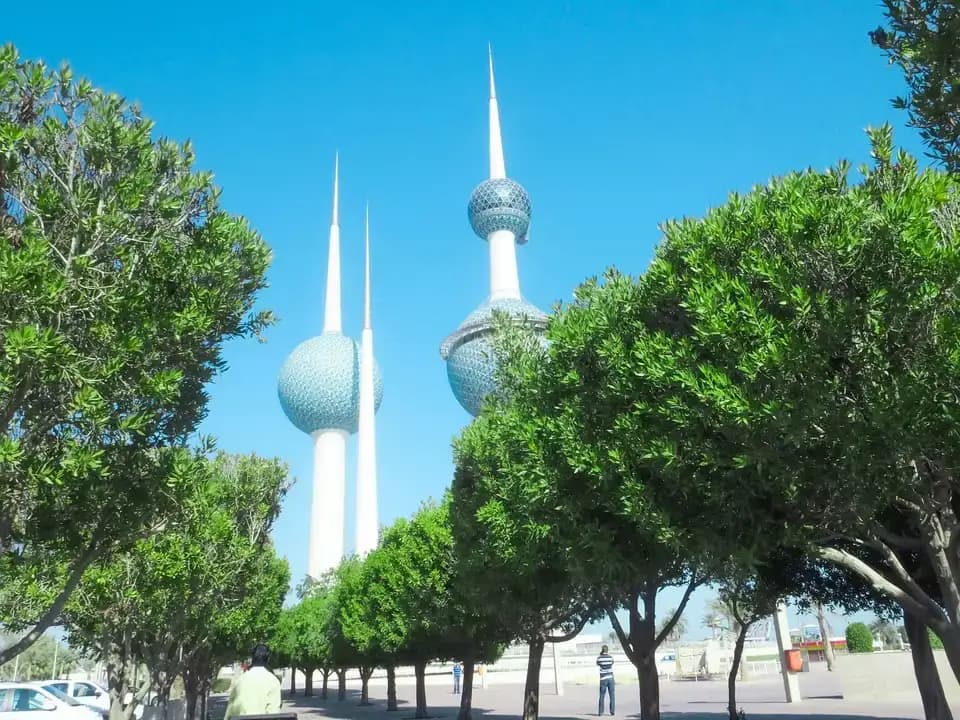
Kuwait City faces the sea. The Kuwait Towers stand over the Arabian Gulf Road in Sharq, and they once stored the city's water. Inland, the lanes of Souq Al Mubarakiya have traded for well over a century. On the edge of the city, Al Shaheed Park sets botanical gardens, a lake and two museums across 200,000 square metres.

  • Kuwait Towers & the waterfront
  • Grand Mosque & Souq Al-Mubarakiya
  • The Avenues mall
  • Failaka Island & Gulf War memory sites
Read more

Kuwait's big cultural project is its new national cultural complex. The Sheikh Abdullah Al Salem Cultural Centre fills six museums, and the Sheikh Jaber Al Ahmad Cultural Centre is home to the performing arts. Social life still turns on the diwaniya, the open reception room where friends talk over cardamom coffee, now on UNESCO's list of intangible heritage.

Where to go

The regions of Kuwait

Kuwait City and Sharq

The old centre and the waterfront. Start at the Kuwait Towers on the Arabian Gulf Road, then walk to Souq Sharq, with the Museum of Modern Art in front of it and the Maritime Museum close by. The Grand Mosque offers guided tours on request through the Ministry of Awqaf.

Souq Al Mubarakiya

The city's best-loved market, which the government lists among Kuwait City's leading landmarks. It takes its name from Sheikh Mubarak Al-Sabah, and the Shaikh Mubarak Kiosk stands inside. We'd come in the evening, when it's cooler, and give it a couple of hours. Take cash for the smaller stalls.

Al Shaheed Park and the cultural district

Kuwait's largest urban park covers 200,000 square metres on the edge of the city, with botanical gardens, two museums, a lake and walking paths. Nearby, the Sheikh Abdullah Al Salem Cultural Centre has six museums, and the Sheikh Jaber Al Ahmad Cultural Centre stages the performing arts.

Salmiya and the Gulf Road

The seafront district along the Gulf Road, and our pick for an evening walk and a long dinner. Bayt Lothan, listed among Kuwait's museums and galleries, sits on the Gulf Road here, and Marina Mall is the place for shopping by the water. The Avenues and the Salhiya Complex are the other big malls on the government's list.

Failaka Island

Failaka lies in the north-west of the Arabian Gulf, 20 km off the coast of Kuwait City, and the government lists it among the country's tourist spots. We'd treat it as a day trip. Check crossings and what's open before you go, as we couldn't confirm current services.

A pillar, not a footnote

Eat your way through Kuwait

The single reason many travellers come back — the food culture worth reshaping a trip around, and the dishes to seek out region by region.

Kuwait

Spiced rice with the day's shrimp and fish, hot Iranian flatbread, and karak strong enough to stand a spoon in.

Kuwait's kitchen faces the water. The plate to seek out is mutabbaq samak — spiced rice layered with fried fish and caramelised onion — or murabyan, fat Gulf shrimp folded through rice heavy with loomi and baharat. Seafood is the pride here, not an afterthought.

The national anchor is machboos, that Gulf constant of spiced basmati with meat or fish, but the everyday joys are cheaper and hotter: shawarma shaved to order, falafel sandwiches at a legally-capped price, and khubz irani torn straight off the tandoor wall of an Iranian bakery, blistered and steaming. There's no alcohol at all, so the social fuel is karak chai, milky and cardamom-spiced, and cups of cardamom gahwa with dates. End on luqaimat, crisp dumplings soaked in date syrup, and you've eaten Kuwait right.

Dishes to seek out
  • Machboos (spiced rice with meat/fish)
  • Mutabbaq samak (spiced rice with fried fish)
  • Murabyan (spiced shrimp & rice)
  • Gabout (dumplings in meat stew)
  • Luqaimat (date-syrup dumplings)
  • Khubz irani (Iranian tandoor bread)
  • Karak chai (spiced milk tea)
Plan your own trip to Kuwait
Plan

Getting there, getting around and where to stay

Getting there from the UK

Kuwait Airways flies between Kuwait and London Heathrow. At the time of writing, the FCDO says Kuwait International Airport is running from Terminals 4 and 5, with Terminal 1 closed and flight schedules reduced because of regional tensions. Check directly with your airline before you book and again before you fly. From the airport, KPTC buses 13, 99 and 501 run into the city for 250 fils, and fixed-zone taxis cost 8 KD to Kuwait City or Salmiya (from the airport's own fare table, checked 28 October 2026).

  • Flight time: check with your airline: schedules are currently reduced
  • Non-stop from the UK: Kuwait Airways (London Heathrow); check British Airways separately
  • Main airport: Kuwait International Airport (KWI), Terminals 4 and 5

Flights to Kuwait City (KWI) →

Getting around

Taxis are the easiest way to get around. From the airport, taxis charge fixed fares by zone: 8 KD to Kuwait City or Salmiya. The Kuwait Public Transport Company runs buses, including three lines from the airport, for 250 fils a ride. If you drive, you'll need third-party insurance, and the FCDO warns that fines have gone up sharply and that local driving can be hazardous. Stay on paved roads and marked tracks. The FCDO says landmines and unexploded weapons remain in Kuwait, so don't drive off-road in the desert.

Where to stay

Kuwait City centre and Sharq

Close to the Kuwait Towers, Souq Sharq, the Maritime Museum and Souq Al Mubarakiya. It's the base for a first visit, and the cultural centres and Al Shaheed Park are a short taxi ride away.

Good for: first visits, the souq, museums

Salmiya

The seafront district on the Gulf Road, with Marina Mall and Bayt Lothan. It's livelier in the evening and still within the 8 KD airport taxi zone.

Good for: sea views, evening walks, shopping

Near The Avenues

A good choice if you're in town for business or want everything under one roof. The mall is one of the shopping venues the government lists, and the centre is a taxi ride away.

Good for: shopping, short business stays

When to go

Weather & timing in Kuwait Right now RIGHT NOW 17°C clear

Best Feb–Mar, Dec · Shoulder Jan, Apr, Nov

Units

Next 7 days

Forecast · Met Office · Powered by Met Office data

Typical · climate data

Best time to visit

November – March

Best for
  • Culture
  • Cuisine
  • Landscape
  • History
At a glance
Sunshine 10.4 hr/day
Rainfall 11 mm/mo
Wettest November · 30.1mm
Driest June · 0mm
Part of Gulf →
By season

Units

Spring (Mar–May)

What to expect — Daytime highs average about 32°C with overnight lows near 21°C, and it stays largely dry.

What's best — Warm & dry, then Shoulder season, then Peak heat. Mar is among the best months here (warm & dry, sunny).

Summer (Jun–Aug)

What to expect — Daytime highs average about 44°C with overnight lows near 32°C, and it stays largely dry.

What's best — Peak heat.

Autumn (Sep–Nov)

What to expect — Daytime highs average about 34°C with overnight lows near 24°C, and it stays largely dry.

What's best — Peak heat, then Shoulder season, then Warm & dry. Nov is among the best months here (warm & dry, sunny).

Winter (Dec–Feb)

What to expect — Daytime highs average about 20°C with overnight lows near 12°C, and it stays largely dry.

What's best — Warm, then Mild. Dec, Jan and Feb are among the best months here (warm, sunny).

Live forecast map · Windy.com · temperature with wind, °C and km/h

Heat, rain and the best months, region by region

Go November to March.

Kuwait's summers are fierce (the national record is 51.3°C), so think of it as a winter trip. The Kuwait Meteorological Center's summer runs from late May to early November, with mid-summer highs of 42–46°C. We'd skip May to September, when the hottest month averages 45°C. From November the days settle at 20–30°C, which is perfect for the souq and the seafront. Midwinter nights can be properly cold, even close to freezing, so pack a jumper. By late April it's heading back towards 40°C.

Average daily high (°C) by month. Measured 2020–2024.
AreaJFMAMJJASOND
Kuwait City 192125323844454441352620

Colours as on the month tiles above. Bold: hot, 32°C or more (go early or late in the day). Outlined: very hot, 35°C or more. Wet: 150 mm of rain or more.

Heat: Skip May–Sep: average 45°C

A little context

A little history

To read what you're looking at — the empires and eras that shaped Kuwait's food, art and streets.

Kuwait was founded in the early 18th century as a trading and pearling port by Bani Utub settlers, among them the Al Sabah, whose merchant families and dynasty have shaped its politics since
the vast Burgan oil field, found in 1938, turned a modest port into an oil state that funded an early cradle-to-grave welfare system
Iraq's 1990 invasion and the 1991 Gulf War liberation, with the oil wells torched, cemented Western security ties and left a deep national scar
its elected National Assembly, from 1963, is the Gulf's most powerful parliament, making public life markedly more political than its neighbours'.
Culture

Culture and etiquette

Dress

The FCDO asks visitors to dress and behave modestly in public, particularly downtown and in more conservative areas. Women should avoid shorts and revealing clothing. Loose, light layers that cover shoulders and knees work for everyone and help in the heat.

Ramadan

Ramadan moves about 11 days earlier each year, so check the dates before you book. During the fast, don't eat, drink, smoke or chew gum in public in daylight, including in your car. Expect shops and restaurants to change their hours.

Alcohol

Alcohol is banned in Kuwait. Buying, selling or carrying it, or being drunk in public, can bring fines, prison or deportation. Don't try to bring any in. The FCDO also warns that illegally made alcohol can cause methanol poisoning.

Behaviour in public

Public displays of affection between men and women are frowned on. It's illegal for unmarried couples to share a hotel room, and hotels may ask for a marriage certificate. Don't photograph government, military, industrial or oil sites, or go near the borders without permission.

The weekend

Kuwait's weekend is Friday and Saturday, and the working week runs Sunday to Thursday. Government offices close at the weekend, so plan any official errands for a weekday.

Food and drink

Kuwait has no bars, so hospitality happens over coffee. In a diwaniya, the host pours cardamom-scented coffee from a long-spouted brass pot into small cups, and the doors stay open for whoever passes. As a visitor, the easiest way in is an evening at Souq Al Mubarakiya, which the government lists among the city's landmarks. For a wider choice, head to Salmiya's seafront or the big malls such as The Avenues and Marina Mall.
Practical

Entry, money and health

Entry and visas (British passport holders)

Visas for UK passport holders

British citizens need a visa, which you can get on arrival or online from the Ministry of Interior. British citizens born in Afghanistan, Iran, Iraq, Lebanon, Pakistan, Sudan, Syria or Yemen must apply at a Kuwaiti embassy first. Your passport needs six months' validity on arrival, and an Israeli stamp may lead to refusal. Stay only as long as your visa allows: overstaying costs 10 KD a day.

The GCC tourist visa

A single Gulf-wide tourist visa covering Kuwait and the other five GCC states has been approved. The latest official statement we found, from the GCC Secretariat in July 2025, said it would launch 'in the near future'. It isn't open to applicants on any official site yet, so get Kuwait's own visa.

Money

Money

The currency is the Kuwaiti dinar (KD), divided into 1,000 fils. Unlike most Gulf currencies, it isn't pegged to the US dollar alone: the Central Bank of Kuwait has tied it to an undisclosed basket of currencies since 2007. Bus fares are in fils, so keep some coins.

Health

Heat

Summer highs of 42–46°C are normal, and Kuwait's record is 51.3°C. Outside winter, keep outdoor sightseeing to early morning and evening, drink water constantly and never leave anyone in a parked car. The government's climate page notes that dust storms often occur in summer.

Medicines

The FCDO says you must get permission from the Kuwaiti authorities before you arrive to carry certain prescription medicines, and that this covers many commonly prescribed drugs. Check with the Kuwaiti embassy well before you travel. Private healthcare is expensive, so take out insurance.

Landmines and borders

The FCDO says there are still landmines and unexploded weapons in Kuwait. Don't drive off-road, stay on clearly marked tracks, and don't go near the borders without authorisation.

UK government travel advice

Before you go

The FCDO updated its Kuwait advice on 27 October 2026. It doesn't advise against travel, but warns that the region is unpredictable, that US bases in Kuwait have been hit by missile and drone fire, and that flights may be cancelled. Read it before you book.

Sources · last checked 28 October 2026

We write this guide from official sources only: GOV.UK, national immigration portals, tourism boards, airports and operators, central banks and met services. Rules change, so check the linked pages before you book.

Before you book

Know before you go

The practical back-matter — safety, drones and the essentials, in one place.

Safety

No FCDO advisory against travel FCDO advice →

Official UK Foreign, Commonwealth & Development Office guidance is the definitive source — check it close to your travel dates.

Drone rules (sub-250g)

  • Kuwait
    A hard barrier in practice. The DGCA can permit a pre-arranged foreign operator, but importing a drone without prior approval is prohibited and devices are routinely seized during airport bag checks, there's no sub-250g exemption, and camera use needs separate Interior Ministry security clearance. ⚠ No night flying without DGCA permission; flights near airports, military installations and oil facilities are prohibited, as is overflight of crowds, highways and residential areas. 2026 regional security tensions have hardened enforcement. Rules checked: Jul 2026

National parks, protected sites and religious/heritage venues often have their own rules and permits — always check the specific site before you fly.

The essentials

Plug & voltage Type C/G · 240V
Daily budget Mid-range (alcohol-free)
Region Western Asia