Laos — hero

Asia

Laos

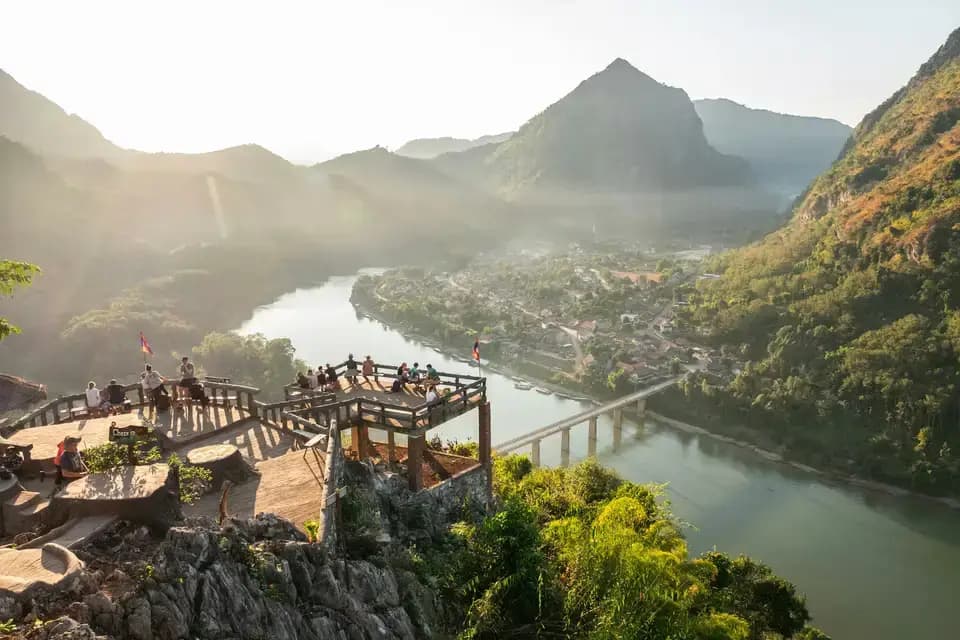
Mountains, the Mekong and the temples of Luang Prabang: a quieter, slower country than its neighbours, best seen at river pace.

Currency
Lao Kip (LAK)
Language
Lao
Best time
November – February
Visa
Visa required — 30-day tourist visa: e-visa (US$50 for UK passports, plus bank charge) or visa on arrival

Still current at: 13 November 2026 Updated: 13 August 2026

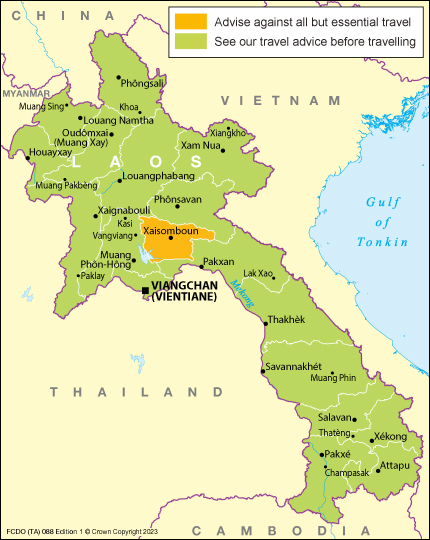
See which areas are affected

FCDO's detailed advisory map (PDF) FCDO (TA) 088 Edition 1 © Crown Copyright

Source: UK Foreign, Commonwealth & Development Office — the definitive source. Check it close to your travel dates.

Flight cancelled or delayed because of this? Your rights under UK261 / EU261 →

Why visit

Why Laos

Laos is a slow country to travel in. It has river towns and temples, the UNESCO-listed old capital of Luang Prabang, the Plain of Jars and the Khmer-era ruins at Vat Phou, all linked by the Mekong and a new railway.

  • Luang Prabang temples, alms-giving & night market
  • Kuang Si waterfalls and Mekong sunsets
  • Vang Vieng karst scenery, caves and tubing
  • The 4000 Islands (Si Phan Don) on the lower Mekong
Read more

Laos is a landlocked country of mountains, rivers and Buddhist temples, and we think it rewards travellers who slow down. The Mekong runs the length of the west, and the old royal town of Luang Prabang sits on a peninsula where the Nam Khan joins it. UNESCO lists the town for the way its temples and wooden Lao houses blend with buildings from the French colonial period.

Vientiane, the capital, is home to Pha That Luang, the golden stupa that serves as a national symbol, and to Wat Sisaket, built in 1818. North of the city, the karst country around Vang Vieng has caves and river crossings, and the Laos–China Railway now links Vientiane, Vang Vieng and Luang Prabang. In Xieng Khouang province, the Plain of Jars holds more than 2,100 Iron Age stone jars used for funerary practices. In the far south, Vat Phou in Champasak is a temple landscape laid out over more than a thousand years and linked mainly to the Khmer Empire.

Plan with care. British visitors need a visa, and the FCDO advises against all but essential travel to Xaisomboun Province. Unexploded ordnance is still a hazard across the country, so we keep to main routes and marked paths. November to February is the cool, dry season. March to May is hot, and the rains run from May to October.

Where to go

The regions of Laos

Luang Prabang and the north

Luang Prabang was the capital of the Lane Xang kingdom from the 14th to the 16th century. It takes its name from the Prabang, a Buddha statue that was a gift from Cambodia. UNESCO inscribed the town in 1995 for the way its traditional Lao buildings blend with colonial-era architecture. The Lao Ministry of Information, Culture and Tourism lists its highlights as Phousi, Wat Xieng Thong, Wat Visoun, Wat Aham, the museum, the Kuang Si waterfall, the handicraft villages and the night market.

About 30 km upriver, opposite Ban Pak Ou where the Nam Ou joins the Mekong, the Tham Ting caves hold more than 4,000 wooden Buddha images.

Vientiane and Vang Vieng

Vientiane sits on the Mekong. Pha That Luang, the gilded stupa in Ban That Luang, is about 45 metres tall and is a national symbol. Wat Sisaket was built in 1818 under Chao Anouvong, and the ministry describes it as the only temple to survive the destruction of 1827–28. Nearby are Ho Phra Keo and Patuxai, the victory monument on Lane Xang Avenue.

Vang Vieng, in Vientiane Province, sits in limestone country. The ministry's listed sights include Tham Poukham cave, about 6 km from town, Tham Nam and Tham Lom, and the Tad Nam Thaem waterfall across the Nam Song. The FCDO warns that tubing, kayaking and swimming carry real risks, including strong currents and hidden obstacles.

The Plain of Jars (Xieng Khouang)

UNESCO lists the Plain of Jars on the Xieng Khouang plateau. More than 2,100 carved stone jars, used for funerary practices between about 500 BCE and 500 CE, are scattered across hill slopes and spurs, and 15 components are inscribed. The ministry describes Site 1, near Phonsavan, as the largest, with 334 sandstone jars.

The area was heavily bombed during the war. UNESCO notes that the inscribed components have been cleared of unexploded ordnance (UXO), but the FCDO warns that UXO is a hazard throughout Laos. We stay on the marked, cleared paths, keep to main routes in the countryside and never pick up metal objects.

The south: Champasak, Vat Phou, Si Phan Don and the Bolaven Plateau

UNESCO describes Vat Phou and the Champasak cultural landscape as a planned landscape more than 1,000 years old. It covers some 39,000 ha on the Mekong, about 500 km south-east of Vientiane. Its temples, shrines and waterworks are laid out along a 10 km axis from Phou Kao mountain to the river and are linked mainly to the Khmer Empire.

Pakse, the regional hub, has an international airport. Further south on the Mekong are Si Phan Don (the 4,000 Islands), and to the east is the Bolaven Plateau. The FCDO reports anthrax in cattle and buffalo near the 4,000 Islands, Pakse and the Bolaven Plateau, so we avoid contact with livestock and eat only thoroughly cooked meat. Fighting between Thailand and Cambodia has closed their shared land borders. If you plan to leave southern Laos overland, read the FCDO advice first.

A pillar, not a footnote

Eat your way through Laos

The single reason many travellers come back — the food culture worth reshaping a trip around, and the dishes to seek out region by region.

Laos

Sticky rice by the fistful, fiery herb-flecked laap, and the Mekong slipping past a French baguette.

Every Lao meal begins with a lidded basket of khao niaow — sticky rice — which you pinch into a ball with your fingers and use to scoop up everything else. It is the thread through the whole table, and the most Lao thing you can do is eat with your hands and share.

The dish to chase is laap, the unofficial national plate: minced meat or fish tossed with lime, chilli, fish sauce, a fistful of herbs and toasted rice powder for crunch — bright, hot and alive. It comes with tam maak hung, green papaya pounded with chilli and fermented crab in a wooden mortar, and smoky sai oua, lemongrass sausage off the coals. France left its mark too: crusty khao chi baguettes with pâté, and thick sweet coffee from the Bolaven Plateau. Wash it all down with a cold Beerlao by the Mekong as the sun drops — this is food to slow you right down.

Dishes to seek out
  • Laap (spicy minced-meat herb salad)
  • Sticky rice (khao niaow)
  • Tam maak hung (green papaya salad)
  • Sai oua (lemongrass pork sausage)
  • Mok pa (fish steamed in banana leaf)
  • Khao chi (baguette with pâté)
  • Beerlao
Things to do

Nature, culture and the outdoors

  1. Walk the temples of Luang Prabang

    Luang Prabang

    Wat Xieng Thong dates from 1560 and stands between the Mekong and the Nam Khan. The ministry calls it a jewel of Lao architecture. It is one of many temples on the UNESCO-listed peninsula.

  2. Take a boat to the Pak Ou caves

    Near Luang Prabang

    Tham Ting, an upper and a lower cave in the cliffs about 30 km north of town, holds more than 4,000 wooden Buddha images. Local people bring them as offerings.

  3. Visit Pha That Luang

    Vientiane

    The 45-metre gilded stupa is a national symbol and the focus of the annual That Luang festival, when monks from every province come together.

  4. See Wat Sisaket and Ho Phra Keo

    Vientiane

    These two temple compounds face each other in central Vientiane. Wat Sisaket was built in 1818.

  5. Explore the caves around Vang Vieng

    Vang Vieng

    Tham Poukham, about 6 km from town, and the nearby Tham Nam and Tham Lom are among the ministry's listed sights. On the river, we wear a lifejacket and check conditions first.

  6. See the stone jars of Xieng Khouang

    Plain of Jars

    These Iron Age funerary jars are a UNESCO World Heritage Site. Site 1, near Phonsavan, is the largest group. Stay on the cleared paths.

  7. Visit Vat Phou

    Champasak

    This is a Khmer-era temple complex on the slopes of Phou Kao, at the head of a sacred axis that runs down to the Mekong.

  8. Travel by train

    Vientiane – Vang Vieng – Luang Prabang

    The Laos–China Railway opened in late 2021, and Vang Vieng and Luang Prabang both have stations. The Lao News Agency reports that day trips from Vientiane to the northern towns are now possible.

Plan your own trip to Laos
Guides

All our Laos guides

Plan

Getting there, getting around and where to stay

Getting there from the UK

The Lao Airlines route list we checked has no UK route. Its international destinations include Bangkok, Chiang Mai, Hanoi, Ho Chi Minh City, Danang, Siem Reap, Seoul and several Chinese cities, so from the UK we connect through a regional hub. International gateways include Wattay International Airport, Vientiane (VTE), Luang Prabang International Airport (LPQ) and Pakse International Airport (PKZ).

Overland, the Lao–Thai Friendship Bridge I is a major entry checkpoint from Thailand, and cross-border trains run between Vientiane and Kunming in China. All foreign nationals must complete the online Lao Digital Immigration Form (LDIF) within the 3 days before arrival and the 3 days before departure. It is required at Wattay, Luang Prabang and Pakse airports and at Friendship Bridge I. Check the FCDO entry requirements before you book.

Flights to Vientiane (VTE) →Flights to Luang Prabang (LPQ) →

Getting around

Rail: the Laos–China Railway runs north from Vientiane through Vang Vieng and Luang Prabang to Boten on the Chinese border. The Lao News Agency reports that tickets are sold at stations and through the operator's LCR Ticket app, which allows bookings up to seven days ahead. Carry your passport when you travel.

Road: the FCDO warns that roads are often in poor condition and that driving after dark is especially risky. To drive, you need a 1949 International Driving Permit as well as your UK licence. The Vientiane–Vang Vieng expressway has speed limits of 80–120 km/h. Never leave your passport as a deposit when hiring a motorbike, and bring or buy a helmet.

River: Mekong boat trips can be dangerous because of changing water levels, strong currents and hidden obstacles. Check for lifejackets and don't board an overcrowded boat.

Where to stay

Luang Prabang's old town

Stay on or near the UNESCO peninsula and you can walk to the temples, the night market and Phousi. See our Luang Prabang guide.

Central Vientiane

The streets near the Mekong put Wat Sisaket, Ho Phra Keo and Patuxai within easy reach.

Vang Vieng

Vang Vieng is a base for the caves and river scenery and is on the railway between Vientiane and Luang Prabang.

Phonsavan and Pakse

Phonsavan is the base for the Plain of Jars. Pakse, which has an airport, is the gateway to Champasak and Vat Phou, Si Phan Don and the Bolaven Plateau.

When to go

Weather & timing in Laos Right now RIGHT NOW 29°C cloudy

Best Dec–Feb · Shoulder Mar–Apr, Nov

Units

Next 7 days

Forecast · Met Office · Powered by Met Office data

Typical · climate data

Best time to visit

November – February

Best for
  • Slow River
  • Temples
  • Waterfalls
  • Colonial Towns
At a glance
Sunshine 9.4 hr/day
Rainfall 174 mm/mo
Wettest September · 442.4mm
Driest December · 1.2mm
Part of Southeast Asia →
By season

Units

Spring (Mar–May)

What to expect — Daytime highs average about 33°C with overnight lows near 24°C, with plenty of rain.

What's best — Dry season, then Shoulder season, then Wet season. Mar is among the best months here (dry season, sunny).

Summer (Jun–Aug)

What to expect — Daytime highs average about 31°C with overnight lows near 25°C — the wettest stretch of the year.

What's best — Monsoon.

Autumn (Sep–Nov)

What to expect — Daytime highs average about 30°C with overnight lows near 23°C, with plenty of rain.

What's best — Monsoon, then Wet season, then Dry season. Nov is among the best months here (dry season, sunny).

Winter (Dec–Feb)

What to expect — Daytime highs average about 28°C with overnight lows near 18°C, and it stays largely dry.

What's best — Dry season. Dec, Jan and Feb are among the best months here (dry season, sunny).

Live forecast map · Windy.com · temperature with wind, °C and km/h

Heat, rain and the best months, region by region

We think November to February is the most comfortable time to visit. It is the cool, dry season: in Vientiane, average highs run from about 27°C to 30°C and there is very little rain.

March, April and May are hot. The site's climate data puts Vientiane's average highs at 32°C in March, 34°C in April and 33°C in May. April and May are also muggy.

The FCDO says the rainy season normally runs from May to October. Vientiane's rainfall peaks in August and September, at over 400 mm a month. During the rains, rivers can rise within hours, mountain roads are prone to landslides, cross-country journeys can take much longer than scheduled, and flash floods can expose unexploded ordnance. The countryside is green and the rivers are full, but leave slack in your plans.

Average daily high (°C) by month. Measured 2020–2024.
AreaJFMAMJJASOND
Vientiane 283032343331313030303028

Colours as on the month tiles above. Bold: hot, 32°C or more (go early or late in the day). Outlined: very hot, 35°C or more. Wet: 150 mm of rain or more.

Heat: Average highs reach 32°C or more in March, April and May (Vientiane: 32.3°C, 34.1°C, 33.4°C). It is humid from April to September, and the rainy season runs from May to October.

A little context

A little history

To read what you're looking at — the empires and eras that shaped Laos's food, art and streets.

Fa Ngum founded the kingdom of Lan Xang ('Million Elephants') in 1353, the wellspring of Lao Buddhist identity still symbolised by Vientiane's That Luang stupa
it became a French protectorate in 1893 and gained full independence by 1953–54, leaving baguettes, coffee culture and colonial architecture in Luang Prabang and Vientiane
from 1964–73 the US dropped some two million tons of ordnance in the 'Secret War', making Laos the most heavily bombed country per capita, and unexploded ordnance still contaminates rural areas
the Pathet Lao abolished the monarchy in 1975, and Laos remains a one-party socialist state, one of Asia's least-visited.
Culture

Culture and etiquette

  • Temples: the FCDO says men and women alike should cover shoulders and knees at temples and religious sites. Luang Prabang's temples are working monasteries, so we keep our voices down and give monks space.
  • Morning alms (tak bat): merit-making, when monks collect offerings of food, is a religious ceremony rather than a show. Ask locally how to watch or take part respectfully, and don't get in the way of the procession.
  • Swimwear: the FCDO says it is not appropriate to walk around in swimwear in public after leaving a waterfall, river or pool.
  • Photography: photographing or entering military sites is banned, and the FCDO advises against photographing bridges and airfields.
  • Law: drug offences carry severe penalties, including possible death for trafficking. Vapes, heated tobacco and shisha are illegal. Sexual relationships between foreigners and Lao nationals are prohibited unless the couple are married under Lao law.
  • Festivals: the ministry lists Lao New Year, the boat-racing festival and the Boun Ok Phansa fire-boat festival in Luang Prabang, and the That Luang festival in Vientiane, among the country's major celebrations.
Practical

Entry, money and health

Entry and visas (British passport holders)

The FCDO says British citizens must have a visa to visit Laos. Your passport needs at least 6 months' validity from your arrival date and at least 2 blank pages. Since 1 January 2025, tourist visas have been valid for 30 days from arrival.

You can apply for a single-entry e-visa at least 5 days ahead. The official portal's fee calculator showed US$50 per applicant for UK passports, excluding bank charges, on our check date. You can also get a single-entry visa on arrival at many entry points, including Wattay, Luang Prabang and Pakse airports. You can extend a tourist visa twice in Laos, for up to 60 more days. Overstaying brings heavy penalties. You must also complete the online LDIF arrival and departure form.

Money

The currency is the Lao kip (LAK, ₭). The Bank of the Lao PDR states that only kip should be used in Laos, and it publishes a daily reference rate. The FCDO warns of petty crime around ATMs and bag snatches by people on motorbikes, so keep cards and cash in separate bags.

Health

See TravelHealthPro at least 8 weeks before you travel. It recommends vaccines including hepatitis A and typhoid for most travellers, and others, such as Japanese encephalitis and rabies, for some. Malaria risk is low, and very low in Vientiane city. Avoiding bites is advised, and dengue rises in the rainy season. If you stay 4 weeks or more, you may need proof of polio vaccination when you leave. The FCDO says medical care outside the capital is basic and evacuation is expensive, so take out full insurance. It also warns of methanol in spirits and of drink spiking. For an ambulance, dial 1195.

UK government travel advice

The FCDO advises against all but essential travel to Xaisomboun Province because of intermittent attacks on infrastructure and armed clashes. We give no stays or booking links there. It also urges extreme caution in Bokeo Province near the borders with Myanmar and Thailand, around the Golden Triangle Special Economic Zone. Landmines and unexploded weapons are a hazard throughout Laos: keep to main routes in rural areas and do not pick up metal objects. The risk rises after floods and landslides. Travelling against FCDO advice can invalidate your insurance. Read the full FCDO travel advice for Laos (last updated 13 August 2026) before you travel.

Sources · last checked 28 October 2026

We write this guide from official sources only: GOV.UK, national immigration portals, tourism boards, airports and operators, central banks and met services. Rules change, so check the linked pages before you book.

Before you book

Know before you go

The practical back-matter — safety, drones and the essentials, in one place.

Safety

FCDO advisory in force — see above FCDO advice →

Official UK Foreign, Commonwealth & Development Office guidance is the definitive source — check it close to your travel dates.

Drone rules (sub-250g)

  • Laos
    Effectively off-limits for casual visitors. Any drone over 200g needs advance DCA registration and a site-specific permit listing coordinates and times, plus separate import clearance — a paper-based, advance-only process, and only genuine sub-200g toys escape it. ⚠ Keep clear of airports and flight paths, government and military sites, and Buddhist temples and heritage areas such as Luang Prabang's UNESCO town; any 200g-plus drone needs a location-specific permit anyway. Rules checked: Jul 2026

National parks, protected sites and religious/heritage venues often have their own rules and permits — always check the specific site before you fly.

The essentials

Plug & voltage Type A/B/C/E/F · 230V
Daily budget Budget-friendly
Region South-Eastern Asia