← Norway
NORWAY · ISLAND

Reine

  • Island
  • Lofoten Fishing Village
  • Red Rorbuer
  • Reinebringen
  • Granite Peaks Over the Sea

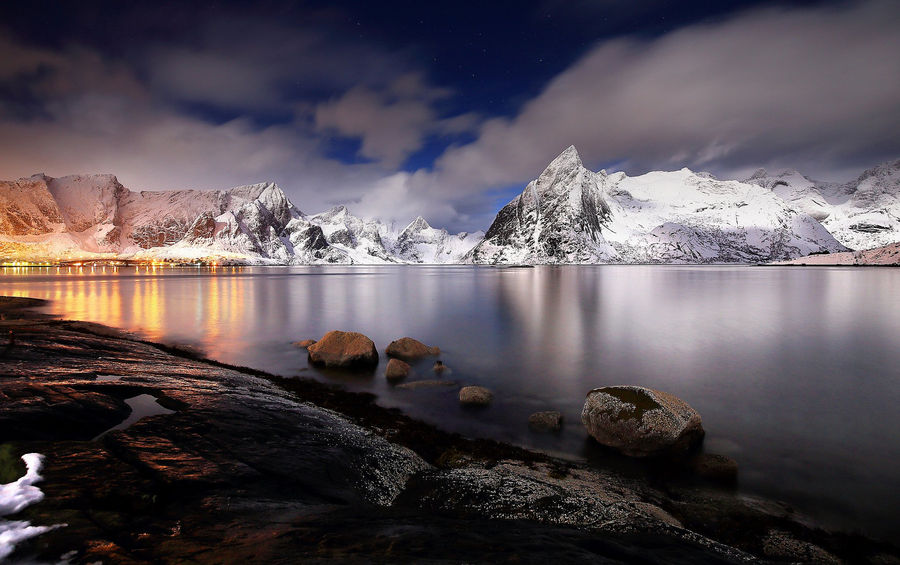
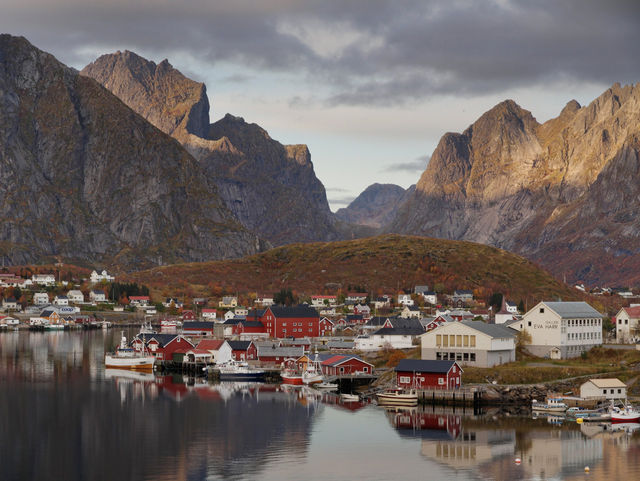
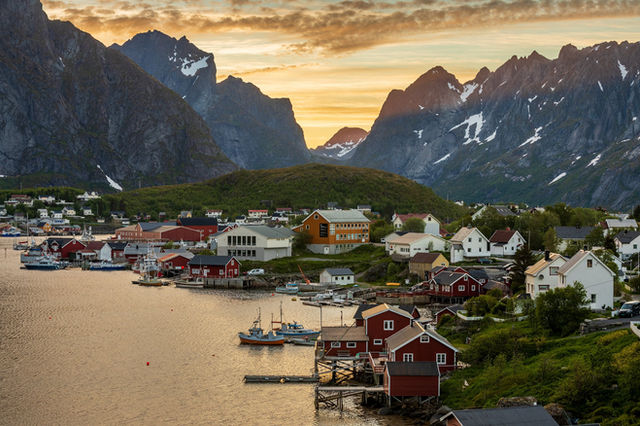
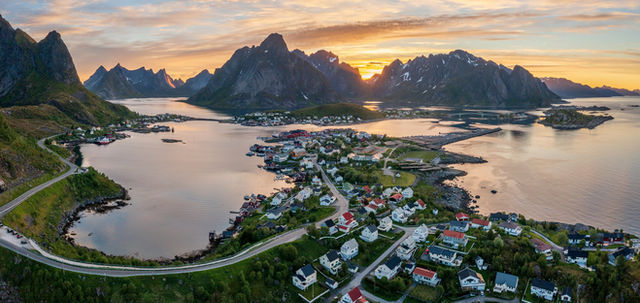
Red rorbuer mirrored in still water, the sawtooth peaks of the Reinefjorden behind them catching the last light, and a single fishing boat drawing a line across the glass.

Reine is a cluster of red fishermen's cabins on stilts, scattered across islets at the foot of black granite peaks that rise straight out of the sea. It is the postcard of Lofoten and one of the most photographed villages in Norway — and, if you climb the ridge above it, one of the most jaw-dropping views in the country.

▸ Discover

About Reine

Reine sits near the western end of the Lofoten archipelago, on the island of Moskenesøya, where a road on stilts hops between rocky islets around a sheltered bay at the mouth of the Reinefjorden. The setting is the whole story: sheer granite mountains drop almost vertically into the sea, and the old red and ochre rorbuer — fishermen's cabins built over the water on posts — sit at their feet. This is deep-Lofoten fishing country, built on centuries of the winter cod (skrei) migration, and it is spectacular in every season: green and long-lit in the midnight-sun summer, dark and aurora-lit in winter. Small, remote and weather-battered, it rewards anyone who makes the long journey out along the E10.

Why go

Reine is the essential Lofoten image made real — red cabins, mirror fjord, vertical peaks — and the launch point for the region's most famous view, the Reinebringen ridge. Add boat trips into a wild fjord, empty beaches a short drive away, the midnight sun in summer and the northern lights in winter, and it is the single most concentrated dose of Lofoten's drama.

Don't miss

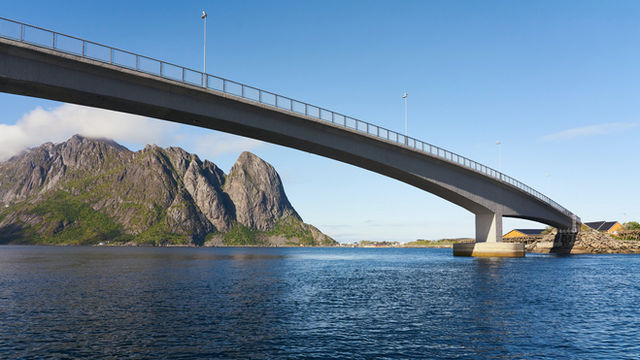
  • The classic view of Reine and its red rorbuer from the E10 bridge and the harbour
  • The Reinebringen hike up the stone "Sherpa steps" to the ridge over the village
  • A boat trip into the Reinefjorden to Vindstad and the Bunes beach
  • The neighbouring red-cabin hamlets of Hamnøy and Sakrisøy
  • The village of Å at the road's end, with its stockfish and fishing-village museums

Signature experiences

The Reinebringen ridge — The hike above Reine is the region's signature view: a steep climb up a long stone stairway — the "Sherpa steps", built by Nepalese stoneworkers — to a knife-edge ridge 448 metres up, looking straight down on the village, the red cabins and the fjord threading between peaks. It is short but genuinely steep and can be busy; go early, wear proper footwear, and check conditions, as the upper section is exposed and closes in bad weather or ice. **A boat into the Reinefjorden** — From Reine harbour, small passenger and charter boats run into the Reinefjorden — a wild, roadless fjord walled by peaks — to the tiny hamlets of Vindstad and Kirkefjord. From Vindstad a marked path crosses to Bunes, a vast sweep of empty sand under sheer cliffs, one of Lofoten's great hidden beaches. It is the quiet counterpoint to the Reinebringen crowds and the only way to reach the fjord's inner reaches. **Living in a rorbu over the water** — Half the point of Reine is staying in a rorbu — an old red fishermen's cabin on stilts, many now converted for visitors, waking with the water beneath the floor and the peaks in the window. It is the classic Lofoten stay, and Reine, Hamnøy and Sakrisøy have some of the most photogenic. Book well ahead; the best cabins go early, especially in the aurora and midnight-sun seasons. **The midnight sun and the northern lights** — Reine's latitude means extremes of light. From roughly late May to mid-July the sun never sets, and the peaks and cabins glow through the small hours — the best time for late-night walks and photography. From roughly September to March the dark returns and the aurora dances over the fjord on clear nights. Either way, the light is as much the experience as the landscape. **Beaches and villages along the E10** — The road out to Reine strings together some of Lofoten's finest sights. Stop for the white-sand, turquoise-water beaches of Kvalvika (a short hike), Ramberg and Skagsanden further back up the archipelago, and the surf breaks that draw Arctic surfers even in winter. Between them, the red-cabin hamlets and fish-drying racks make the whole drive a slow, stop-start pleasure.

Neighbourhoods

Reine neighbourhood by neighbourhood — the character of each and who it suits.

  • Reine village & harbour

    The core settlement around the sheltered bay — a working harbour, red and ochre rorbuer over the water, a small shop and a couple of restaurants, all hemmed by peaks.

    Why go
    The base for the boats and the Reinebringen hike, and the postcard view itself.
    Best for
    Rorbuer staysfjord boatsphotographythe Reinebringen trailhead nearby
    Known for
    The red rorbuer on stilts, the fishing harbour, the E10 causeway views, and the mountains rising straight from the bay.
  • Hamnøy & Sakrisøy

    Two tiny neighbouring islet-hamlets just up the E10 — Hamnøy with its classic red-cabin cluster below a great peak, Sakrisøy with its distinctive ochre-yellow cabins.

    Why go
    The most photographed cabin-and-mountain compositions in Lofoten, minutes from Reine.
    Best for
    Photographyrorbuer staysthe famous bridge viewpoints
    Known for
    The Hamnøy bridge photo spot, the yellow Sakrisøy rorbuer, and a well-known roadside fish restaurant and stockfish shop.
  • The Reinefjorden

    The wild, mountain-walled fjord reaching inland behind Reine, reached only by boat, with abandoned hamlets and a beach hidden at its far end.

    Why go
    The quiet, roadless heart of the scenery, and the walk to the beach at Bunes.
    Best for
    Boat tripsthe Bunes beach hikesolitude
    Known for
    The passenger boat to Vindstad and Kirkefjord, the hike over to Bunes beach, and the sheer walls with no road in.
  • Å and the road's end

    The last village on the E10 at the very tip of Lofoten, a preserved fishing station whose name is a single Norwegian letter, "Å".

    Why go
    A time-capsule fishing village and the museums that explain the cod trade that built the whole region.
    Best for
    Fishing heritagemuseumsthe end-of-the-road feeling
    Known for
    The Norwegian Fishing Village Museum, the Lofoten Stockfish Museum, the old rorbuer and the road's literal end.

Views & hidden gems

Best views

  • The Reinebringen ridge — the definitive view down onto Reine and the fjord
  • The Hamnøy bridge — the classic red-cabins-under-a-peak composition
  • The E10 causeways around Reine, with the village mirrored in still water
  • Bunes beach at the end of the Reinefjorden boat-and-boot trip

Hidden gems

  • Bunes and Kvalvika beaches — empty Arctic sand reached only on foot
  • The passenger boat to Vindstad and Kirkefjord, into the roadless inner fjord
  • The village of Å and its quiet fishing-heritage museums beyond the tour-bus hours
  • The fish-drying racks (hjell) of stockfish cod — the smell and sight of the trade that built Lofoten
  • The late-evening light in high summer, when the day-trippers have gone and the sun stays up

Food & drink

Reine eats from the sea and the cod trade. This is the home of Lofoten stockfish — cod dried on wooden racks in the Arctic wind, exported for a thousand years — and of skrei, the prized winter cod that migrates here to spawn. Expect fresh cod and its liver and roe in season, fish soup, dried-fish dishes, and, out at Sakrisøy, a well-known roadside spot for fishcakes and a stockfish shop. Choice is limited and prices are high in such a remote village, so mix a rorbu self-catered dinner with a harbour meal, and try the local cod however it comes.

  • Skrei — the migratory winter cod, Lofoten's prize catch (in season)
  • Tørrfisk (stockfish) — air-dried cod, the region's ancient export
  • Fiskesuppe — creamy Norwegian fish soup
  • Fishcakes and fresh cod from the Sakrisøy roadside kitchen
  • Brown cheese (brunost) and Norwegian waffles
  • Cloudberries and Arctic berries in late summer
Dietary notes

Options are minimal in a village this small and remote; the few restaurants will manage vegetarian and gluten-free with notice, but vegan, halal and kosher choices are very limited. Self-catering in a rorbu is how most visitors eat — stock up at the Leknes or Moskenes shops before heading out, as the local shop is tiny.

Reine in photos

▸ Getting around

Getting around Reine

A car is by far the most practical way to explore — the villages, beaches and trailheads are strung along the E10 and its spurs. Local buses run the main road but infrequently; the Reinefjorden and its beaches are reached by passenger boat from Reine. Distances feel short on the map but the winding road and photo stops slow everything down.

On foot within Reine; by car for Hamnøy, Sakrisøy and Å, all minutes away up or down the E10; by boat for the Reinefjorden hamlets and Bunes beach.

▸ Plan your days

Suggested itineraries

Ready-made day plans for Reine — from a single day to a long weekend.

One day

Start early with the Reinebringen climb for the definitive view before the crowds, then spend the late morning photographing the red cabins at Hamnøy and Sakrisøy. Drive out to Å at the road's end for the fishing-village museums and lunch, and finish the day with the long light back at Reine harbour among the rorbuer.
Two days

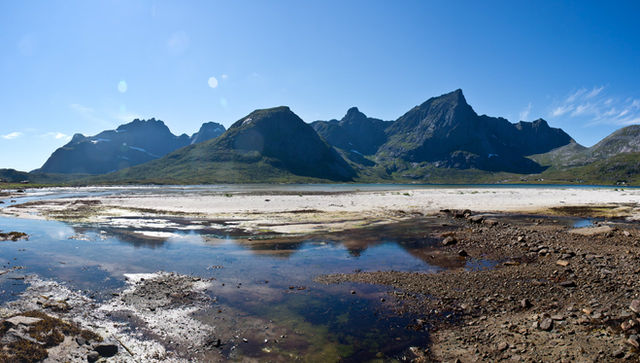
Give day two to the water and the beaches. Take the passenger boat into the Reinefjorden to Vindstad and hike over to the empty sands of Bunes, or drive back up the archipelago to the beaches at Kvalvika and Ramberg. Return for a self-catered rorbu dinner and, in season, the midnight sun or the aurora over the fjord.

Three days

Use day three to range wider across western Lofoten — the surf and sands around Ramberg and Flakstad, the villages and viewpoints back toward Leknes, and, if the weather turns, the museums and indoor culture — treating Reine as the western base of a fuller Lofoten trip that could run on to Henningsvær and Svolvær.

▸ What you'll do

Insider tips

  • Fill the car and stock up on food at Leknes or Moskenes before heading out — Reine's shop is tiny and the drive is long.
  • Book your rorbu and the Reinebringen weather window as far ahead as you can; both are in high demand.
  • Respect the passing places and narrow bridges on the E10 — stop only in proper lay-bys for photos, not on the road.
  • The Moskenes–Bodø car ferry is a scenic and useful way in or out; book vehicle space ahead in summer.
Explore

Explore the area

Interactive area map
Map coordinates coming soon

This place is missing lat/lng — waiting on the next Wix sync.

Do

Local attractions & tours

Skip-the-line tickets and small-group tours in Reine — compare across our partners.

We're still curating hand-picked tickets and tours for Reine. In the meantime, the map above and the nearby cities are a great place to start.

▸ Budget

What it costs in Reine

Backpacker
roughly kr 800–1,400 a day.
Mid-range
roughly kr 2,000–3,500 a day.
Luxury
kr 4,500 a day and up.
Cash vs card
Norway is effectively cashless — tap a card or phone everywhere, even out here. Cash is rarely needed.
Tipping
Not expected; round up for good service if you wish.
▸ When you'll go

When to visit Reine

Spring

What to expect — Snow lingering on the peaks, lengthening days, and the winter cod season tailing off. The E10 is open year-round but conditions can still be wintry into April.

What's best — Fewer visitors, dramatic snow-on-peak-over-green scenery, and the shoulder-season quiet before the summer coaches.

Summer

What to expect — The midnight-sun season — endless daylight, the warmest and busiest months, rorbuer booked out, and the Reinebringen and beaches at their most popular. Still cool and changeable; Lofoten weather is never guaranteed.

What's best — Round-the-clock light for hiking, boating and photography, all services running, and long empty evenings once the day-trippers leave.

Autumn

What to expect — The dark returns and the first auroras appear, the crowds thin, and the weather turns wilder. Cool, moody and increasingly quiet.

What's best — Autumn colour, the northern lights beginning over the fjord, and rorbuer easier to book at better rates.

Winter

What to expect — Cold, dark and dramatic — snow on the peaks, the aurora on clear nights, the skrei cod season, and short blue-lit days. Some services reduce and driving needs care, but the E10 stays open.

What's best — The northern lights over the red cabins, the winter-cod fishing culture, Arctic surfers in the swell, and the starkest, most photogenic Lofoten of all.

▸ Know before you go

Know before you go

Honest swaps

Skip driving straight through to the photo spots → stay a night in a rorbu so you have the villages in the quiet early and late hours.

Skip the crowded midday Reinebringen climb → go early morning or late evening (in summer, even at "night" in the midnight sun).

Skip trying to see all of Lofoten from Reine in a day → it's a long, stop-start archipelago; base out here and explore the western islands slowly.

Skip counting on any single night for the aurora → give yourself several clear-sky chances across a multi-night stay.

Crowds & timing

Reine, Hamnøy and the Reinebringen trail are busy midday in summer with coach and camper traffic — early and late are far quieter and better lit.

The Reinebringen upper section closes in poor conditions and can be icy outside summer; check before you climb.

Rorbuer and the popular restaurants book out well ahead in the midnight-sun and aurora seasons — reserve early.

Local rules & etiquette

This is a working fishing and farming community — respect private land, drying racks and moorings, and don't block the narrow E10 or passing places for photos.

The hikes and beaches are real Arctic terrain — proper footwear, layers, water and a weather check; conditions change fast.

Wild camping is now largely restricted across Lofoten — a change from Norway's usual right-to-roam — so use the official campsites and designated motorhome stopovers rather than pitching wild.

Money

Tap-to-pay everywhere; cash is essentially unnecessary. Decline "pay in your home currency" on card terminals — choose Norwegian kroner.

After dark

There is no nightlife to speak of — the evening is a rorbu deck, a harbour walk and the sky.

In summer "after dark" is the midnight sun; use the small hours for empty trails and glowing peaks.

In winter the aurora is the show — clear, dark nights over the fjord, best away from the few village lights.

▸ Ready to book your trip?

Getting there

Lofoten is remote. The nearest airports are Leknes (LKN) and Svolvær (SVJ), short flights from Bodø, and Reine is a drive of roughly an hour or so from Leknes along the E10. The scenic alternative is the Bodø–Moskenes car ferry, landing minutes from Reine. Long-distance buses run the E10, and Narvik/Evenes (EVE) airport with an onward drive is another way in.

Book

Ready to book your trip?

Flights, airport transfers and car hire — search and compare without leaving the page.

▸ Trip extras
Book

More trip extras

Parking, holiday extras, and more — coming soon.

Coming soon

We're lining up parking, holiday extras and activities you'll be able to add to any trip from here.