← Spain
SPAIN · CITY

Santiago de Compostela

The soaring end-point of the Camino pilgrimage — a granite old town wrapped in mist, incense and history.

  • City
  • May, June and September — milder and drier; it rains a lot here
  • ~approx 2 days
  • Camino's End
  • Great Granite Cathedral
  • Arcaded Old Town
  • Galician Feasts

Weary pilgrims stumbling into the vast Praza do Obradoiro to collapse before the cathedral's soaring stone façade, the giant silver botafumeiro swinging in clouds of incense across the transept, and the smell of paprika-dusted octopus drifting from a market stall.

Santiago de Compostela is the end of the road — the goal of the great medieval pilgrimage, a rain-silvered granite city in green Galicia whose colossal cathedral draws walkers from across Europe, its old streets arcaded against the weather and its tables loaded with octopus and Albariño.

Type
city
Ideal length
~approx 2 days
Getting around
on foot — the old town is compact and walkable
Neighbourhoods
3 areas
Best season / months
May, June and September — milder and drier; it rains a lot here
Language
Spanish and Galician (Galego); some English
Currency
euro (€)
Budget level
moderate — affordable by Spanish standards
Good for
  • History
  • Pilgrims
  • Food
  • Architecture
  • Slow travel
▸ Discover

About Santiago de Compostela

Santiago sits inland in Galicia, in Spain's damp, green northwest. Its old town is a compact maze of granite streets, arcaded rúas and small squares, all climbing to the cathedral and the grand Praza do Obradoiro at the summit. This is the terminus of the Camino de Santiago, the pilgrim routes that have led to the tomb of St James for over a thousand years, and the city's whole rhythm still turns on arriving walkers. Beyond the medieval core spreads the modern Ensanche and the university; the surrounding hills are lush and often wet. It's atmospheric, walkable and unlike anywhere else in Spain.

Why go

Santiago is one of Europe's great pilgrimage cities and a UNESCO World Heritage jewel — its cathedral, the destination of the Camino, is a Romanesque-and-Baroque masterpiece, and the old town around it is a beautifully preserved granite ensemble. But it's also a lively university city with a superb Galician food scene: some of Spain's best seafood, octopus, empanada and Albariño. Whether you walk in or simply arrive, the sense of journey's-end ceremony, the architecture and the eating make it unmissable.

Don't miss

  • The Cathedral — the Camino's soaring granite goal
  • The Praza do Obradoiro — the grand cathedral square
  • The Pórtico da Gloria — the carved Romanesque portal
  • The Mercado de Abastos — the great Galician food market
  • The old-town rúas — arcaded granite streets

Signature experiences

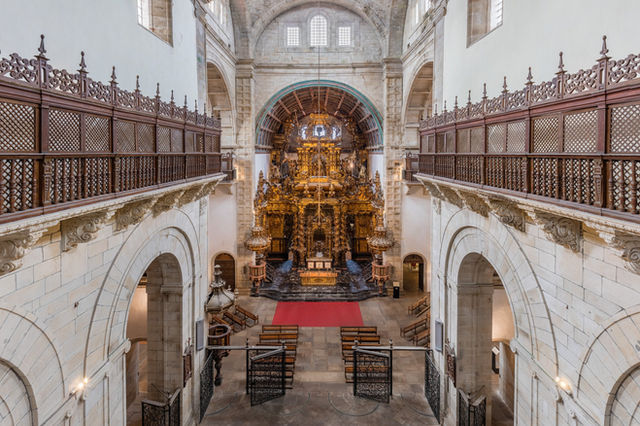
The cathedral and the Camino's end — Santiago's cathedral is the emotional heart of the city — the goal of the Camino, rising over the vast Praza do Obradoiro in a grand Baroque façade that hides a Romanesque core. Inside, pilgrims embrace the statue of St James above his tomb, and, on the right occasions, the giant botafumeiro incense burner is swung on ropes across the transept in great smoking arcs. Even without walking a step of the route, standing in the square as pilgrims arrive is deeply moving. (The famous carved Pórtico da Gloria is a highlight — check access and any timed visit.) **Wandering the granite old town** — The old town is a joy to explore on foot — arcaded rúas that shelter you from the Galician rain, small stone squares around the cathedral (each with its own character), convents, the university's old colleges, and shopfronts of pilgrim gear, silverwork and tarta de Santiago. It's compact, walkable and atmospheric in any weather; the wet granite gleams, and the pilgrim energy gives it a purpose few old towns have. **Galician feasting** — Santiago eats superbly, and the Mercado de Abastos is the place to start — Galicia's seafood and produce under granite halls, where some stalls will cook what you buy. The regional table is a highlight of Spain: pulpo á feira (paprika-dusted octopus), padrón peppers, empanada, percebes (goose barnacles), and the almond tarta de Santiago, washed down with crisp Albariño or a cloudy young wine in a ceramic cup. Graze the market and the old-town tapas bars. **Pilgrim rituals and the Alameda** — Santiago's whole life turns on the Camino, and joining its rituals — watching arrivals in the Obradoiro, collecting a scallop shell, attending the pilgrims' Mass — is part of the experience even for non-walkers. For the classic view, walk out to the Alameda park just west of the old town, where a leafy promenade frames the cathedral's spires above the rooftops — the postcard shot, and a lovely green escape from the stone.

Neighbourhoods

Santiago de Compostela neighbourhood by neighbourhood — the character of each and who it suits.

  • The Old Town (Zona Vella)

    The granite medieval core climbing to the cathedral — arcaded rúas, small squares, convents and pilgrim life, all in weathered stone. The historic, atmospheric heart.

    Why go
    The cathedral, the great squares and the arcaded streets.
    Best for
    Sightseeingpilgrim atmospheretapaswandering
    Known for
    The Cathedral and the Praza do Obradoiro, the surrounding squares (Praterías, Quintana), the arcaded Rúa do Vilar and Rúa Nova, the university's old colleges, and the pilgrim-thronged lanes.
  • The Mercado and San Pedro

    The eastern edge of the old town around the great market and the pilgrim gateway of San Pedro — where the Camino enters the city and Galicia's produce is bought and eaten. The city's earthy, edible corner.

    Why go
    The Mercado de Abastos food market and the Camino's arrival street.
    Best for
    Food marketsseafoodpilgrim arrivalslocal life
    Known for
    The Mercado de Abastos (Galicia's produce and seafood under granite halls), the Rúa de San Pedro where pilgrims arrive, the octopus and tapas bars, and the convents on the eastern slope.
  • The Ensanche

    The modern town south and west of the old core — a grid of shops, cafés, the university's newer faculties and most of the everyday city life. Santiago's contemporary, workaday side.

    Why go
    The shopping, the cafés and the student city, plus some hotels.
    Best for
    Shoppingcafésmodern dininghotels
    Known for
    The main shopping streets and plazas, the university faculties and student life, the modern cafés and restaurants, and the everyday services of the new town.

Views & hidden gems

Best views

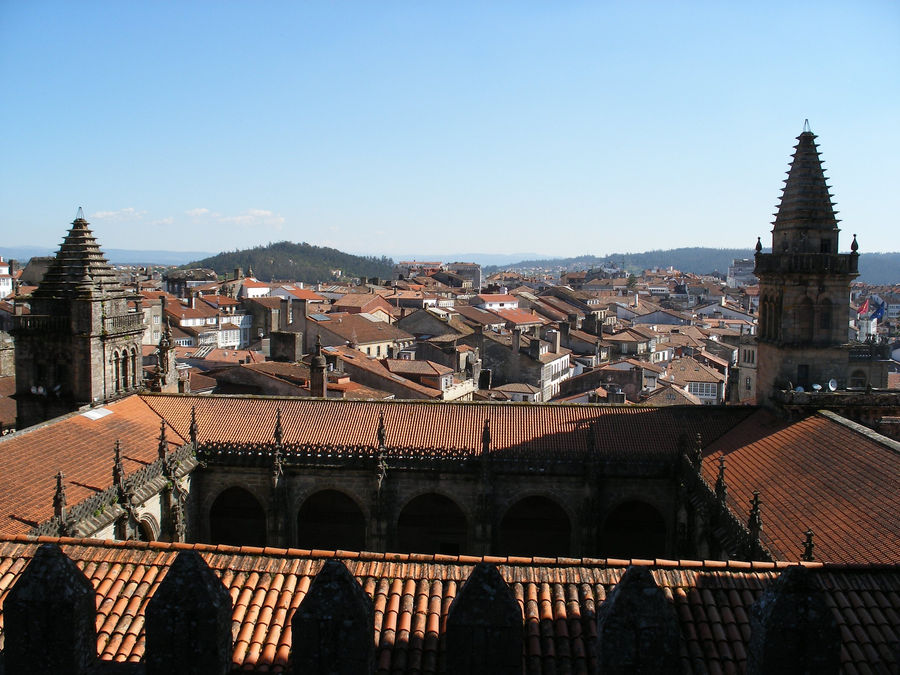
  • The Alameda park — the classic cathedral-spires view over the old town
  • The Praza do Obradoiro — the cathedral façade and arriving pilgrims
  • The cathedral rooftop tour — over the old town from the granite roofs
  • The Quintana square at dusk — the cathedral's Holy Door side, floodlit

Hidden gems

  • The Mercado de Abastos — cook-your-catch stalls and Galician produce
  • The Pazo de Xelmírez — the Romanesque archbishop's palace beside the cathedral
  • The Bonaval park and old convent on the eastern edge — quiet and green
  • The pilgrims' Mass and the botafumeiro when it flies (check the schedule)
  • The arcaded Rúa Nova and Rúa do Vilar in the rain — the old town at its most atmospheric

Food & drink

Galicia is one of Spain's great food regions, and Santiago is its showcase. The Mercado de Abastos overflows with Atlantic seafood and produce, and the old-town bars serve it: pulpo á feira (octopus with paprika and oil), padrón peppers, savoury empanada, percebes and razor clams, and the tetilla cheese. The sweet finish is tarta de Santiago, an almond cake stamped with the cross of St James. The wines are Galicia's crisp Albariño and Ribeiro, sometimes poured cloudy and young into little ceramic cups.

  • Pulpo á feira — boiled octopus with paprika, oil and salt
  • Empanada gallega — a flat savoury pie of tuna, meat or cockles
  • Pimientos de Padrón — small fried green peppers (some fiery)
  • Percebes — goose barnacles, a prized Atlantic delicacy
  • Tarta de Santiago — an almond cake marked with the saint's cross
  • Albariño — Galicia's crisp white wine
Dietary notes

This is a seafood-and-octopus city, so committed vegetarians rely on padrón peppers, tortilla, empanada (vegetable versions), cheese and salads — ask about stock and fillings. Vegan options are growing in the student Ensanche. Halal and kosher are limited. Gluten-free travellers are helped by the naturally almond-based tarta de Santiago, but empanada and breads are wheat — confirm; some bars mark gluten-free tapas.

Santiago de Compostela in photos

▸ Where you'll stay

Where you'll stay in Santiago de Compostela

Stay in or right beside the old town to be steps from the cathedral, the squares and the market — a maze of granite that's the most atmospheric base, with everything walkable. The Ensanche just south is cheaper and handy for services and the station. Pilgrim-oriented hostels (albergues) and guesthouses cluster near the Camino's entry. Santiago is affordable but fills for Holy Week and the July St James festival — book ahead.

  • Budget
    Near San Pedro / the Ensanche albergues, hostels and budget hotels near the Camino and the station.
  • Mid-range
    The old town (Zona Vella) comfortable and boutique hotels among the granite streets.
  • Luxury
    On or near the Praza do Obradoiro historic high-end hotels by the cathedral, including a famous former pilgrims' hospital.
Stay

Hotels & rentals around Santiago de Compostela

Pan, zoom and compare live prices — every stay in one map.

▸ Getting around

Getting around Santiago de Compostela

The old town is compact and entirely walkable — the cathedral, squares, market and rúas are all on foot, if up and down granite slopes (wear grippy shoes for the wet). City buses link the Ensanche, the stations and the airport; a car is a liability in the old core.

The old town, the market and the Ensanche are all a short walk apart (~approx); the Alameda park is on the old town's western edge, a few minutes' stroll — the whole city is easily walked.

▸ Plan your days

Suggested itineraries

Ready-made day plans for Santiago de Compostela — from a single day to a long weekend.

One day

Start in the Praza do Obradoiro before the crowds, visit the cathedral and the Pórtico da Gloria, and circle the surrounding squares (Praterías, Quintana). Graze a market-and-tapas lunch of octopus and empanada at the Mercado de Abastos, wander the arcaded rúas and the university colleges in the afternoon, then walk to the Alameda for the sunset view of the spires and a final Galician dinner in the old town.

Two days

Give day two to the deeper city and the Camino spirit. See the cathedral rooftops and museum, the Bonaval park and convent, and the Ensanche's cafés and shops, and — if the timing works — the pilgrims' Mass and the botafumeiro. Consider a short stretch of the Camino on foot, or a trip out into green Galicia toward the coast.

▸ What you'll do

Insider tips

  • Check the cathedral's Mass and botafumeiro schedule if you hope to see the great incense burner fly.
  • Eat at the Mercado de Abastos, where some stalls will cook the seafood you buy on the spot.
  • Walk out to the Alameda park for the classic cathedral view, especially at dusk.
  • Pack a proper waterproof whatever the season — Galicia earns its green.
What's on

While you're there

09
SEP
XXIV Bienal de Flamenco de Sevilla 2026 — Seville, September 2026
Calle Blanca De Los Ríos 2, 41004 Sevilla, Seville, Spain · festival
Build a trip around it →
19
SEP
La Mercè 2026
Carrer De La Canuda 30, 08002 Barcelona, Barcelona, Spain · festival
Build a trip around it →
15
MAR
Las Fallas 2027
Plaça De L'ajuntament 22, 46002 València, Valencia, Spain · festival
Build a trip around it →
18
APR
Seville Feria de Abril 2027
Pz España 1, 41013 Sevilla, Seville, Spain · festival
Build a trip around it →
Explore

Explore the area

© OpenFreeMap · OSM · terrain Mapterhorn
Do

Local attractions & tours

Skip-the-line tickets and small-group tours in Santiago de Compostela — compare across our partners.

We're still curating hand-picked tickets and tours for Santiago de Compostela. In the meantime, the map above and the nearby cities are a great place to start.

▸ Budget

What it costs in Santiago de Compostela

Backpacker
roughly €40–65 a day.
Mid-range
roughly €85–150 a day.
Luxury
€250 a day and up.
Cash vs card
Cards and contactless work almost everywhere, but carry a little cash for the market stalls and smallest bars.
Tipping
Tipping is modest and optional in Spain — round up or leave small change; no obligation.
▸ When you'll go

When to visit Santiago de Compostela

May, June and September — milder and drier; it rains a lot here

Spring

What to expect — Mild, green and wet — Galicia is one of Spain's rainiest corners, and spring is showery, warming slowly. Lush and fresh between the rain.

What's best — Green countryside, Holy Week's grand processions, and the Camino waking up before the summer crush — pack a good waterproof for the frequent showers.

Summer

What to expect — The warmest, driest and busiest season, though even summer brings Atlantic rain; the Camino and the old town are at their most crowded, peaking around the St James festival. Lively and mild.

What's best — The best chance of dry, warm days, the huge Feast of St James (25 July) with fireworks and events, and the Camino at its most alive — book ahead and expect crowds.

Autumn

What to expect — Mild, atmospheric and increasingly wet as autumn sets in, with the summer crowds fading. Green, misty and often beautiful.

What's best — Thinner crowds, the harvest and seafood seasons, and the granite city glistening in the rain — a rewarding, moody time; bring waterproofs.

Winter

What to expect — Cool, grey and wet, with plenty of rain and short days, though rarely freezing. The quiet, low season, and a hushed one on the Camino.

What's best — The old town at its most atmospheric and pilgrim-free, cosy tapas bars, low prices, and the cathedral without the summer queues — pack warm, waterproof layers.

▸ Know before you go

Know before you go

Honest swaps

Skip a full sit-down lunch every day → graze the Mercado de Abastos and the old-town tapas bars on octopus and empanada.

Skip only photographing the façade → walk to the Alameda for the classic spires-over-rooftops view.

Skip assuming the botafumeiro always swings → it flies only at certain Masses and events; check the schedule if you want to see it.

Skip griping about the rain → embrace it under the arcaded rúas, where the wet granite is at its most beautiful.

Crowds & timing

The July Feast of St James and Holy Years pack the city — book far ahead; Holy Week too.

The cathedral and Pórtico da Gloria can need timed or guided tickets — check on arrival.

Local rules & etiquette

The cathedral is a working shrine and pilgrimage goal — dress respectfully and be mindful during Mass.

Galician (Galego) shares signage with Spanish; a little goes down well.

Bring proper rain gear — this is a genuinely wet climate, and it's part of the character.

Money

Cards work almost everywhere; carry a little cash for market stalls and small bars.

Use bank ATMs and avoid the standalone tourist machines with poor rates.

After dark

The old town's tapas bars and taverns hold the evening life, with a student edge from the university.

The Ensanche has the more modern bars and the younger, later crowd.

Santiago is atmospheric rather than clubby after dark — the pleasure is a lamplit granite wander and a wine.

▸ Ready to book your trip?

Getting there

Santiago's airport (SCQ) is east of the city, linked to the centre by bus and taxi (~approx 20–30 min). Trains and long-distance buses reach the stations a walk or bus ride from the old town; many pilgrims, of course, arrive on foot.

Book

Ready to book your trip?

Flights, airport transfers and car hire — search and compare without leaving the page.

▸ Trip extras
Book

More trip extras

Parking, holiday extras, and more — coming soon.

Coming soon

We're lining up parking, holiday extras and activities you'll be able to add to any trip from here.