← United States
UNITED STATES · CITY

Atlanta

  • City
  • April to May and October to early November, for warm days, low humidity and spring blossom or autumn colour
  • 3–4 days
  • Civil Rights History
  • The BeltLine
  • Southern Cooking
  • City in a Forest

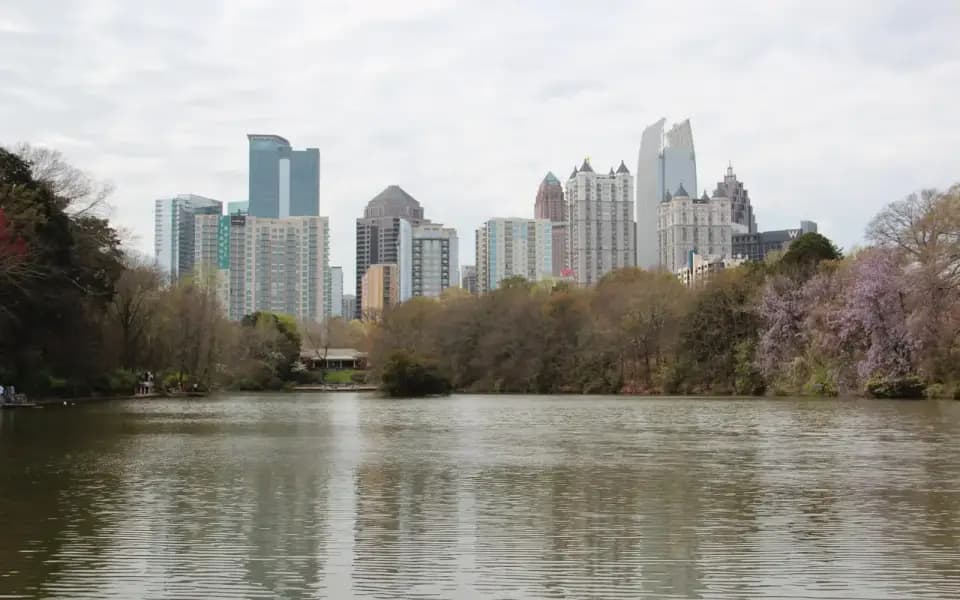
The Midtown skyline rising out of the tree canopy beyond Piedmont Park, with the paved BeltLine trail curving past murals, cyclists and food halls in old brick warehouses.

Atlanta is the South's big, green, sprawling capital: the birthplace of Martin Luther King Jr., the home of Coca-Cola and a city of leafy neighbourhoods tied together by an old railway loop turned walking trail. It rewards visitors who skip the freeways and explore it one district at a time.

Type
city
Ideal length
3–4 days
Getting around
MARTA trains for the airport, Downtown, Midtown and Buckhead; ride-hailing or a car for most other trips; walking or cycling on the BeltLine
Neighbourhoods
7 areas
Best season / months
April to May and October to early November, for warm days, low humidity and spring blossom or autumn colour
Language
English
Currency
US dollar ($)
Budget level
moderate — cheaper than New York or Washington, but tips and sales tax add up
Good for
  • First-timers
  • Families
  • History
  • Food
  • Music
  • Short city breaks
▸ Discover

About Atlanta

Atlanta sits in the rolling Piedmont foothills of north Georgia and spreads out in every direction from a compact core. Downtown holds the big visitor sights around Centennial Olympic Park, built for the 1996 Olympic Games. Just east is Sweet Auburn, the historic heart of Black Atlanta and the site of Martin Luther King Jr.'s birth home. North of Downtown, Midtown is the arts district around Piedmont Park, and further north Buckhead is the upscale shopping and business area. On the east side, the BeltLine's Eastside Trail links Old Fourth Ward, Inman Park and Ponce City Market. The tree cover is so dense that Atlanta calls itself the "city in a forest".

Why go

Atlanta tells the story of the civil rights movement where it happened: you can stand in the church where Dr King preached and see the house where he was born, a short walk apart (the house itself is closed for renovation; rangers give short talks about it next door). Around that history, it is a lively, young city with one of the best food scenes in the South, a world-class aquarium and an easy-going neighbourhood life along the BeltLine. It is also one of the best-connected airports in the world, which makes it an easy add-on to a wider US trip.

Don't miss

  • Martin Luther King Jr. National Historical Park — Historic Ebenezer Baptist Church and the street where Dr King was born
  • Georgia Aquarium — whale sharks and beluga whales Downtown
  • The Atlanta BeltLine Eastside Trail — murals, food halls and neighbourhoods
  • World of Coca-Cola — the drink's story in its home town
  • Piedmont Park and the Atlanta Botanical Garden in Midtown

Signature experiences

The civil rights story on Auburn Avenue — Start at the visitor centre of the Martin Luther King Jr. National Historical Park, then walk the few blocks of Auburn Avenue that shaped Dr King's life: the house where he was born, Historic Ebenezer Baptist Church where he co-pastored, and the King Center, where he and Coretta Scott King are buried on a brick plinth in a reflecting pool. Dr King's birth home is closed for renovation, so you can see it only from outside; park rangers give short talks about it in the bookshop next door several times a day, and the park's temporary visitor centre is at Historic Fire Station No. 6 — check nps.gov/malu for the latest before you go. Downtown, the National Center for Civil and Human Rights links the American movement to human rights struggles worldwide.

Big sights around Centennial Olympic Park — The park built for the 1996 Olympic Games is surrounded by Atlanta's headline attractions. The Georgia Aquarium is famous for its whale sharks and beluga whales, seen in huge tanks; World of Coca-Cola next door covers the drink's history and ends with a tasting room of sodas from around the world. In warm weather, children play in the Fountain of Rings between visits.

Walking the BeltLine — The Atlanta BeltLine is a planned 22-mile loop of trails and parks along old railway lines, with more than 16 miles open today. The Eastside Trail is the busiest stretch: walk or cycle from Piedmont Park past Ponce City Market and Historic Fourth Ward Park to Inman Park and Krog Street Market, with murals and patios all the way. It is the easiest way to see how the city lives.

Midtown's parks and arts — Piedmont Park is the city's main green space, with skyline views across the lake. The Atlanta Botanical Garden on its edge has the Kendeda Canopy Walk, a raised walkway about 40 feet up through the treetops of Storza Woods. A short walk away, the High Museum of Art is the South's leading art museum, and the Fox Theatre, a 1920s movie palace with a Moorish-style interior, still hosts shows.

Neighbourhoods

Atlanta neighbourhood by neighbourhood — the character of each and who it suits.

  • Downtown

    The business and convention core, built around a large green park and packed with big-ticket attractions and stadiums.

    Why go
    Most of Atlanta's headline sights stand on the edges of a single park.
    Best for
    Familiesattractionssportfirst-time sightseeing
    Known for
    Centennial Olympic Park and its Fountain of Rings, the Georgia Aquarium, World of Coca-Cola, the National Center for Civil and Human Rights, and Mercedes-Benz Stadium.
  • Sweet Auburn

    The historic district along Auburn Avenue that grew into the centre of Black business and church life in segregated Atlanta.

    Why go
    To understand the civil rights movement where Dr King was born, preached and is buried.
    Best for
    Historyreflectionguided ranger tours
    Known for
    The Martin Luther King Jr. birth home, Historic Ebenezer Baptist Church, the King Center with the tomb of Dr and Mrs King, and the Sweet Auburn Curb Market.
  • Old Fourth Ward

    A fast-changing neighbourhood on the BeltLine's Eastside Trail, mixing old brick warehouses, new apartments and a large lakeside park.

    Why go
    For the BeltLine at its liveliest and Ponce City Market in a former Sears building.
    Best for
    Walkingfood hallsstreet artcycling
    Known for
    Ponce City Market, Historic Fourth Ward Park, the Eastside Trail and the graffiti-covered Krog Street Tunnel on its southern edge.
  • Inman Park

    Atlanta's first planned suburb, a calm neighbourhood of restored Victorian houses and big trees on the east side.

    Why go
    For good restaurants, pretty streets and easy BeltLine access.
    Best for
    Diningstrollingarchitecturea quieter base
    Known for
    Its Victorian houses, Krog Street Market, and the Inman Park Festival and Tour of Homes each April.
  • Little Five Points

    The city's alternative corner — vintage shops, record stores, murals and late-night bars around one junction.

    Why go
    For independent shops and a scruffy, creative streak that contrasts with the glossier districts.
    Best for
    Vintage shoppingmusicpeople-watchingnightlife
    Known for
    Its junction of indie shops and murals, its record stores and live-music venues.
  • Midtown

    The arts and green-space district north of Downtown, with high-rises at its centre and leafy streets around Piedmont Park.

    Why go
    For the city's main park, its major museum and its historic theatre.
    Best for
    Museumsparksperformancesrunning
    Known for
    Piedmont Park, the Atlanta Botanical Garden, the High Museum of Art and the Fox Theatre.
  • Buckhead

    The upscale north of the city, with big shopping malls, office towers and grand houses on leafy streets.

    Why go
    For shopping, polished restaurants and the Atlanta History Center.
    Best for
    Shoppingfine dininghistory museums
    Known for
    The Atlanta History Center and Swan House, its large shopping malls, and its quieter residential streets.

Views & quieter corners

Best views

  • The Jackson Street Bridge — the classic view of the Downtown skyline above the freeway
  • Piedmont Park's lake and meadow — the Midtown skyline over the trees
  • The rooftop of Ponce City Market — views of the Downtown, Midtown and Buckhead skylines from the old Sears, Roebuck building

Quieter corners

  • Krog Street Tunnel — a short underpass covered in ever-changing graffiti
  • Oakland Cemetery — a historic garden cemetery with skyline views, next to Cabbagetown
  • The Sweet Auburn Curb Market — a long-running city market for a casual lunch
  • Cabbagetown — a small former mill village with shotgun houses and murals

Food & drink

Atlanta takes Southern food seriously and mixes it with everything else. Fried chicken, biscuits and shrimp and grits sit alongside chefs reworking Southern classics in Inman Park and Old Fourth Ward, and the food halls at Ponce City Market and Krog Street Market are good for a mixed group. Lemon pepper wings are a local obsession. Just north of the city line, Buford Highway is a long road of Korean, Vietnamese, Mexican and Chinese restaurants that locals swear by. The peach is the state's symbol, and Coca-Cola is the local soft drink by default.

  • Fried chicken — the Southern staple, often with collard greens and mac and cheese
  • Shrimp and grits — creamy ground-corn grits topped with shrimp
  • Lemon pepper wings — chicken wings tossed in lemon pepper, an Atlanta favourite
  • Biscuits — fluffy breakfast bread rolls, often with sausage gravy
  • Peach cobbler — baked Georgia peaches under a crumbly topping
  • Coca-Cola — the drink invented in the city, ordered without a second thought
Dietary notes

Vegetarian and vegan food is easy in Midtown, Old Fourth Ward and Little Five Points, and the food halls always have options. Traditional Southern cooking often uses pork or meat stock even in vegetable sides, so ask. Halal and kosher food is available but more spread out across the metro area; gluten-free is widely understood and often labelled on menus.

▸ Where you'll stay

Where you'll stay in Atlanta

Pick your base according to how you will get around. Downtown is the most convenient for the big attractions and for MARTA from the airport, but goes quiet in the evenings outside event nights. Midtown is the best all-round base: on the MARTA Red and Gold lines, close to Piedmont Park and the arts, with plenty of restaurants. Old Fourth Ward and Inman Park put you on the BeltLine and near the best eating, but you will rely on ride-hailing more. Buckhead suits shopping and a quieter, upscale stay further north.

  • Budget
    Downtown near Centennial Olympic Park many large chain hotels, walkable to the main attractions, on MARTA.
  • Mid-range
    Midtown on the MARTA Red and Gold lines, close to Piedmont Park, the High Museum and restaurants.
  • Luxury
    Buckhead or Midtown high-end hotels, top restaurants and shopping.
Stay

Hotels & rentals around Atlanta

Pan, zoom and compare live prices — every stay in one map.

We may earn a commission if you book through these links, at no extra cost to you. How we make money

▸ Getting around

Getting around Atlanta

MARTA's rail network has four lines — Red and Gold running north–south, and Blue and Green running east–west — meeting at Five Points in Downtown; tap a contactless bank card, a phone or watch wallet, or a Breeze card at the gates (one card per person; the Breeze Mobile app is for topping up, not for tapping). The Atlanta Streetcar runs a short Downtown loop past Sweet Auburn. Everywhere else, most visitors use ride-hailing; a car is useful only for trips out of town, and parking and traffic are real costs.

Downtown, Midtown and Buckhead are linked by the MARTA Red and Gold lines. The Atlanta Streetcar connects Centennial Olympic Park with Sweet Auburn. The BeltLine Eastside Trail connects Midtown and Piedmont Park with Old Fourth Ward and Inman Park on foot or by bike 30–45 minutes. Little Five Points is a short ride or walk from Inman Park.

▸ Plan your days

Suggested itineraries

Ready-made day plans for Atlanta — from a single day to a long weekend.

One day

Start in Downtown at Centennial Olympic Park, then spend the morning at the Georgia Aquarium. After lunch, take a short ride east to Sweet Auburn for the Martin Luther King Jr. National Historical Park, Historic Ebenezer Baptist Church and the King Center. In the evening, walk the BeltLine's Eastside Trail north to Ponce City Market for dinner.

Two days

Give day two to Midtown: a morning in Piedmont Park and the Atlanta Botanical Garden, then the High Museum of Art. Take a ride-hailing car to Inman Park for an afternoon on the Eastside Trail, the Krog Street Tunnel and Krog Street Market, then catch a show at the Fox Theatre or a drink in Little Five Points.

Three days

Choose between World of Coca-Cola and the National Center for Civil and Human Rights Downtown in the morning, then take MARTA north to Buckhead for the Atlanta History Center and Swan House. Finish with a walk through Oakland Cemetery and Cabbagetown, or dinner on Buford Highway.

▸ What you'll do

Insider tips

  • Atlanta has dozens of streets with "Peachtree" in the name — check the full street name (and whether it is Street, Road or Avenue) before you set off.
  • Hartsfield-Jackson is huge; the airport advises arriving at least two hours before domestic and three hours before international flights, and you may need the Plane Train to reach your concourse.
  • Pollen season in early spring can coat cars in yellow dust — bring allergy medication if you are sensitive.
Explore

Explore the area

© OpenFreeMap · OSM · terrain Mapterhorn
Do

Local attractions & tours

Skip-the-line tickets and small-group tours in Atlanta — compare across our partners.

▸ Budget

What it costs in Atlanta

Backpacker
A hostel or budget hotel, MARTA, food-hall meals and the free civil rights sites keep daily costs low, though hotel prices jump during big events.
Mid-range
expect several paid entries, rides and a sit-down meal with tax and tip to add up quickly.
Luxury
easily several times the mid-range spend.
Cash vs card
Cards and contactless payments are accepted almost everywhere; cash is only handy for tips and the odd market stall.
Tipping
Expected, not optional, in sit-down restaurants and bars, plus tips for taxis and hotel staff. Prices are shown before sales tax.
▸ When you'll go

When to visit Atlanta

April to May and October to early November, for warm days, low humidity and spring blossom or autumn colour

Spring

What to expect — March to May is warm and green, with dogwood and azalea blossom across the city — and very heavy tree pollen in early spring, which can be hard for hay-fever sufferers. Rain showers are common.

What's best — The city at its prettiest, with festivals in Piedmont Park such as the Atlanta Dogwood Festival in April.

Summer

What to expect — June to August is hot and very humid, with frequent afternoon thunderstorms. Outdoor sightseeing gets tiring by midday.

What's best — Long evenings on the BeltLine and patios, and air-conditioned museums and the aquarium for the hottest hours. Do the outdoor parts early, the indoor parts after lunch.

Autumn

What to expect — September is still warm and sticky, but October and November turn drier and more comfortable, with good autumn colour in the parks.

What's best — Probably the best time to visit — easy walking weather, college football season and the leaves turning on the BeltLine.

Winter

What to expect — December to February is mild by UK standards, but grey days and cold snaps happen, and occasional ice can bring the city's roads to a stop.

What's best — Low hotel prices outside big events, quiet museums and the aquarium at its least crowded on weekdays.

▸ Know before you go

Know before you go

Honest swaps

Skip driving the Downtown Connector at rush hour → take MARTA to Downtown, Midtown and Buckhead, and save the car for out-of-town trips.

Skip a whole day of paid attractions Downtown → split the day with the free Martin Luther King Jr. National Historical Park a short ride east.

Skip an expensive chain dinner Downtown → eat at the food halls of Ponce City Market or Krog Street Market, or on Buford Highway.

Crowds & timing

Big conventions, concerts and games at Mercedes-Benz Stadium fill Downtown hotels and push prices up — check the event calendar before booking.

The Georgia Aquarium is busiest at weekends, on holidays and in summer; go on a weekday, early or late in the day. Online tickets are for a set arrival time, and the dolphin and sea lion presentations need a reservation on the day.

Local rules & etiquette

Atlanta is built for cars: walking between distant neighbourhoods is rarely practical, and pavements can end abruptly away from the centre.

Use normal big-city caution after dark around quiet parts of Downtown and near some MARTA stations; stick to busy streets or take a ride-hailing car.

On the BeltLine, keep right and watch out for cyclists and e-scooters sharing the paved trail.

After dark

Midtown has the most varied nightlife, from cocktail bars to the Fox Theatre.

Old Fourth Ward and Inman Park are about BeltLine patios and late dinners.

Little Five Points and East Atlanta Village are the grungier bar and live-music districts.

Downtown comes alive on game and concert nights, but goes quiet otherwise.

▸ Ready to book your trip?

Getting there

Hartsfield-Jackson Atlanta International Airport (ATL), south of the city, is one of the busiest airports in the world. MARTA Red and Gold line trains leave from Airport station, the southern end of both lines, and reach Downtown in 20 minutes and Midtown in 30. Amtrak trains use Peachtree station in the north of the city.

Book

Ready to book your trip?

Flights, airport transfers and car hire — search and compare without leaving the page.