← Albania
ALBANIA · CITY

Berat

Two rare Ottoman-era Albanian towns — Berat, the 'city of a thousand windows', and stone-roofed Gjirokastra.

  • City
  • April to June and September to October — mild; hot summers, cool winters
  • ~approx 1–2 days
  • City of a Thousand Windows
  • Inhabited Castle
  • Ottoman White Quarters
  • Osum River

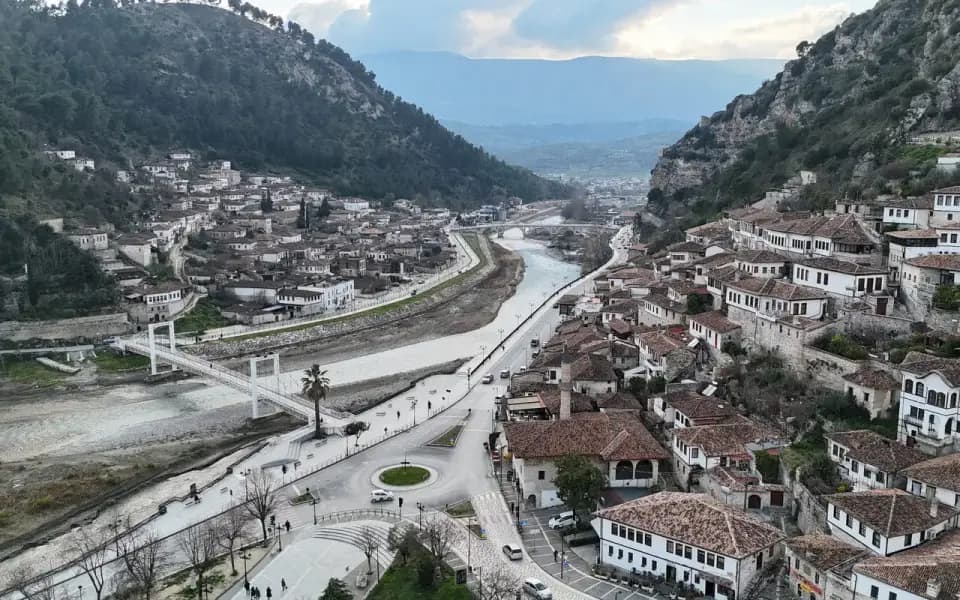
Row upon row of white stone houses with rank on rank of wooden windows climbing a hillside above a river, a castle on the height where families still live among centuries-old churches, and an old arched bridge linking two mirror-image quarters of white and stone.

Berat is the "city of a thousand windows" — a UNESCO Albanian town where tiers of white Ottoman houses stacked up two hillsides stare across the Osum river, crowned by a still-inhabited castle full of Byzantine churches and mountain views.

Type
town
Ideal length
~approx 1–2 days
Getting around
on foot — steep and cobbled; a car for the canyon
Neighbourhoods
3 areas
Best season / months
April to June and September to October — mild; hot summers, cool winters
Language
Albanian (some English and Italian)
Currency
Albanian lek (L)
Budget level
low — very affordable
Good for
  • History
  • Ottoman architecture
  • Photography
  • Balkan trips
  • Slow travel
▸ Discover

About Berat

Berat sits on the Osum river in central Albania, in a valley between mountains. One of the country's oldest and most beautiful towns, it kept a remarkable Ottoman-era townscape — two historic quarters, Mangalem and Gorica, facing each other across the river, their steep hillsides packed with white stone houses whose many large wooden windows, stacked in tiers, earned Berat its nickname, "the city of a thousand windows." Above Mangalem, a castle (the Kalaja) crowns the hill — unusually, still inhabited, a living neighbourhood within medieval walls, dotted with Byzantine churches and an icon museum. A UNESCO site (with Gjirokastër), atmospheric and welcoming, Berat is a highlight of Albania.

Why go

Berat is one of the loveliest and best-preserved Ottoman towns in the Balkans — a UNESCO city whose tiered white houses climbing two hillsides above the Osum, the "thousand windows," make an unforgettable sight, and whose still-inhabited hilltop castle, with its Byzantine churches and the icons of Onufri, is remarkable. It has atmospheric cobbled quarters, an old bridge, mosques and churches side by side, good Albanian food and wine, and the dramatic Osum canyon and mountains nearby. Beautiful, affordable and still under-touristed, it rewards travellers exploring the Balkans.

Don't miss

  • The "thousand windows" — the tiered white houses of Mangalem
  • Berat Castle (Kalaja) — the inhabited hilltop citadel
  • The Byzantine churches and Onufri icons — in the castle
  • The Gorica quarter and the old bridge — across the river
  • The Osum river and the mountains — the setting

Signature experiences

The thousand windows — Berat's unforgettable sight is its townscape — the steep hillside of the Mangalem quarter (and Gorica across the river) packed with white stone Ottoman houses whose rank on rank of large wooden windows, stacked in neat tiers, give the town its nickname, "the city of a thousand windows." The effect, especially in the low light of morning or evening, or seen from across the Osum, is remarkable. Wander the cobbled lanes of Mangalem, climbing between the white houses toward the castle, and cross to Gorica for the classic view back. The whole white town is the experience.

The inhabited castle — Crowning the hill above Mangalem is the Kalaja, Berat's castle — and unusually, it's still lived in, a genuine neighbourhood of stone houses and cobbled lanes within the medieval walls, where families have carried on for centuries. Wander its lanes to find a scatter of Byzantine churches (some open, some ruined), the cathedral housing the Onufri Icon Museum (with the vivid icons of the 16th-century master Onufri), the ruins of mosques, and viewpoints over the town, the river and the mountains. It's a living, layered, atmospheric place, and the highlight of the town.

Two faiths, one town — Berat's history has left a distinctive religious harmony — Orthodox Christian churches and Ottoman mosques stand close together (the town has long had both Muslim and Christian communities), and the castle's Byzantine churches, the Onufri icons, and Mangalem's mosques (the Lead Mosque, the King Mosque) all speak to that layered heritage. Albania's tradition of religious tolerance is felt here. Between the churches, the icons and the mosques, the town's mixed, coexisting past adds depth to its beauty.

Albanian flavours and the Osum — Berat eats Albanian, a Balkan-Mediterranean-Ottoman cuisine — byrek (savoury filo pies), tavë kosi (baked lamb with yoghurt, a national dish), qofte and grilled meats, fërgesë (a peppers-and-cheese dish), and plenty of olive oil, vegetables and dairy, with raki (fruit brandy) and good, cheap Albanian wine (the Berat region has a wine tradition). And the town is the base for the dramatic Osum canyon (with rafting in season) and the surrounding mountains and villages. Eat tavë kosi, sip a raki, and get out to the canyon and the hills.
Neighbourhoods

Berat neighbourhood by neighbourhood — the character of each and who it suits.

  • The Castle (Kalaja)

    The still-inhabited hilltop citadel above Mangalem — a living neighbourhood of stone houses within medieval walls, dotted with Byzantine churches, an icon museum, and viewpoints over the town and valley. The historic, elevated heart.

    Why go
    The inhabited castle, the Byzantine churches, the Onufri icons and the views.
    Best for
    The castlechurchesthe icon museumviews
    Known for
    The Berat Castle (Kalaja) and its lived-in lanes and houses, the Byzantine churches (Holy Trinity and others), the Onufri Icon Museum in the cathedral, the mosque ruins, and the panoramas over Berat and the Osum valley.
  • Mangalem and the Old Town

    The Ottoman quarter on the steep hillside below the castle — the famous tiers of white houses with their many windows, cobbled lanes, mosques and the old bazaar. The picturesque core.

    Why go
    The "thousand windows," the cobbled lanes and the mosques.
    Best for
    The white housesphotographywanderingthe bazaar
    Known for
    The tiered white "thousand windows" houses, the cobbled Mangalem lanes climbing to the castle, the Lead Mosque and King Mosque, the old bazaar and Ethnographic Museum, and the riverfront.
  • Gorica and the River

    The quieter white quarter across the Osum, linked by an old arched stone bridge — its own tiers of white houses facing Mangalem, with riverside lanes and views. The mirror-image, riverside quarter.

    Why go
    The Gorica houses, the old bridge and the river views.
    Best for
    The old bridgequieter lanesriver viewsphotography
    Known for
    The Gorica quarter's white houses facing Mangalem, the old Ottoman stone bridge (Gorica Bridge), the riverside lanes, and the classic view of Mangalem and the castle from across the water.

Views & quieter corners

Best views

  • The "thousand windows" of Mangalem from across the river
  • The castle's viewpoints over the town and the Osum valley
  • The Gorica quarter and the old bridge
  • The white houses in the low morning or evening light

Quieter corners

  • The Onufri Icon Museum's vivid 16th-century icons
  • The lived-in lanes and Byzantine churches inside the castle
  • The old Ottoman Gorica Bridge over the Osum
  • Tavë kosi and byrek at a local restaurant
  • The Osum canyon and the mountains beyond

Food & drink

Berat eats Albanian — a Balkan-Mediterranean-Ottoman blend, rich in olive oil, vegetables and dairy. The staples are byrek (savoury filo pies of cheese, spinach or meat), tavë kosi (a national dish of baked lamb or veal in a yoghurt-and-egg custard), qofte (meatballs) and grilled meats, fërgesë (peppers, tomato and cheese), and plenty of salads, cheese and bread. The Berat region has a wine tradition, so local wine and raki (fruit brandy) accompany. Eat in the old-town restaurants, and try tavë kosi and byrek.

  • Tavë kosi — baked lamb or veal in a yoghurt-and-egg custard, the national dish
  • Byrek — savoury filo pies (cheese, spinach or meat)
  • Qofte — grilled or fried meatballs
  • Fërgesë — a baked dish of peppers, tomato and cheese
  • Grilled meats and salads — the everyday staples
  • Albanian wine and raki — the local drinks
Dietary notes

Vegetarians do reasonably well — cheese and spinach byrek, fërgesë, vegetable dishes, salads, cheese and bread — though meat features in the mains; ask. Vegan is workable with vegetable dishes and breads (check for dairy/egg). Halal is available given the Muslim community; kosher is effectively unavailable. Gluten-free is hard around byrek and breads — grilled meats, tavë kosi (check), and salads help, but confirm.

▸ Photos

Berat in photos

▸ Where you'll stay

Where you'll stay in Berat

Stay in a restored Ottoman house guesthouse in Mangalem or Gorica for the atmosphere — many of the white "thousand windows" houses are now lovely guesthouses, with wooden interiors and views, atmospheric and very affordable. Staying inside the castle is possible too. It's a compact, steep, cheap town best on foot, and a base for the Osum canyon. Book ahead for summer. The Ottoman-house guesthouses are the characterful choice.

  • Budget
    Mangalem / Gorica guesthouses and hostels in the old white houses.
  • Mid-range
    Restored Ottoman houses guesthouses in the white "thousand windows" houses with views.
  • Luxury
    The best boutique guesthouses high-end restored Ottoman houses, the top of a modest range.
Stay

Hotels & rentals around Berat

Pan, zoom and compare live prices — every stay in one map.

We may earn a commission if you book through these links, at no extra cost to you. How we make money

▸ Getting around

Getting around Berat

The old town is compact but steep and cobbled — Mangalem, Gorica and the castle are all on foot (wear proper shoes; the castle is a climb). A car or tour is useful for the Osum canyon and the mountains; a car is a liability in the narrow old lanes.

Mangalem, Gorica and the castle are all a short (steep) walk apart, linked by the old bridge (~approx); the Osum canyon and the mountains are drives out — plan those with a car or tour.

▸ Plan your days

Suggested itineraries

Ready-made day plans for Berat — from a single day to a long weekend.

One day

Wander the cobbled lanes of Mangalem among the white "thousand windows" houses, climbing to the castle (Kalaja) — the inhabited citadel, the Byzantine churches, and the Onufri Icon Museum, with the viewpoints over the town and valley. Have a tavë-kosi lunch, cross the old Gorica bridge for the classic view back at Mangalem and the castle, and explore the quieter Gorica quarter. End with the white houses lit at dusk and dinner in the old town.

Two days

With an overnight (in an Ottoman-house guesthouse), add the canyon and the region. Give a day to the dramatic Osum canyon (rafting in the spring season) and the surrounding mountains and villages, and enjoy Berat's white quarters, castle and food at a slower pace. Berat also pairs with the UNESCO town of Gjirokastër and the Albanian coast on a wider route.

▸ What you'll do

Insider tips

  • Cross the Gorica bridge for the classic view of Mangalem's "thousand windows."
  • Give the inhabited castle (Kalaja) time — the Byzantine churches and Onufri icons are the highlights.
  • Eat tavë kosi and byrek, and try the region's wine and raki.
  • Stay in a restored Ottoman-house guesthouse, and get out to the Osum canyon.
Explore

Explore the area

© OpenFreeMap · OSM · terrain Mapterhorn
▸ Budget

What it costs in Berat

Backpacker
roughly €18–35 a day.
Mid-range
roughly €35–70 a day.
Luxury
€130 a day and up.
Cash vs card
Carry Albanian lek for the old town, food, taxis and small guesthouses; cards work in bigger hotels and some restaurants; euros are sometimes accepted.
Tipping
Tipping is modest — round up or leave around 10% for good service.
▸ When you'll go

When to visit Berat

April to June and September to October — mild; hot summers, cool winters

Spring

What to expect — Mild and green, the valley fresh and the river high, warming through the season with the odd shower. One of the best times.

What's best — Comfortable weather for the steep town and the castle, green surroundings and blossom, and fewer crowds — a lovely, easy season; the Osum canyon is best for rafting with the spring melt.

Summer

What to expect — Hot and dry, and busier with visitors; the white houses bright and the evenings warm, the river low. Warm and lively.

What's best — Long light on the white "thousand windows," warm evenings in the old town, and the summer season — but it's hot midday, so explore the town and castle early and late.

Autumn

What to expect — Warm easing to mild, the summer crowds fading and the light golden, with the wine and olive harvest. One of the best times.

What's best — Comfortable weather for the town and the mountains, the harvest and wine season, golden light on the white houses, and thin crowds — a rewarding window.

Winter

What to expect — Cool and often wet, with grey, rainy spells and the odd bright day, and a quiet town; the mountains sometimes snowy. The off-season.

What's best — The white town atmospheric and near-empty, mild days for the castle and old town between showers, and low prices — pack a layer and a waterproof; it's the quiet time.

▸ Know before you go

Know before you go

Honest swaps

Skip only photographing from the street → cross the Gorica bridge for the classic view of the "thousand windows."

Skip a tourist-menu meal → eat tavë kosi and byrek in a local restaurant, with an Albanian wine.

Skip a rushed castle visit → the Kalaja is a living neighbourhood with Byzantine churches and icons; give it time.

Skip a town-only visit → the Osum canyon and the mountains are a beautiful day out.

Crowds & timing

Berat is still under-touristed but busier in summer and at weekends — book ahead then; it's calm the rest of the year.

The white houses and the views are loveliest in the low morning and evening light.

Local rules & etiquette

The town is steep and cobbled — wear proper shoes for the climbs (and the castle).

Dress respectfully at the mosques and churches; the town's religious harmony is part of its character.

A little Albanian or Italian helps; the Albanian welcome is warm.

Money

Carry lek for the old town, food and small guesthouses; cards cover bigger hotels; euros are sometimes taken at poor rates.

Use bank ATMs; the town is affordable, so carry cash for the market and entries.

After dark

The old-town restaurants, the riverfront and a few bars hold the gentle evening life.

Berat is a relaxed, small town rather than a nightlife hub — the evening is tavë kosi, a raki and a lamplit stroll among the white houses.

The lit white quarters and castle at night are lovely.

▸ Ready to book your trip?

Getting there

Berat has no airport; Tirana (TIA) is the gateway, around two hours away by road, with buses and furgons (minibuses) reaching the town. Most arrive by road.

Book

Ready to book your trip?

Flights, airport transfers and car hire — search and compare without leaving the page.