Maputo
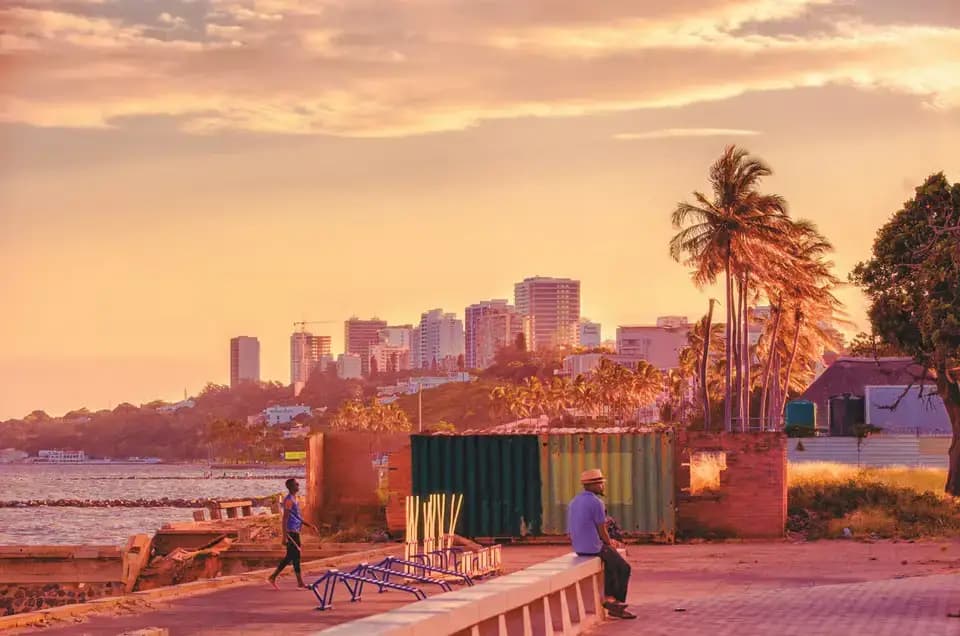
the capital, on a bay in the far south, with a Portuguese-era centre and the bay's seafood. Most international flights land here. The FCDO says street crime is common in Maputo, so we use taxis after dark rather than walking.
Africa
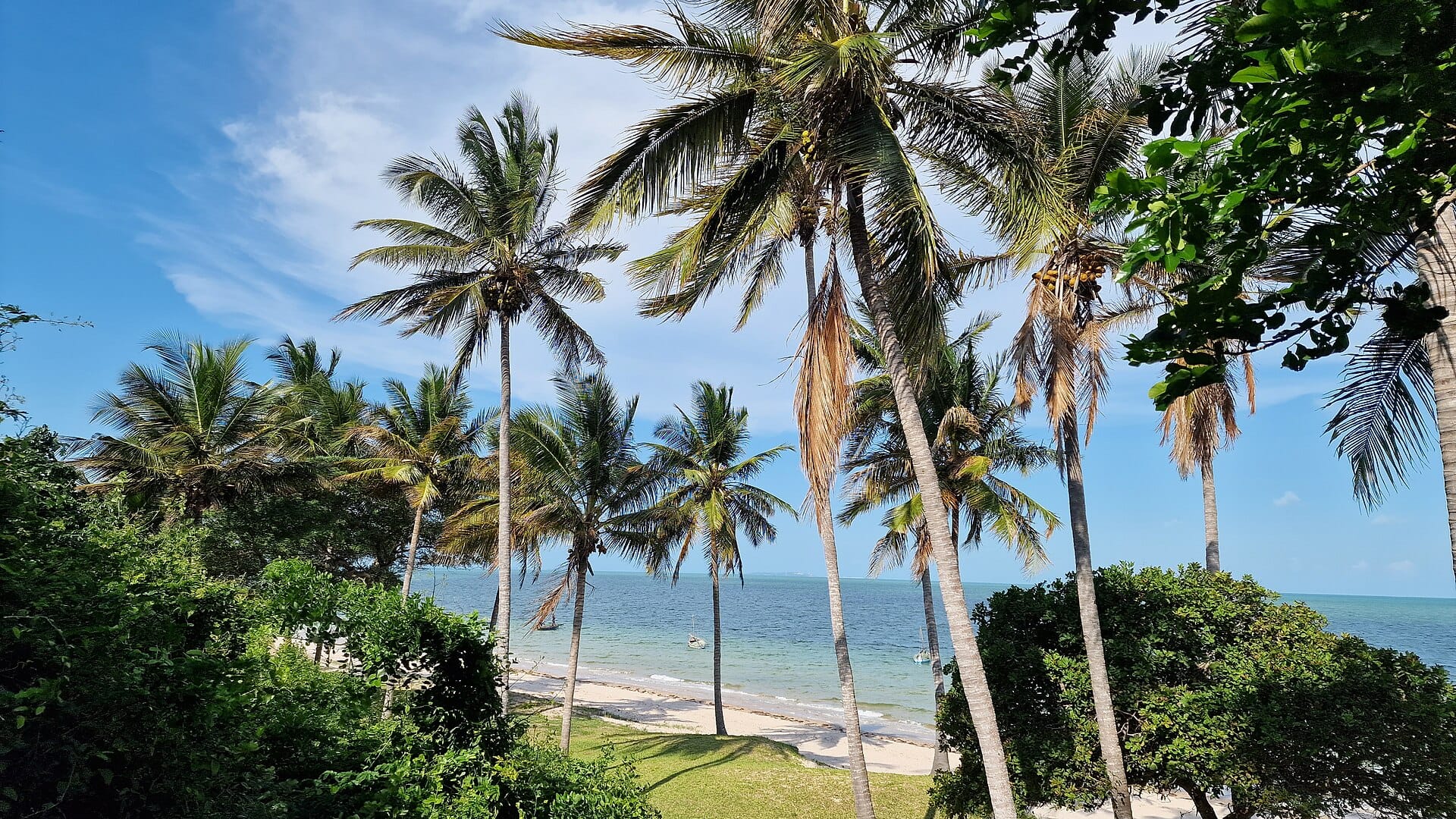
A long Indian Ocean coast of beaches, islands and diving, from Maputo and Tofo to the Bazaruto Archipelago and the Island of Mozambique.
FCDO advises against all travel to parts of Mozambique
FCDO advises against all but essential travel to parts of Mozambique
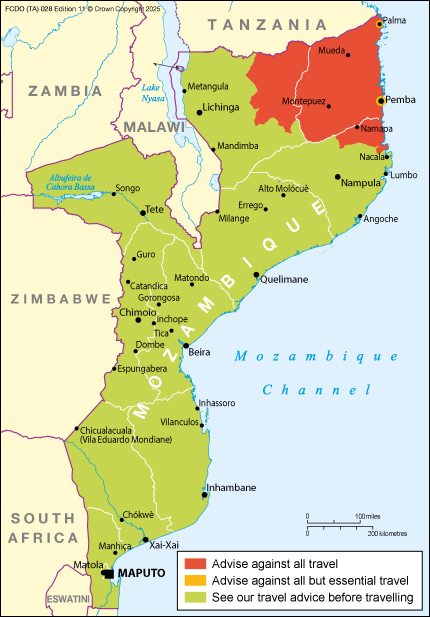
Source: UK Foreign, Commonwealth & Development Office — the definitive source. Check it close to your travel dates.
Flight cancelled or delayed because of this? Your rights under UK261 / EU261 →
A long Indian Ocean coast of beaches, islands and diving, from Maputo and Tofo to the Bazaruto Archipelago and the Island of Mozambique.
Mozambique runs for a very long way down the Indian Ocean coast of southern Africa, and most visitors come for that coast: warm water, offshore islands, seafood and a mix of African, Arab and Portuguese history you can still see in the buildings. It takes more planning than its neighbours. Flights connect, roads are slow, and the far north has serious security problems, so we plan trips around the south, the centre and the Island of Mozambique, and check the FCDO advice before booking anything.
the capital, on a bay in the far south, with a Portuguese-era centre and the bay's seafood. Most international flights land here. The FCDO says street crime is common in Maputo, so we use taxis after dark rather than walking.
Ponta do Ouro, close to the South African border, and Tofo, near the old town of Inhambane, are the beach and diving bases of the south. Our stay near Inhambane is Sussurro.
a group of islands off Vilankulo, protected as a national park, with dhow trips, snorkelling and a handful of island lodges such as andBeyond Benguerra Island. Vilankulo has its own airport.
in Sofala province in the centre, and one of Africa's best-known wildlife recoveries. The park's own advice is to fly to Beira, then drive about four hours (200 km) to Chitengo camp; the park can arrange the transfer, and Air Gorongosa flies charters into the park.
a small coral island in Nampula province, joined to the mainland by a causeway, and a UNESCO World Heritage site since 1991. Its stone town and reed-roofed macuti town were built the same way for five centuries. Our Island of Mozambique guide has the detail; the nearest airport is Nampula.
The far north: the Quirimbas Archipelago lies off Cabo Delgado province, where the FCDO advises against all travel (apart from Palma town and the area around Pemba and Afungi, which are all but essential travel only). We are not recommending it while that advice stands, and we do not recommend the advise-against districts of Niassa province either, which take in much of the Niassa Special Reserve.


The single reason many travellers come back — the food culture worth reshaping a trip around, and the dishes to seek out region by region.
Piri-piri prawns off the grill and Portuguese bread on the side — the Indian Ocean coast at its most delicious.
Mozambique's kitchen is where Africa, Portugal and the Indian Ocean meet. On the coast that means seafood and fire: fat prawns and crayfish split and grilled, then lashed with piri-piri — the bird's-eye chilli, garlic, lemon and vinegar sauce this country gave the world. You eat them with your fingers, a cold 2M beer sweating on the table, Portuguese bread rolls to mop the juices.
Away from the grill the flavours turn deeper: matapa, cassava leaves stewed slow with ground peanuts and coconut milk, often with prawns folded through and spooned over rice. Five centuries of Portugal left prego steak rolls and rissóis prawn pastries on every corner; the northern coast leans Swahili-spiced, the south more Lisbon. Coconut, cassava leaf and chilli — taste those three and you've tasted Mozambique.
Maputo
The capital, on a bay in the far south, with a Portuguese-era centre.
The south coast
The beach and diving bases of the south: Tofo near the old town of Inhambane, and Ponta do Ouro close to the South African border.
Off Vilankulo
Islands protected as a national park, with dhow trips, snorkelling and a handful of island lodges. Vilankulo has its own airport.
Sofala
One of Africa's best-known wildlife recoveries. The park's advice: fly to Beira, then drive about four hours (200 km) to Chitengo camp; it can arrange the transfer.
Nampula
A coral island joined to the mainland by a causeway and a UNESCO World Heritage site since 1991, with a stone town and a reed-roofed macuti town.
There are no direct flights from the UK. The simplest route is via Johannesburg: British Airways flies there from London in about 11 hours, and Airlink flies on from Johannesburg to Maputo and to Vilankulo, and to Beira for Gorongosa. TAP flies to Maputo from Lisbon and Ethiopian Airlines from Addis Ababa. Within the country, the national airline, LAM (now AirMozambique), links Maputo with Inhambane, Vilankulo, Beira, Chimoio and Nampula. Distances are long and the FCDO advises travelling by road outside the cities in daylight only, so we fly the long hops. If you drive, a UK photocard licence is valid for up to 90 days, and you must carry two warning triangles and reflective vests; police checks are frequent.
Best Jun–Aug · Shoulder Apr, Oct–Nov
Units
Forecast · Met Office · updated 13 Nov · Powered by Met Office data
Typical · climate data
May – September (dry season)
Units
What to expect — Daytime highs average about 28°C with overnight lows near 19°C.
What's best — Warm & dry, then Warm, then Shoulder season. Sep and Oct are among the best months here (warm & dry, sunny).
What to expect — Daytime highs average about 30°C with overnight lows near 23°C — the wettest stretch of the year.
What's best — Wet, then Warm.
What to expect — Daytime highs average about 28°C with overnight lows near 20°C.
What's best — Shoulder season, then Warm, then Warm & dry. Apr and May are among the best months here (warm, sun and cloud).
What to expect — Daytime highs average about 25°C with overnight lows near 15°C, and it stays largely dry.
What's best — Warm & dry. Jun, Jul and Aug are among the best months here (warm & dry, sunny).

Our climate data for Maputo shows average highs of about 25°C in June and July, rising to about 30°C from December to February, so it is warm rather than very hot. The dry season, May to September, is the best time: July and August average around 10 mm of rain each. The wet season brings much more, about 144 mm in December and 183 mm in February. The FCDO says cyclones and floods are common in the rainy season from November to April, when roads, including in Maputo, can flood at short notice; INAM, the national weather service, and Météo-France's cyclone centre on La Réunion issue the warnings.
| Area | J | F | M | A | M | J | J | A | S | O | N | D |
|---|---|---|---|---|---|---|---|---|---|---|---|---|
| Maputo | 30 | 30 | 30 | 28 | 27 | 25 | 25 | 26 | 28 | 28 | 29 | 30 |
Colours as on the month tiles above. Bold: hot, 32°C or more (go early or late in the day). Outlined: very hot, 35°C or more. Wet: 150 mm of rain or more.
To read what you're looking at — the empires and eras that shaped Mozambique's food, art and streets.
The coast eats seafood: prawns grilled with piri-piri, crab curry with coconut, and matapa, cassava leaves stewed with peanut and coconut. Portuguese rolls and pastries are everywhere, and 2M is the local beer, though drinking alcohol on public beaches is illegal. The Chopi timbila, xylophone orchestras from the south, are on UNESCO's list of Intangible Cultural Heritage, and marrabenta is the dance music you will hear in Maputo.
British citizens need an Electronic Travel Authorisation (ETA) for tourist visits of up to 30 days. Apply and pay on the official portal, evisa.gov.mz, at least five working days before you travel; you cannot pay at the border. The FCDO puts the fee at about US$47. Your passport needs six months' validity on arrival and two blank pages, and you may be asked for proof of accommodation, an onward ticket and funds. The currency is the metical (MT), issued by the Banco de Moçambique; US dollars and South African rand are the easiest to exchange, Mastercard is not always accepted, and you must carry your passport at all times, as police will not accept copies.
Read the FCDO travel advice for Mozambique in full. As of 28 October 2026 it advises against all travel to most of Cabo Delgado, to the Memba and Eráti districts of Nampula and to the Mecula and Marrupa districts of Niassa, and warns of a terrorist threat in the north, protests that can start at short notice, carjacking and kidnap for ransom, mainly in Maputo. Malaria risk is high across the country and TravelHealthPro recommends antimalarials; there is also a cholera outbreak in central and northern areas.
Read the FCDO's travel advice for Mozambique travel guide before booking and again before you go; it changes, and it is the official word on safety and entry.
We write this guide from official sources only: GOV.UK, national immigration portals, tourism boards, airports and operators, central banks and met services. Rules change, so check the linked pages before you book.
The practical back-matter — safety, drones and the essentials, in one place.
Official UK Foreign, Commonwealth & Development Office guidance is the definitive source — check it close to your travel dates.
National parks, protected sites and religious/heritage venues often have their own rules and permits — always check the specific site before you fly.