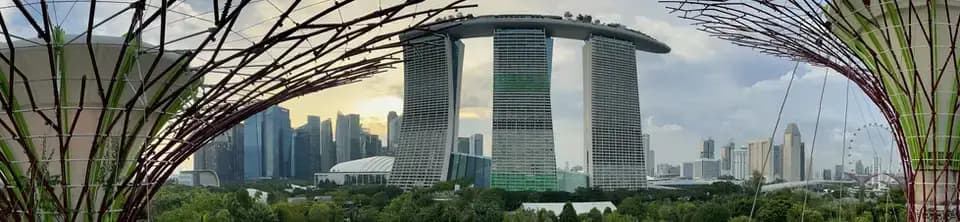
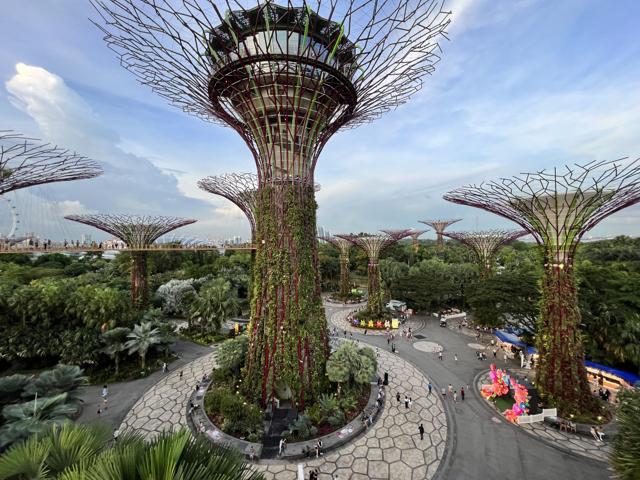
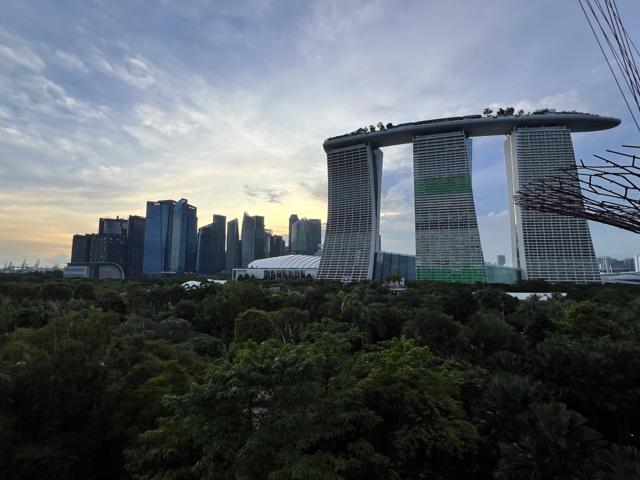
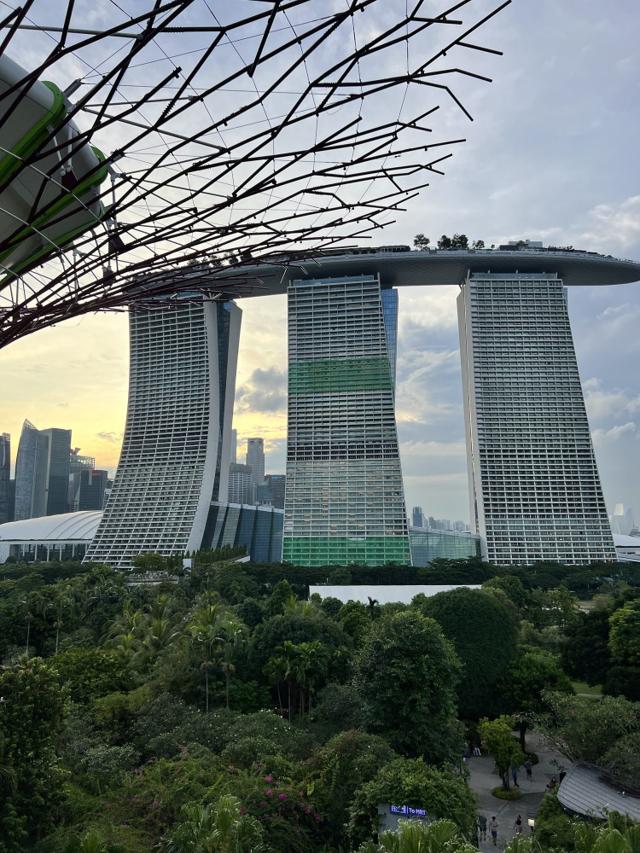
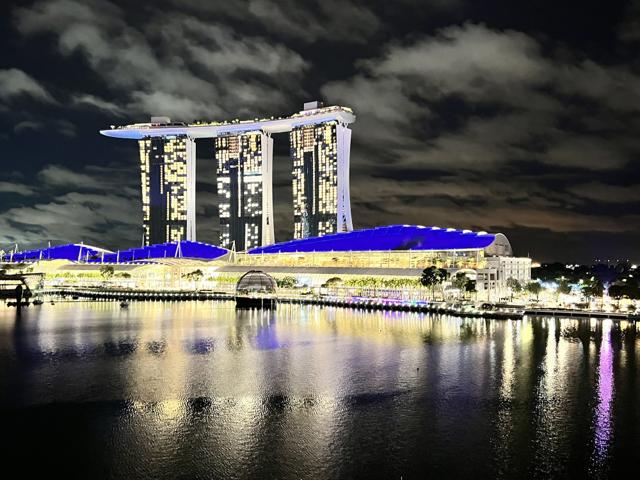
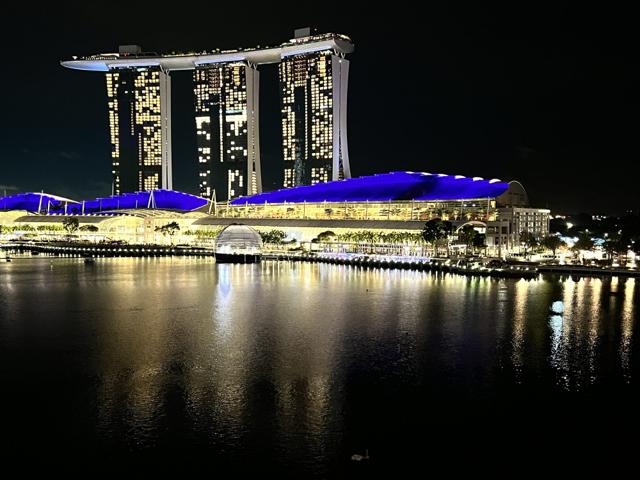
Supertree canopies framing Marina Bay Sands and the Singapore skyline at dusk, Gardens by the Bay

Asia

Singapore

A key air hub for Asia and Oceania, with direct flights to about 170 cities: supertrees and rooftop pools, and hawker centres serving four food cultures.

Currency
Singapore Dollar (SGD)
Language
English, Malay, Tamil, Chinese
Best time
February – March
Visa
Visa-free for tourism; the immigration officer decides how long you can stay (normally 30 to 90 days). Complete the electronic SG Arrival Card in the 3 days before you arrive. Passport valid 6 months from arrival

The FCDO has no advisory against travel to Singapore.

Still current at: 13 November 2026 Updated: 19 March 2026

Source: UK Foreign, Commonwealth & Development Office — the definitive source. Check it close to your travel dates.

Flight cancelled or delayed because of this? Your rights under UK261 / EU261 →

City guide Explore the Singapore city guide → Neighbourhoods, getting around, where to stay, food and tickets — the on-the-ground guide to the city.
Regional hub

Singapore as a regional hub

Changi is one of Asia's major air hubs: close to 100 airlines fly direct from it to about 170 cities, around 7,000 flights a week. Most UK visits are short, too (62–77% of UK visitors stay three days or fewer, depending on the season), so Singapore works well for a night or three before or after the rest of a trip in Asia or Oceania.

Changi's network
Direct flights to about 170 cities, close to 100 airlines, around 7,000 flights a week (Changi, Oct 2026)
From the UK
About 13 hours nonstop from Heathrow, Gatwick or Manchester
Entry
Visa-free for British citizens; submit the free SG Arrival Card in the 3 days before you land
Airport to Marina Bay
About 30 minutes by taxi; the MRT runs from Changi from about 05:30
Short layover
A free 2.5-hour city tour for transit passengers with 5.5 to 24 hours between flights

How long have you got?

  1. Under 5 hours Stay airside. Changi's transit areas have a butterfly garden, a free cinema and rest areas, and the Changi Transit Hotel has rooms airside in Terminals 1, 2 and 3, so you do not clear immigration.
  2. 5.5 to 24 hours Book the Free Singapore Tour: 2.5 hours by coach with a guide, run by the airport for transit passengers whose bags are checked through. Register at the booth in the T2 or T3 transit area, at least 90 minutes before the tour.
  3. About 7 hours or more Go on your own. Allow about an hour to leave the plane and clear immigration, 30–45 minutes each way into town, and two hours back at the airport before departure. That leaves two or three hours in the city.
  4. Overnight to 3 nights Enter Singapore, stay near Marina Bay and follow one of the plans below. Jewel, the glass dome beside Terminal 1, is landside, so it fits best on the way back.

The time guide in the third row is our own working, not an official figure. Changi recommends at least 5 hours of transit time just to visit Jewel.

UK arrivals peak in February and March, when 75–77% of UK stays are three days or fewer and over-55s make up just over half of UK visitors. That fits a stop before or after travel elsewhere in Asia or Oceania, although the figures do not record where visitors go next. Sources: Changi Airport Group, Q3 2026 operating indicators (19 Oct 2026); Singapore Tourism Board (Stan), visitor arrival statistics, 2016–2026. Analysis by mynext.holiday.

Plan your stop

Singapore in 24, 48 or 72 hours

  • 24 hours

    Marina Bay from the afternoon heat to the evening shows, then breakfast in Chinatown before the flight.

    See the 24-hour plan →
  • 48 hours

    Day one as above. Day two: the Botanic Gardens, a museum for the hottest hours, and the Night Safari.

    See the 48-hour plan →
  • 72 hours

    Add the heritage quarters and an afternoon on Sentosa.

    See the 72-hour plan →
Where next

Pair it with…

Changi's five busiest routes are Kuala Lumpur, Jakarta, Bali, Bangkok and Shanghai (Changi, Q3 2026), and its network reaches across Southeast and Northeast Asia, Australia and New Zealand. These are the onward destinations we cover, all with direct flights from Changi.

Flight times are approximate nonstop scheduled times from timetable listings checked on 9 November 2026. They vary by airline and season.

Why visit

Why Singapore

A key air hub for Asia and Oceania, with direct flights to about 170 cities: supertrees and rooftop pools, and hawker centres serving four food cultures.

  • Gardens by the Bay
  • Universal Studios Sentosa
  • Night Safari zoo
  • Marina Bay light show
Read more

Singapore is a key air hub for Asia and Oceania. Close to 100 airlines fly direct from Changi Airport to about 170 cities, some 7,000 flights a week, and its busiest routes run to Kuala Lumpur, Jakarta, Bali, Bangkok and Shanghai. Add a skyline of supertrees and rooftop infinity pools and a street-food culture drawn from four cuisines, and it is an easy base for a night or three before or after the rest of your trip.

Getting in and out is simple. British passport holders can visit without a visa, the city centre is about 30 minutes from the airport by taxi, and Changi runs a free 2.5-hour city tour for transit passengers with 5.5 to 24 hours between flights. Spend one to three nights near Marina Bay and you can see the main sights before flying on to Bali, Thailand, Vietnam, Australia or New Zealand.

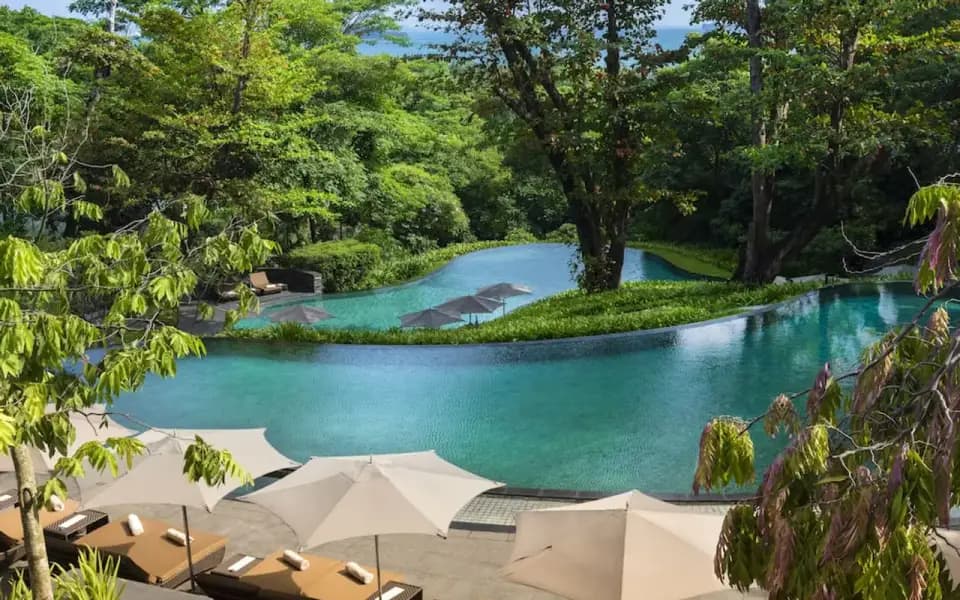
Green space runs through the high-rise city, from the nature reserves to the UNESCO-listed Singapore Botanic Gardens and Gardens by the Bay. Chinatown, Little India and Kampong Glam keep the city's Chinese, Malay and Indian roots on show, and the hawker centres, some with stalls listed in the Michelin Guide, serve all of them under one roof.

A pillar, not a footnote

Eat your way through Singapore

The single reason many travellers come back — the food culture worth reshaping a trip around, and the dishes to seek out region by region.

Singapore

Four cultures, one hawker centre — chicken rice, chilli crab and laksa, world-class food off a plastic tray.

Lunchtime in a Singapore hawker centre is a controlled riot: hundreds of stalls under one roof, a packet of tissues 'choping' your seat, and the smoke of satay drifting over queues that move with quiet purpose. This is a city where four food cultures — Chinese, Malay, Indian and the Peranakan fusion the first two invented between them — share a single food court, and where a stall can hold a Michelin star while the plate still costs a few dollars.

The unofficial national dish is Hainanese chicken rice, poached chicken laid over rice cooked in its own broth, deceptively plain and completely addictive. Then there's chilli crab eaten with your hands, its sweet-hot sauce mopped up with fried buns; laksa, rice noodles in a rich coconut-curry soup; and the deep, dark Peranakan stew ayam buah keluak. Breakfast is its own institution — kaya toast with coconut jam, soft-boiled eggs and a thick, sweet kopi. The whole point is the mixing: order fish head curry and it comes Indian-fiery or Chinese-mild, the very same dish told two ways.

Dishes to seek out
  • Hainanese chicken rice
  • chilli crab
  • laksa (coconut-curry noodles)
  • char kway teow (fried flat noodles)
  • satay (grilled skewers)
  • ayam buah keluak (Peranakan chicken)
  • kaya toast (breakfast set)
Do

Local attractions & tours

Top tickets in Singapore. The full list, by neighbourhood and interest, is in the Singapore city guide.

All tickets in the Singapore city guide →

Plan your own trip to Singapore
Guides

All our Singapore guides

Short stays

Where to stay for one or two nights

On a short stay, location beats everything. Marina Bay and the Civic District put the evening shows, the river and the MRT on your doorstep. For a very early flight, sleep at the airport.

  • Marina Bay. Beside Gardens by the Bay and the evening shows. The most expensive area.
  • Clarke Quay and Robertson Quay. On the river, central, with MRT stations on several lines.
  • Chinatown or Bugis. Cheaper rooms and hawker food nearby, often in smaller rooms.
  • Changi Airport. For a late arrival or an early departure: see the airport hotels above.
Airport & transit

Changi: arriving, transiting and getting into town

Before you fly

  • Entry: British citizens can visit without a visa. GOV.UK says the immigration officer decides how long you can stay, normally 30 to 90 days. Your passport must be valid for 6 months from the date you arrive.
  • SG Arrival Card: submit it online in the 3 days before you arrive, on the ICA website or the MyICA app. It is free. ICA warns that it does not endorse sites that charge a fee.
  • Free Singapore Tour: you can pre-book one tour up to 50 days ahead. Passengers can enter and leave Singapore only once during a layover.

Into town

  • MRT: from Changi Airport station, change at Tanah Merah for the East-West Line, or at Expo for the Downtown Line. First trains leave at 05:31 Monday to Saturday and 05:59 on Sundays and public holidays. Pay by tapping a contactless bank card or phone; an admin fee applies to foreign-issued cards.
  • Taxi: about 30 minutes to the city, S$25–45 on the meter plus an airport surcharge (S$8 from 5pm to midnight, S$6 at other times). Grab and other ride-hailing apps pick up at every terminal.

Sleeping at the airport

  • Changi Transit Hotel is airside, in the transit areas of Terminals 1, 2 and 3, so you do not clear immigration.
  • YOTELAIR is in Jewel, landside: you clear immigration, and the minimum booking is 4 hours.
  • Crowne Plaza Changi Airport is a landside hotel linked to the terminals.

Jewel

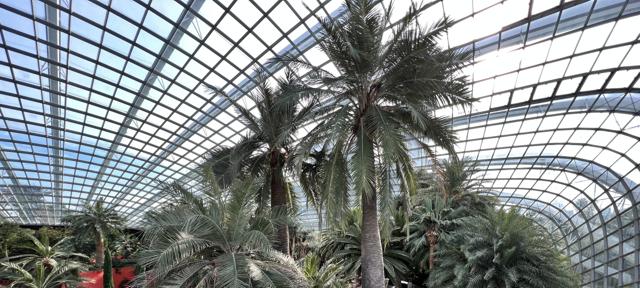
Jewel is the glass dome beside Terminal 1, linked by bridges to Terminals 2 and 3 and by shuttle bus to Terminal 4. It is landside: transit passengers must clear immigration to visit. The Rain Vortex runs from 10am to 10pm, with light-and-sound shows in the evening. Check in for your flight at least 2 hours before departure.

When to go

Weather & timing in Singapore Right now RIGHT NOW 30°C drizzle

Best Feb–Mar, Jul · Shoulder Jan, Aug–Sep

Units

Next 7 days

Forecast · Met Office · Powered by Met Office data

Typical · climate data

Best time to visit

February – March

Best for
  • Street Food
  • Skyline
  • Gardens
  • Cultural Fusion
At a glance
Sunshine 9.2 hr/day
Rainfall 290 mm/mo
Wettest November · 402.4mm
Driest February · 145.1mm
Part of Southeast Asia →
By season

Units

Spring (Mar–May)

What to expect — Daytime highs average about 30°C with overnight lows near 25°C, with plenty of rain.

What's best — Warm & humid. Mar is among the best months here (warm & humid, some showers).

Summer (Jun–Aug)

What to expect — Daytime highs average about 29°C with overnight lows near 25°C, with plenty of rain.

What's best — Warm & humid. Jul is among the best months here (warm & humid, some showers).

Autumn (Sep–Nov)

What to expect — Daytime highs average about 30°C with overnight lows near 24°C — the wettest stretch of the year.

What's best — Warm & humid. Sep is among the best months here (warm & humid, some showers).

Winter (Dec–Feb)

What to expect — Daytime highs average about 30°C with overnight lows near 23°C, with plenty of rain.

What's best — Warm & humid. Feb is among the best months here (warm & humid, some showers).

Live forecast map · Windy.com · temperature with wind, °C and km/h

When to go for a short stay

Best weather
February to early March. February is the driest month, with the fewest thunderstorm days. November to January are the wettest months; April and May have the most thunderstorms.
Busiest
July and August. Arrivals run about 12–18% above the yearly average, and hotels are about 90% full.
Hotels cheapest
May and June. Average room rates run a few per cent below the yearly average. Expect slightly cheaper, not bargain prices.
Hotels dearest
The Grand Prix month (September or October). Average room rates in the F1 month run about 13–15% above the yearly average.
UK visitors
February and March. UK arrivals peak then, about a third above the UK monthly average, mostly on short stays. UK families tend to come at Easter and in the summer holidays.

Crowds and hotel prices: Singapore Tourism Board (Stan), visitor arrival and hotel statistics, 2023–25 average. Weather: Meteorological Service Singapore, Changi climate normals 1991–2020. Analysis by mynext.holiday.

A little context

A little history

To read what you're looking at — the empires and eras that shaped Singapore's food, art and streets.

A sleepy fishing island until Stamford Raffles made it a free British trading port in 1819
its place on the strait between the Indian and Pacific oceans drew Chinese, Malay, Indian and Arab traders whose descendants make up the multi-ethnic city
a brutal Japanese occupation in WWII and independence from Malaysia in 1965 forged a fierce self-reliance
one lifetime turned a small port into a gleaming global financial hub
Formula 1

Grand Prix weekend in Singapore

Formula 1 season calendar: every race →

Local events

What's on in Singapore

See all Singapore events →
Before you book

Know before you go

The practical back-matter — safety, drones and the essentials, in one place.

Safety

No FCDO advisory against travel FCDO advice →

Official UK Foreign, Commonwealth & Development Office guidance is the definitive source — check it close to your travel dates.

Drone rules (sub-250g)

  • Singapore
    A sub-250g drone needs no registration and a tourist can fly it recreationally, but only in approved areas below 60m and clear of the island's many no-fly zones; anything heavier must be registered with CAAS first. ⚠ Most of Singapore sits inside a 5km airport no-fly buffer, and the iconic spots (Marina Bay, Sentosa, the parks) are no-fly or need an Activity Permit, so a permit is required for essentially every scenic flight — check the CAAS map before flying. Rules checked: Jul 2026

National parks, protected sites and religious/heritage venues often have their own rules and permits — always check the specific site before you fly.

The essentials

Plug & voltage Type C/G/M · 230V
Daily budget Expensive
Region South-Eastern Asia